Title: The Enchanted Cottage (1945)
Director: John Cromwell
Language: English
Rating: Not Rated
Oliver Bradford (Robert Young) is a WWII vet who suffered disfiguring injuries. Laura Pennington (Dorothy McGuire) works as a maid (and also has a strong talent for wood-carving art). Pretty much everyone dismisses her as plain. Oliver and Laura become friends and marry for companionship, but some time after their wedding they begin to perceive each other as beautiful, as if a transformation has come over their physical appearance.
There are a few things I like about this movie:
- Generally good acting, especially a touching performance from McGuire, showing Laura's kindness and profound sadness and loneliness, a burning desire to be loved combined with the torment of knowing that it's highly unlikely. Herbert Marshall also puts in a lovely appearance as a blind pianist (who lost his sight in the First World War), and Mildred Natwick is surprising as a housekeeper who could have been a creepy Mrs. Danvers type of figure, but instead is supportive of other people's love even though her own prospects for happiness were bitterly thwarted.
- The movie shows the perniciousness of pity – not just self-pity, but also treating another person as pitiable rather than helping them see what's good, blessed, and possible in their lives, and doing so in a way that isn't condescending.
- I also liked how the movie depicted the uneasiness around "ugly people." This uneasiness exists in the filmmakers themselves and in the audience. The two main characters are what can be called "Hollywood ugly." Oliver hardly looks like the Phantom of the Opera, and while Laura does look remarkably more plain in comparison to her physically transformed self, she still has a facial structure and figure for conventional beauty. In the romantic moments between the couple, we see them as they see each other – the loved one rendered physically beautiful. Would the audience have enjoyed watching them kiss passionately if they were both still shown in their plainer state?
It lifted off from a chair-back,
Beating a smooth course for the right window
And clearing the sill of the world.
- Richard Wilbur, "The Writer"
Showing posts with label romance. Show all posts
Tuesday, August 4, 2020
Saturday, December 7, 2019
Six Fun Movies to Watch During the Holiday Season
A few years ago, I made a similar post, which will give you several more recommendations. These movies aren't themed for the winter holidays, but they're fun to watch on a cold night with a warm drink, like hot apple cider with rum, and they're (mostly) family-friendly. (Yes, even The Maltese Falcon can be fun for the whole family... why not.)
Title: Cinderella (1997)
Director: Robert Iscove
Language: English
Rating: G
This is a Rodgers & Hammerstein musical adaptation of Cinderella, set in a pretty Disney version of a European town. The stepmother's house looks like it's made of stained glass and melted crayons. I like how vivid all the colors are in this one, including the lush blues and purples of the ballroom scene.
The cast is vibrant. Whitney Houston plays the fairy godmother, Bernadette Peters is the stepmother, Whoopi Goldberg is the queen (an opinionated lady who makes squeaking noises of dismay), and Jason Alexander (best known as George Costanza on Seinfeld) is a royal servant with an Italian-ish accent and a song-and-dance number about the upcoming ball.
Paolo Montalban is cute as the prince, and Brandy Norwood plays a lovely, fragile-looking, and sometimes vacant-looking Cinderella. I like how, even before the prince finds her at the end, she decides to leave home, knowing that she deserves a better life than the one she has with her stepmother and stepsisters.
Title: How to Steal a Million (1966)
Director: William Wyler
Language: English and some French
Rating: Not rated
This movie has the absurdity of a screwball comedy. The leads, Audrey Hepburn and Peter O'Toole, associate under highly improbable circumstances and look beautiful while doing so. (O'Toole is so damn charming here. Reminds me a little of Peter Wimsey - intelligent, doesn't appear to take much seriously, but is more serious than he appears.)
Anyway, Hepburn plays Nicole, the daughter of an art forger who passes himself off as an art collector. He's a Wizard of Oz type of scoundrel. One thing leads to another, and Nicole realizes that to keep her father's crimes from being discovered, she'll have to steal a statue he loaned to a museum. Simon (Peter O'Toole's character) arrives on the scene as a burglar who may be able to help her. Or so she thinks.
Labels:
crime,
laughter,
magic,
movies,
musicals,
mystery,
relationships,
romance,
worth watching
Thursday, April 5, 2018
Week in Seven Words #394
fantastical
We lean on each other as the train sways. Our feet adjust to accommodate the extra weight of the other person, and I smile to think we're like a four-legged, two-headed creature.
lighter
He's best to be with when he's feeling soft-hearted and full of fun. The years drop from him, and he wants a laugh and good company.
longing
Etta James is calling for a Sunday kind of love through the speakers of his laptop.
long-suffering
She looks fragile in the driver's seat of the SUV and in the pale wash of its interior light. The courage in her comes out in a tired smile.
magnifico
It's the sort of day where the highlight is hearing "Bohemian Rhapsody" at the supermarket. Not a lackluster cover band performing it, but Queen itself.
tablecloth
The lake looks like it's covered in brown oilcloth and dribbles of spilled pea soup.
traits
"Money doesn't change you," he says, "it just shows you who you already are." So if someone turns mean and stingy (or kind and generous) when they acquire money, did they have those tendencies all along?
Thursday, May 4, 2017
Austen's Persuasion and exploration of intimacy in conversation
Something that jumped out at me while reading Jane Austen's Persuasion for the Classics Club Challenge was the exploration of intimacy in conversation.
Throughout Persuasion, Anne Elliot and Frederick Wentworth barely speak to each other. When they do, it's pained small talk conducted in public. They have a significant shared history and much to say to each other, but they don't speak. They mostly notice each other, wordlessly. Or they hear about each other through what other people say. But there are social and personal barriers between them.
What they need isn't public conversation anyway. Conversation overheard by other people often comes across as silly, insignificant, or misguided in this book.
Look at Admiral and Sophy Croft, for instance. They're a model for happily married couples, well-matched and walking side-by-side through life (and on-board ship). Their conversations are almost never overheard publicly. You see them spending a lot of time together, heads together, but rarely does the reader hear what they say to each other. (The one significant time a conversation of theirs takes place in front of other people is when Anne briefly shares their curricle - and in that scene, the Admiral's observation about how Frederick should choose one of the Musgrove girls isn't a sensible one.) Their most meaningful exchanges are private, where even the reader can't access them.
So, Anne and Frederick aren't meant to have conversations for public consumption. But how do they get to the place where they can talk privately?
There's the letter at the end. Some say it's Frederick's letter, but really he's writing it in collaboration with Anne, based on what she's telling someone else in the room. It's a joint effort. And it's what brings down the barrier, because a letter is private, wholly, and introduces space for intimate conversation between them at last.
(That letter also makes me think of Anne drawing a bow back, throughout the book. Frederick's the arrow. She slowly brings him to a place where he can fly forward true in his intentions.)
Friday, February 12, 2016
Five Older Movies to Watch on Valentine's Day
Or on other days. I watched these in the last year and a half, and have been meaning to write about them. This list is an excuse to. They're all quite different from each other, and make an interesting mix.
Title: The African Queen (1951)
Director: John Huston
Language: English (and a little German and Swahili)
Rating: PG
This is a fun, uncomplicated movie set in German East Africa during the start of World War I. Charlie Allnut (Humphrey Bogart) is a grungy, adorably monkey-faced Canadian steamboat captain who delivers mail and other supplies in the area. Rose Sayer (Katharine Hepburn) is a stern and decorous British missionary who needs to get out of German territory.
In Charlie, there are echoes of previous characters Bogart has played - men who want to sit out a war and stay neutral. Rose, on the other hand, is determined to use Charlie's steamboat to make an unexpected strike at the Germans. Hepburn combines in her the spirit of a warrior with the demeanor of a prim spinster. She and Allnut fall in love, and their wedding ceremony is funny (and brief). Along with Hepburn and Bogart's performances, another reason to watch the movie is that it was filmed mostly in Africa, with great difficulty.
Title: Design for Living (1933)
Director: Ernst Lubitsch
Language: English (and some French)
Rating: Unrated
A good Lubitsch movie is like champagne. In this one, Gilda Farrell (Miriam Hopkins) illustrates ads for a living and meets two impoverished artists on a train: a painter, George Curtis (Gary Cooper), and a playwright, Tom Chambers (Frederic March), who is quick to tell her, "I write unproduced plays. I'm very good at that kind." She becomes their critic, driving them towards commercial success. She's also deeply attracted to them, finding it difficult to choose one over the other, and who can blame her. As the movie progresses, the question changes from which one of them she should choose to why can't she have them both.
Design for Living is good-natured, witty, risqué, and really funny. Gilda has one other suitor in the movie, Max Plunkett (Edward Everett Horton), who presents a safe, respectable and also soul-killing choice, as they have no compatibility. Should someone settle for safety as a mere escape from difficult decisions and intriguing, unconventional possibilities?
Wednesday, September 18, 2013
The Thin Man (1934): Murder, wit, and martinis
Title: The Thin Man
Director: W.S. Van Dyke
Language: English
Rating: Unrated
There are few movie couples more fabulous than Nick and Nora Charles. Their electric banter, chemistry, and continuous boozing make for great entertainment.

Nick (William Powell) is a retired private eye whose only ambition now is to enjoy the wealth of his heiress wife, Nora (Myrna Loy), a "lanky brunette with a wicked jaw" (his words). They're very much in love, rib each other constantly, and enjoy drinking and doting on their terrier, Asta. But as they're taking a trip to NYC at the start of the film, they're approached by Dorothy Wynant (Maureen O'Sullivan), the daughter of a crotchety, absent-minded inventor who once worked with Nick. She doesn't know where her father is, and as the movie progresses, it appears he's in trouble - first because he's gone on a trip without telling anyone where, and secondly because he's implicated in a murder.
The movie is clever and funny with great dialogue. And while Nick and Nora are the ones who truly shine, there's also an amusing cast of supporting characters made up of crooks, greedy opportunists, soft-hearted romantics, a young man who's overly attached to his mother, and police officers who aren't so much stupid as unimaginative. Nick gets pulled into the mystery surrounding the case, and Nora both helps out and watches, concerned and entertained. The climax of the movie is a dinner party where all the suspects (and police) are invited.
Whimsical, funny, doesn't take itself seriously - it's a great movie to relax with.

*The images link back to their source (Flixster Community).
Director: W.S. Van Dyke
Language: English
Rating: Unrated
There are few movie couples more fabulous than Nick and Nora Charles. Their electric banter, chemistry, and continuous boozing make for great entertainment.
Nick (William Powell) is a retired private eye whose only ambition now is to enjoy the wealth of his heiress wife, Nora (Myrna Loy), a "lanky brunette with a wicked jaw" (his words). They're very much in love, rib each other constantly, and enjoy drinking and doting on their terrier, Asta. But as they're taking a trip to NYC at the start of the film, they're approached by Dorothy Wynant (Maureen O'Sullivan), the daughter of a crotchety, absent-minded inventor who once worked with Nick. She doesn't know where her father is, and as the movie progresses, it appears he's in trouble - first because he's gone on a trip without telling anyone where, and secondly because he's implicated in a murder.
The movie is clever and funny with great dialogue. And while Nick and Nora are the ones who truly shine, there's also an amusing cast of supporting characters made up of crooks, greedy opportunists, soft-hearted romantics, a young man who's overly attached to his mother, and police officers who aren't so much stupid as unimaginative. Nick gets pulled into the mystery surrounding the case, and Nora both helps out and watches, concerned and entertained. The climax of the movie is a dinner party where all the suspects (and police) are invited.
Whimsical, funny, doesn't take itself seriously - it's a great movie to relax with.
*The images link back to their source (Flixster Community).
Labels:
detectives,
greed,
movies,
murder,
mystery,
relationships,
romance,
worth watching
Tuesday, May 7, 2013
Worth Watching: Born Yesterday (1950)
Title: Born Yesterday
Director: George Cukor
Language: English
Rating: PG
In Born Yesterday, Billie Dawn (Judy Holliday) slowly emerges from the 'dumb blonde' persona she's buried herself under for years in order to get by in life. At the start of the movie, she's arrived in Washington, D.C. with her boyfriend, Harry Brock (Broderick Crawford), a crooked businessman who's trying to bribe his way to greater political influence. Brock was born in Jersey and is in the junk business, sort of a 1950s Tony Soprano.
Billie drifts through life with her mind turned off. She gets furs and jewels and verbal, and sometimes physical, abuse from Brock, who also uses her as an unwitting stooge for some of his deals. However, he finds that when they try to mingle in D.C. society, she comes across as too crass and ignorant. (So does he, but he thinks she's the only one who needs more polish.) His solution is to hire a journalist, Paul Verrall (William Holden), to teach her about culture and proper speech.
Paul gives Billie a lot of books, shows her historic sites in D.C., and talks to her like one human being to another. She starts to think for herself, and they fall in love.

I like that Billie isn't dumb; she just acts dumb. Once she becomes less ignorant and naive and learns to think for herself, she's a force to contend with. She's also still recognizably Billie, not some polished socialite (this isn't My Fair Lady). I also like that Paul isn't her 'white knight.' He doesn't charge in and rescue her or tell her what to do, other than to keep reading and thinking. She figures out what Brock is up to on her own and decides to leave on her own terms, while thinking of a plan for how to stop him; only then does she recruit Paul to be her accomplice.
Holden is a sweetheart as Paul, and Crawford plays Brock both as a comical ignoramus and as a genuine menace who only understands two kinds of power: money and physical force. But it's Holliday's performance that the movie rests on, and she holds it together. Like the movie as a whole, her performance is a skillful blend of comedy and drama, as seen in the way she can toss off a funny line and then, in a heartbeat, look lost and vulnerable. Not all performers, or movies, would handle these transitions well.
*The image links back to its source (Flixster Community).
Director: George Cukor
Language: English
Rating: PG
In Born Yesterday, Billie Dawn (Judy Holliday) slowly emerges from the 'dumb blonde' persona she's buried herself under for years in order to get by in life. At the start of the movie, she's arrived in Washington, D.C. with her boyfriend, Harry Brock (Broderick Crawford), a crooked businessman who's trying to bribe his way to greater political influence. Brock was born in Jersey and is in the junk business, sort of a 1950s Tony Soprano.
Billie drifts through life with her mind turned off. She gets furs and jewels and verbal, and sometimes physical, abuse from Brock, who also uses her as an unwitting stooge for some of his deals. However, he finds that when they try to mingle in D.C. society, she comes across as too crass and ignorant. (So does he, but he thinks she's the only one who needs more polish.) His solution is to hire a journalist, Paul Verrall (William Holden), to teach her about culture and proper speech.
Paul gives Billie a lot of books, shows her historic sites in D.C., and talks to her like one human being to another. She starts to think for herself, and they fall in love.
I like that Billie isn't dumb; she just acts dumb. Once she becomes less ignorant and naive and learns to think for herself, she's a force to contend with. She's also still recognizably Billie, not some polished socialite (this isn't My Fair Lady). I also like that Paul isn't her 'white knight.' He doesn't charge in and rescue her or tell her what to do, other than to keep reading and thinking. She figures out what Brock is up to on her own and decides to leave on her own terms, while thinking of a plan for how to stop him; only then does she recruit Paul to be her accomplice.
Holden is a sweetheart as Paul, and Crawford plays Brock both as a comical ignoramus and as a genuine menace who only understands two kinds of power: money and physical force. But it's Holliday's performance that the movie rests on, and she holds it together. Like the movie as a whole, her performance is a skillful blend of comedy and drama, as seen in the way she can toss off a funny line and then, in a heartbeat, look lost and vulnerable. Not all performers, or movies, would handle these transitions well.
*The image links back to its source (Flixster Community).
Tuesday, February 12, 2013
Worth Watching: Desk Set (1957)
Title: Desk Set
Director: Walter Lang
Language: English
Rating: Unrated
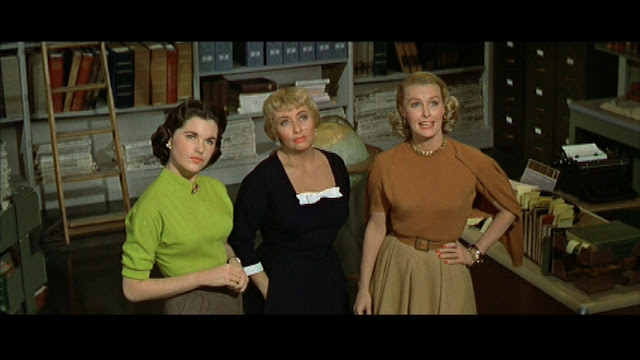
Desk Set is a charming office romance featuring Bunny Watson (Katharine Hepburn), the head research librarian at a major TV network, and Richard Sumner (Spencer Tracy), an engineer whose giant computer might cost Bunny and her team of librarians their jobs.
One description I read of this movie claimed that Bunny and Richard clash dramatically, but I didn't find this to be true. The movie shows them slowly getting comfortable with each other and developing a mutual respect; both of them are quirky, middle-aged nerds, and their romance is gentle.

Bunny has a boyfriend at the beginning of the movie - one of the network executives, in fact (played by Gig Young) - but he desires her more for her dependability and usefulness and less for her personal qualities. Richard, on the other hand, just likes her as she is and respects her work. Given that Desk Set was filmed in the 1950s, I was surprised that the movie did a fairly decent job portraying a group of smart, hard-working women in the workplace who are friends and colleagues. These ladies are also very snappy dressers.

The only woman whose portrayal was off-the-mark was Richard's finicky lab assistant, who collapses into unnecessary and unrealistic hysterics at one point, because the filmmakers thought it would be funny.
I enjoyed the giant computer, EMERAC - really a sign of the times, how huge this computer was. And though computers have become much smaller, and more powerful and multifunctional, the concern raised in this movie is still relevant today: In what ways will computers take the place of people in the workplace? The movie's answer to that is rather sophisticated; it really takes into consideration the kinds of jobs people perform and the limitations of computers.
What else did I like? Bunny's friendship with her most senior employee, Peg (Joan Blondell), and their fun at an office holiday party.

I'm glad I came across Desk Set. It's low-key, lovely, with some well-written conversations and memorable scenes (including a rooftop lunch combined with a test of memory and logic). The screenplay was written by Nora Ephron's parents, Phoebe and Henry; I'm not that familiar with their work or with Nora's, but if you're a fan, that's another reason to check out this movie.
*All images link back to their sources (The Movie Projector and Glamamor).
Thursday, January 17, 2013
Worth Watching: Midnight (1939)
Title: Midnight
Director: Mitchell Leisen
Language: English
Rating: Not rated
Eve Peabody (Claudette Colbert) is a quick-thinking American gold-digger who arrives in Paris on a rainy night, penniless but wearing an evening gown. She's picked up at the train station by a gruff taxi driver, Tibor Czerny (Don Ameche), and the two drive around the city and stop to have some food.

Though they're attracted to each other, Eve can't imagine getting involved with a taxi driver, so she flees his cab and crashes a late night recital attended by upper class notables including George Flammarion (John Barrymore), his wife, Helene (Mary Astor), and his wife's lover, Jacques Picot (Francis Lederer). Eve passes herself off as a noblewoman, and the only one who sees through her guise is George, who offers her money to break up his wife's affair by luring Jacques away. So Eve finds herself in a dilemma - should she marry Jacques, the wealthy playboy, or tenacious Tibor, who's been searching for her ever since she disappeared from his cab?

Colbert is charming and funny, and gives her character a hard edge too, as Eve tries to focus on the intrigue she's involved in and not get sentimental about anyone. The filmmakers seem determined that she and Tibor get together, but there are moments of troubled reflection on her part. Eve tells Tibor that her parents' marriage soured over money issues. And she can't imagine keeping house all day long as Tibor drives around in his taxi. Their conflicting outlooks on life are a real issue, but because this is a light-hearted comedy any concerns are swept away. They'll have their happily ever after even if it kills them.
The ending wasn't as funny as I'd hoped it would be (some parts of it made me cringe). You know how I wish the movie would have ended? With Eve and George teaming up as con artists and infiltrating royal palaces and embassies across Europe. I really liked the dynamic between Colbert and John Barrymore as co-conspirators.

Barrymore's performance in Midnight is deranged. The gears in his head are whirring a few seconds out of sync with everyone else's. He comes across as bored, rich, and off his rocker. In short, he's delightful.

He and Colbert are the highlights of this movie (along with Rex O'Malley playing Marcel, Helene's witty and effete confidant). The dialogue is funny, the characters play off of each other well, and even though Tibor and Eve's romance was problematic and didn't move me much, at least the comedy side in this comedy-romance was entertaining.
*All images link back to their source (Flixster Community).
Director: Mitchell Leisen
Language: English
Rating: Not rated
Eve Peabody (Claudette Colbert) is a quick-thinking American gold-digger who arrives in Paris on a rainy night, penniless but wearing an evening gown. She's picked up at the train station by a gruff taxi driver, Tibor Czerny (Don Ameche), and the two drive around the city and stop to have some food.
Though they're attracted to each other, Eve can't imagine getting involved with a taxi driver, so she flees his cab and crashes a late night recital attended by upper class notables including George Flammarion (John Barrymore), his wife, Helene (Mary Astor), and his wife's lover, Jacques Picot (Francis Lederer). Eve passes herself off as a noblewoman, and the only one who sees through her guise is George, who offers her money to break up his wife's affair by luring Jacques away. So Eve finds herself in a dilemma - should she marry Jacques, the wealthy playboy, or tenacious Tibor, who's been searching for her ever since she disappeared from his cab?
Colbert is charming and funny, and gives her character a hard edge too, as Eve tries to focus on the intrigue she's involved in and not get sentimental about anyone. The filmmakers seem determined that she and Tibor get together, but there are moments of troubled reflection on her part. Eve tells Tibor that her parents' marriage soured over money issues. And she can't imagine keeping house all day long as Tibor drives around in his taxi. Their conflicting outlooks on life are a real issue, but because this is a light-hearted comedy any concerns are swept away. They'll have their happily ever after even if it kills them.
The ending wasn't as funny as I'd hoped it would be (some parts of it made me cringe). You know how I wish the movie would have ended? With Eve and George teaming up as con artists and infiltrating royal palaces and embassies across Europe. I really liked the dynamic between Colbert and John Barrymore as co-conspirators.
Barrymore's performance in Midnight is deranged. The gears in his head are whirring a few seconds out of sync with everyone else's. He comes across as bored, rich, and off his rocker. In short, he's delightful.
He and Colbert are the highlights of this movie (along with Rex O'Malley playing Marcel, Helene's witty and effete confidant). The dialogue is funny, the characters play off of each other well, and even though Tibor and Eve's romance was problematic and didn't move me much, at least the comedy side in this comedy-romance was entertaining.
*All images link back to their source (Flixster Community).
Labels:
dishonesty,
driving,
false identity,
laughter,
money,
movies,
Paris,
romance,
worth watching
Thursday, May 31, 2012
Worth Watching: Swing Time (1936)
Title: Swing Time
Director: George Stevens
Language: English
Rating: G
Swing Time introduces Lucky Garnett (Fred Astaire) to Penny Carroll (Ginger Rogers), and they're obviously going to get married and dance together as long as they both shall live, but only after they work past several plot contrivances.
At the start of the movie Lucky has a fiancee, Margaret (Betty Furness); they treat each other like distant acquaintances. Penny is pursued for half the movie by a possessive band leader, Ricardo Romero (Georges Metaxa), who at times has the speech patterns of a Bond villain. In one scene he's gloating sedately and says to Lucky, "Hello, Lucky... or perhaps you should call me lucky today," and I started to picture him cradling and petting a white cat.
Maybe I imagined him as a Bond villain to make his character more interesting. You see, I wanted more from the romantic rivals in this movie. The filmmakers put them in enough scenes to make you think they matter, but by the end, Ricardo and Margaret might as well be made of cardboard. Even though people watch these movies for the musical numbers and for Rogers and Astaire's cuteness and chemistry (and those elements are strong enough to make Swing Time worth it), the filmmakers could have still treated story and character with more care.

Astaire's character is called Lucky because he's a gambler as well as a dancer. Most of the time he comes across as glib or bumbling, sort of likable but also flat. None of the gambling scenes in Swing Time is suspenseful, because the outcome is obvious each time and given the flimsiness of the plot it's not even that important anyway - you're just waiting for him to flirt with Rogers, sing to Rogers, or dance alone or with Rogers. And have Rogers sing to him, which she does a few times in the film.
The movie picks up when Rogers first appears as Penny, a dancer and dance teacher. One of the reasons she and Astaire were a good team was because they complemented each other. Rogers was a great dancer but didn't have nearly as extensive a background in dance or dance training as Astaire, who was incredible; however she was the better actor by quite a bit and could suggest depth, vulnerability, and inner conflict in her characters even in a movie like this one. She worked well with both drama and comedy, and pretty much every scene that spotlights her in Swing Time is entertaining. After Penny the most enjoyable character is her friend, Mabel (Helen Broderick), a middle-aged gal who's seen everything and takes pleasure in zinging people with witty lines.
Lucky and Penny first meet at a cigarette machine after Lucky's manager, Pop (Victor Moore), comes down with a bad craving ("I'd give my life for a smoke," he says). From that auspicious moment their relationship is expressed in some banter, some songs, and most notably through dance. I've been taking jabs at the silly parts of Swing Time so to be fair I'll emphasize now that the dance duets are wonderful and also beautifully highlight different stages in the Lucky-Penny relationship.
The first number, "Pick Yourself Up," is playful, light, and energetic, and my favorite of the three dance duets in the film. Penny has just gotten to know Lucky, and when she dances with him here he finally gives her a favorable impression of himself, after managing earlier in the film to annoy and humiliate her. I love the choreography, especially towards the end when they're leaping over the low barrier surrounding the dance floor. Rogers especially looks like she's floating, and I love her dress.

The second dance duet, "Waltz in Swing Time," is full of the grandness of love; they're no longer in the flirty getting-to-know you stage. This really is a beautiful number, with rich sound and abrupt changes in tempo, and watching them you feel like you're getting swept around the dance floor as well.

Then the third dance duet, "Never Gonna Dance," is a sorrowful wake-up call. They remember that Lucky hasa distant acquaintance a fiancee. Oh no. And Penny is going to give in to the charms of Ricardo Romero. So it's one last dance for the road, full of longing and things that can never be and a love that will go unfulfilled. The number unfolds on two different floors, with Astaire and Rogers dancing separately up a grand curving staircase in between.

Astaire also gets spotlighted in a solo dance number, "Bojangles of Harlem," a tribute to an incredible tap dancer, Bill "Bojangles" Robinson, who made cinematic history dancing alongside Shirley Temple in the 1930s in a few movies where he played tap-dancing servants (due to rampant racism, talented black entertainers of the time were by and large consigned to simpleton and/or servant parts when acting on-screen). Maybe it would have been nice to have gotten Robinson himself to appear in Swing Time and dance on his own too, because Astaire's dancing in the "Bojangles of Harlem" number doesn't resemble Robinson's (after looking it up, now I know why: Astaire's dancing style was inspired by John Bubbles, another innovative tap dancer).
On a positive note, the "Bojangles of Harlem" number is energetic and inventive; the best part is when Astaire is accompanied by three of his shadows, looming on the wall behind him and dancing right along with him. A great moment in movies and dance. The downside to the number is that it's in blackface. Actually Astaire's face is grayish, and he doesn't go for any racially stereotypical behaviors or physical characteristics, so he keeps it as classy as it can be. The most cringeworthy moment comes before Astaire starts dancing and involves a grotesque pair of giant legs hauled off the stage at the start of the number, with their shiny black shoes sporting a face on the soles.
What other musical numbers are there? A strong singing duet, "A Fine Romance," where Rogers shines (she's cute when she's in a strop), her performance giving richness to the cheerfully silly lyrics. Astaire gets to impersonate a seal. Incidentally another version of the song that I like is a duet with Ella Fitzgerald and Louis Armstrong. But Rogers and Astaire are the ones who first sang it, out on a snowy day.
I wish the movie as a whole would have been worthy of the musical numbers. There are good non-musical scenes and sparkling dialogue, but the plot is just ridiculous. Had the story been stronger, with more at stake, I think the musical scenes would have also been better: intensifying something that's already powerful. "Never Gonna Dance," for instance, might have been even more poignant had the romantic rivals in the movie possessed even the remotest chance of laying claim to Lucky and Penny.
Instead the musical numbers just pop in and out, not quite fitting in with everything else. They come, they go, ending too quickly, and it's back to the awkward plot contrivances and, towards the end, the long moments of forced laughter (I've seen this in other old movies, where the actors just laugh and laugh on screen, because it's supposed to show us that they're full of fun and joy, when really it sounds desperate, like they ran out of dialogue and now have to do something to tell us that things are funny and that we should laugh too). Fortunately Ginger Rogers and Helen Broderick help prop up the non-musical parts with some life and wit.
*All images link back to their sources (Rotten Tomatoes).
Director: George Stevens
Language: English
Rating: G
Swing Time introduces Lucky Garnett (Fred Astaire) to Penny Carroll (Ginger Rogers), and they're obviously going to get married and dance together as long as they both shall live, but only after they work past several plot contrivances.
At the start of the movie Lucky has a fiancee, Margaret (Betty Furness); they treat each other like distant acquaintances. Penny is pursued for half the movie by a possessive band leader, Ricardo Romero (Georges Metaxa), who at times has the speech patterns of a Bond villain. In one scene he's gloating sedately and says to Lucky, "Hello, Lucky... or perhaps you should call me lucky today," and I started to picture him cradling and petting a white cat.
Maybe I imagined him as a Bond villain to make his character more interesting. You see, I wanted more from the romantic rivals in this movie. The filmmakers put them in enough scenes to make you think they matter, but by the end, Ricardo and Margaret might as well be made of cardboard. Even though people watch these movies for the musical numbers and for Rogers and Astaire's cuteness and chemistry (and those elements are strong enough to make Swing Time worth it), the filmmakers could have still treated story and character with more care.
Astaire's character is called Lucky because he's a gambler as well as a dancer. Most of the time he comes across as glib or bumbling, sort of likable but also flat. None of the gambling scenes in Swing Time is suspenseful, because the outcome is obvious each time and given the flimsiness of the plot it's not even that important anyway - you're just waiting for him to flirt with Rogers, sing to Rogers, or dance alone or with Rogers. And have Rogers sing to him, which she does a few times in the film.
The movie picks up when Rogers first appears as Penny, a dancer and dance teacher. One of the reasons she and Astaire were a good team was because they complemented each other. Rogers was a great dancer but didn't have nearly as extensive a background in dance or dance training as Astaire, who was incredible; however she was the better actor by quite a bit and could suggest depth, vulnerability, and inner conflict in her characters even in a movie like this one. She worked well with both drama and comedy, and pretty much every scene that spotlights her in Swing Time is entertaining. After Penny the most enjoyable character is her friend, Mabel (Helen Broderick), a middle-aged gal who's seen everything and takes pleasure in zinging people with witty lines.
Lucky and Penny first meet at a cigarette machine after Lucky's manager, Pop (Victor Moore), comes down with a bad craving ("I'd give my life for a smoke," he says). From that auspicious moment their relationship is expressed in some banter, some songs, and most notably through dance. I've been taking jabs at the silly parts of Swing Time so to be fair I'll emphasize now that the dance duets are wonderful and also beautifully highlight different stages in the Lucky-Penny relationship.
The first number, "Pick Yourself Up," is playful, light, and energetic, and my favorite of the three dance duets in the film. Penny has just gotten to know Lucky, and when she dances with him here he finally gives her a favorable impression of himself, after managing earlier in the film to annoy and humiliate her. I love the choreography, especially towards the end when they're leaping over the low barrier surrounding the dance floor. Rogers especially looks like she's floating, and I love her dress.
The second dance duet, "Waltz in Swing Time," is full of the grandness of love; they're no longer in the flirty getting-to-know you stage. This really is a beautiful number, with rich sound and abrupt changes in tempo, and watching them you feel like you're getting swept around the dance floor as well.
Then the third dance duet, "Never Gonna Dance," is a sorrowful wake-up call. They remember that Lucky has
Astaire also gets spotlighted in a solo dance number, "Bojangles of Harlem," a tribute to an incredible tap dancer, Bill "Bojangles" Robinson, who made cinematic history dancing alongside Shirley Temple in the 1930s in a few movies where he played tap-dancing servants (due to rampant racism, talented black entertainers of the time were by and large consigned to simpleton and/or servant parts when acting on-screen). Maybe it would have been nice to have gotten Robinson himself to appear in Swing Time and dance on his own too, because Astaire's dancing in the "Bojangles of Harlem" number doesn't resemble Robinson's (after looking it up, now I know why: Astaire's dancing style was inspired by John Bubbles, another innovative tap dancer).
On a positive note, the "Bojangles of Harlem" number is energetic and inventive; the best part is when Astaire is accompanied by three of his shadows, looming on the wall behind him and dancing right along with him. A great moment in movies and dance. The downside to the number is that it's in blackface. Actually Astaire's face is grayish, and he doesn't go for any racially stereotypical behaviors or physical characteristics, so he keeps it as classy as it can be. The most cringeworthy moment comes before Astaire starts dancing and involves a grotesque pair of giant legs hauled off the stage at the start of the number, with their shiny black shoes sporting a face on the soles.
What other musical numbers are there? A strong singing duet, "A Fine Romance," where Rogers shines (she's cute when she's in a strop), her performance giving richness to the cheerfully silly lyrics. Astaire gets to impersonate a seal. Incidentally another version of the song that I like is a duet with Ella Fitzgerald and Louis Armstrong. But Rogers and Astaire are the ones who first sang it, out on a snowy day.
I wish the movie as a whole would have been worthy of the musical numbers. There are good non-musical scenes and sparkling dialogue, but the plot is just ridiculous. Had the story been stronger, with more at stake, I think the musical scenes would have also been better: intensifying something that's already powerful. "Never Gonna Dance," for instance, might have been even more poignant had the romantic rivals in the movie possessed even the remotest chance of laying claim to Lucky and Penny.
Instead the musical numbers just pop in and out, not quite fitting in with everything else. They come, they go, ending too quickly, and it's back to the awkward plot contrivances and, towards the end, the long moments of forced laughter (I've seen this in other old movies, where the actors just laugh and laugh on screen, because it's supposed to show us that they're full of fun and joy, when really it sounds desperate, like they ran out of dialogue and now have to do something to tell us that things are funny and that we should laugh too). Fortunately Ginger Rogers and Helen Broderick help prop up the non-musical parts with some life and wit.
*All images link back to their sources (Rotten Tomatoes).
Wednesday, May 9, 2012
Worth Watching: Roman Holiday (1953)
Title: Roman Holiday
Director: William Wyler
Language: English
Rating: G
Princess Ann (Audrey Hepburn) doesn't have a life of her own. She's shuttled from one diplomatic engagement to another, where her speech, appearance, and behavior need to be impeccable. It's as if she's a Miss Universe contestant every day, all day long, delivering rehearsed lines and looking beautiful in the face of intense scrutiny.
Sometimes she wishes she could live more freely.
When her royal good will tour winds up in Rome, she decides to do what the people of Rome do: sit in cafés, eat gelato, endanger pedestrians with reckless driving, and go dancing in the evening. While under the influence of a sedative she escapes one night from her royal keepers with the intention of only exploring Rome for an hour or two. Instead she winds up in the hands of an American journalist, Joe Bradley (Gregory Peck), who at first doesn't realize that she's a princess. In fact he thinks she's drunk, and is impressed and bewildered by the fact that she can quote from her favorite poems and regally dismiss him from his own tiny apartment when she's half-asleep.
Joe realizes only after a hilarious conversation with his editor that the woman he sheltered for the night is Princess Ann. While her (nameless) country sends agents to Rome to comb the city looking for her, an announcement is made that the princess is ill and can't appear in public. This gives Ann a little extra time to enjoy Rome incognito, and it gives Joe the opportunity to make money by writing an exclusive story on the truant princess and her exploration of everyday life. He doesn't tell Ann who he is (mumbling something about selling chemicals and fertilizers for a living - in other words, journalistic dung?) and watches her as she gets a haircut, visits historic sites, buys a pair of sandals, tries her first cigarette, gets arrested for reckless driving, and dances by the river.
While Joe is honorable enough not to take advantage of an anonymous young woman who needs a place to stay for a night, as a journalist there's little he won't do for a juicy story, including trying to take a camera away from a child in order to secretly photograph Ann. He winds up enlisting his friend and photographer, Irving (Eddie Albert), who says at one point, "It's always open season on princesses."
But what Joe doesn't count on is him and Ann falling in love.
Roman Holiday is a delightful film. It's more funny than I thought it would be. Audrey Hepburn and Gregory Peck are wonderful to watch and well-suited for their roles; there's chemistry and playful friendship between them. And on top of that we get to see Rome; one breath-taking moment that stood out for me was a shot of the Coliseum that showed just how enormous it is.
Then there's the ending, which I thought was crafted beautifully, including those final moments when Joe is walking towards the exit in the grand hall where the press conference was held. The hall looms large and empty behind him. Maybe, just maybe, against all hope, he'll have a happy reason to turn around. There's a feeling of expectancy and possibility, a breath being held, up until the moment when he reaches the exit.
Monday, January 2, 2012
Coughing Through Shostakovich
One of my short stories, "Coughing Through Shostakovich," has been published in Subtle Fiction and can be found here.
Several pieces of music crop up in the piece, including this one by Tchaikovsky (here it's performed by Eugene Ugorski on violin and Konstantin Lifschitz on piano; in the short story it's the main character playing it solo on violin):
Labels:
classical music,
music,
my writing,
romance,
short stories,
violins
Tuesday, December 27, 2011
Worth Watching: Pillow Talk (1959)
Title: Pillow Talk
Director: Michael Gordon
Language: English
Rating: Unrated
Synopsis
Jan Morrow (Doris Day) is an interior decorator who leads an uncomplicated life fending off the advances of a friend and client, Jonathan Forbes (Tony Randall), and preparing hangover remedies for her maid, Alma (Thelma Ritter). The one disturbance in her life is that she doesn't have a private phone line in her home but has to share a party line with a man she's never laid eyes on before: Brad Allen (Rock Hudson), a songwriter who holds up the line sweet-talking a succession of women. Jan and Brad bicker over the phone, with Brad initially writing her off as a prude with bedroom problems, but when he realizes who she is and what she looks like he decides to seduce her. Figuring that she'd reject him out of hand if he reveals his true identity, he masks his voice with what's supposed to be a Texan accent and introduces himself as Rex Stetson. One thing leads to another, the truth comes to light, the lothario loses his heart, and Jan gets her revenge as only an interior decorator can.

Characters
Rock Hudson's character annoyed me for most of the film with his fake Texan accent and relentless dishonesty, and by the time he gets around to humbling himself a little I still didn't like him. At least he's lovely to look at and seemed to have fun with his part.
Doris Day plays Jan as a sharp self-possessed woman with a warm smile. It's not often that she falls in love but when she does her feet get knocked out from under her. Day delivers her witty lines crisply, and she's overall a good leading lady for this film.
Then there's Thelma Ritter as Jan's maid, Alma, who reports to work each morning with a hangover (telling the elevator man, after a ride up to her employer's apartment, "you don't have to break the sound barrier"). Even when she's woozy Alma can still see things pretty clearly; she's straightforward, straight-talking, and likes her drinks neat. I looked forward to Ritter's appearances in the film, just as I did with Randall. At some point I was even hoping for a bizarre twist where Alma and Jonathan decide to get hitched, with Alma mothering him and Jonathan keeping her supplied with quality liquor.
Relationships
You know Jan and Brad will get together at the end; even their names sound similar. Enough said about them. I thought Jonathan and Brad's friendship was a treat. It's fun to have a friend like Jonathan; he doesn't stay mad at you, and when he's cackling over your downfall he's still courteous enough to fix you a drink. As for him and Jan, they may have no romantic chemistry, but their banter can be really sweet and funny.
Memorable sights and sounds
Jan is a snappy dresser. Snappy clothes, snappy dialogue, sharp colors, and a classy Doris Day.

There's also a memorable interior decorating job towards the end.
Stand-out scenes
At one point Brad figures that in order to win over Jan, he'll need to get to her through Alma. He doesn't count on Alma drinking him under the table.

Another good scene features Perry Blackwell, a pianist and singer, performing at a club. She sings "Roly Poly" with Doris Day (which got stuck in my head), and a couple of other songs including one that takes a sly jab at Brad and his lying.
Further thoughts
If this movie were a drink it would be a strawberry kiwi daiquiri with a little turquoise umbrella sticking out the top.
*All images link back to their source (Rotten Tomatoes).
Director: Michael Gordon
Language: English
Rating: Unrated
Synopsis
Jan Morrow (Doris Day) is an interior decorator who leads an uncomplicated life fending off the advances of a friend and client, Jonathan Forbes (Tony Randall), and preparing hangover remedies for her maid, Alma (Thelma Ritter). The one disturbance in her life is that she doesn't have a private phone line in her home but has to share a party line with a man she's never laid eyes on before: Brad Allen (Rock Hudson), a songwriter who holds up the line sweet-talking a succession of women. Jan and Brad bicker over the phone, with Brad initially writing her off as a prude with bedroom problems, but when he realizes who she is and what she looks like he decides to seduce her. Figuring that she'd reject him out of hand if he reveals his true identity, he masks his voice with what's supposed to be a Texan accent and introduces himself as Rex Stetson. One thing leads to another, the truth comes to light, the lothario loses his heart, and Jan gets her revenge as only an interior decorator can.
Characters
Rock Hudson's character annoyed me for most of the film with his fake Texan accent and relentless dishonesty, and by the time he gets around to humbling himself a little I still didn't like him. At least he's lovely to look at and seemed to have fun with his part.
Doris Day plays Jan as a sharp self-possessed woman with a warm smile. It's not often that she falls in love but when she does her feet get knocked out from under her. Day delivers her witty lines crisply, and she's overall a good leading lady for this film.
But the film is worth watching most for Tony Randall and Thelma Ritter. Randall gets good screen time as Jonathan Forbes, not only because he's trying to woo Jan but because he's also Brad Allen's best friend. Jonathan is sly, neurotic, rich, and in his own way quite honest about himself; the film gives him some terrific lines, and he fills the screen with a simmering manic energy. He's the kind of guy who courts a woman by telling her that his previous three marriages "were just a revolt against my mother" and reacts to his best friend's dishonesty by saying: "I should have listened to my psychiatrist; he told me never to trust anyone but him!"
Then there's Thelma Ritter as Jan's maid, Alma, who reports to work each morning with a hangover (telling the elevator man, after a ride up to her employer's apartment, "you don't have to break the sound barrier"). Even when she's woozy Alma can still see things pretty clearly; she's straightforward, straight-talking, and likes her drinks neat. I looked forward to Ritter's appearances in the film, just as I did with Randall. At some point I was even hoping for a bizarre twist where Alma and Jonathan decide to get hitched, with Alma mothering him and Jonathan keeping her supplied with quality liquor.
Relationships
You know Jan and Brad will get together at the end; even their names sound similar. Enough said about them. I thought Jonathan and Brad's friendship was a treat. It's fun to have a friend like Jonathan; he doesn't stay mad at you, and when he's cackling over your downfall he's still courteous enough to fix you a drink. As for him and Jan, they may have no romantic chemistry, but their banter can be really sweet and funny.
Memorable sights and sounds
Jan is a snappy dresser. Snappy clothes, snappy dialogue, sharp colors, and a classy Doris Day.
There's also a memorable interior decorating job towards the end.
At one point Brad figures that in order to win over Jan, he'll need to get to her through Alma. He doesn't count on Alma drinking him under the table.
Another good scene features Perry Blackwell, a pianist and singer, performing at a club. She sings "Roly Poly" with Doris Day (which got stuck in my head), and a couple of other songs including one that takes a sly jab at Brad and his lying.
Further thoughts
If this movie were a drink it would be a strawberry kiwi daiquiri with a little turquoise umbrella sticking out the top.
*All images link back to their source (Rotten Tomatoes).
Labels:
laughter,
movies,
relationships,
romance,
worth watching
Saturday, September 24, 2011
Worth Watching: You Can't Take It With You (1938)
Title: You Can't Take It With You
Director: Frank Capra
Language: English
Rating: Unrated
Synopsis
Alice (Jean Arthur) and Tony (Jimmy Stewart) are in love. Alice comes from a household of fun, free artistic people presided over by her grandpa, Martin (Lionel Barrymore). Tony comes from society's upper crust; his father, the arrogant and powerful Mr. Kirby (Edward Arnold), is a banker. Martin is already a thorn in Mr. Kirby's side; his refusal to sell his house prevents Mr. Kirby from completing a lucrative deal. At last the families meet, in an evening that includes fireworks, a wrestling match, some jail time, and a courtroom scene with an adorable judge (Harry Davenport).
Characters
The film features a house full of eccentric people, so it has at least one good thing going for it right there. My favorite of the bunch is Alice's mother, Penny (Spring Byington), a sweet absent-minded lady who writes plays at her desk in the main room as fireworks rumble from the cellar, and her other daughter, Essie (Ann Miller), dances ballet while setting the table; Essie is supposed to be clumsy, so Ann Miller does her best to look like an amateur dancer. Another character I like is Mr. Poppins (Donald Meek) who is rescued by Martin from a mindless job and installed as a permanent house guest, working mostly from the cellar on his masks and mechanical toys. I don't remember if the movie ever explains how Martin has enough money to support a large household. Maybe he worked for years and saved up, or maybe he really never paid any taxes.

The wily and kind Martin, played wonderfully by Lionel Barrymore, is contrasted with the avaricious Mr. Kirby whose values slowly shift from the jail scene onwards. Mr. Kirby's character development is one of the best parts of You Can't Take It With You - it's a gradual dawning, as he realizes that he's a distant father with little joy in his life and no true friends. Edward Arnold is a subtle expressive actor, and I loved one point in the film when he's in an elevator and the doors open on a large board room full of men hungrily applauding him and waiting to gorge on the profits he'll make from a landmark deal; the close-up on his face shows dismay and spiritual exhaustion, in a powerful moment.
His son, Tony, was never cut out to be a banker. Stewart plays Tony as goofy, gallant, and mischievous - which makes him a delicious romantic lead; he's the kind of guy who can laugh at himself while softly and confidently flirting and moving in for a kiss. In the course of the film he grows up a little and takes his first steps away from the life that's been laid out for him since birth.
Like Tony Alice is also different from her family, but she has a close loving relationship with them. Of everyone in her family Alice is the least eccentric, though even she prefers sliding down banisters to taking stairs. Jean Arthur makes Alice sensible without being boring, and gentle without being meek. She has a quiet feistiness, and in the courtroom scene the underlying steel in her emerges.
Relationships
Alice and Tony are in love from the start. What they need to figure out is how to marry happily when they come from such different backgrounds. Alice's family likes Tony, but Tony's family, particularly his haughty mother (played by Mary Forbes), thinks Alice is unsuitable.
As Alice and Tony's relationship is tested, a fellowship slowly forms between Martin and Mr. Kirby. Martin at one point loses his temper and berates Mr. Kirby, then apologizes and gives him a harmonica. The harmonica becomes the symbol of their friendship, and of the simpler happier life that Mr. Kirby wants to settle into by the end. Martin effectively rescues Mr. Kirby much as he did Mr. Poppins.

Though class conflicts are central to the film, at its heart it's more about what's important in life. The film's title comes from the observation that you can't take money with you to the grave and beyond; if you're letting your heart wither as you pursue wealth, if it gets to the point where you're sacrificing everything and everyone for it, then what kind of life are you leading?
Memorable sights and sounds
Harmonicas lead to happiness. A harmonica duet has the power to reunite quarreling lovers and give them hope.
I didn't see this film primarily as a comedy though there are funny moments throughout. Jimmy Stewart screaming like a murderous toddler is among them (in the very same scene where he offers a marriage proposal). He's showing Alice how since infancy all he's ever needed to do to get what he wants is yell loudly enough. Stewart's comedic talent also extends to some awkward dancing and the mild, natural way in which he says funny things.
Stand-out scenes
The courtroom scene is a highlight, with all of Martin's friends from the neighborhood showing up in contrast to Mr. Kirby's four lawyers. This is the scene were Alice makes a stand against her future in-laws' snobbery, and Mr. Kirby is already beginning to see how impoverished his existence is.
I enjoyed all the scenes with Tony and Alice too, when it's just the two of them. They banter, confide in one another, and bring love and levity to stuffy places like Tony's office or a high-end restaurant.

Further thoughts
Sometimes the film drags along or a point is belabored. Regardless it has a heart and a strong cast of characters. One of the lessons it leaves you with is not to live an anxious miserly existence. Love your life and the people in it and don't live in constant fear.
*All images link back to their sources (Flickr; Flixster (community); Wikipedia).
Director: Frank Capra
Language: English
Rating: Unrated
Synopsis
Alice (Jean Arthur) and Tony (Jimmy Stewart) are in love. Alice comes from a household of fun, free artistic people presided over by her grandpa, Martin (Lionel Barrymore). Tony comes from society's upper crust; his father, the arrogant and powerful Mr. Kirby (Edward Arnold), is a banker. Martin is already a thorn in Mr. Kirby's side; his refusal to sell his house prevents Mr. Kirby from completing a lucrative deal. At last the families meet, in an evening that includes fireworks, a wrestling match, some jail time, and a courtroom scene with an adorable judge (Harry Davenport).
Characters
The film features a house full of eccentric people, so it has at least one good thing going for it right there. My favorite of the bunch is Alice's mother, Penny (Spring Byington), a sweet absent-minded lady who writes plays at her desk in the main room as fireworks rumble from the cellar, and her other daughter, Essie (Ann Miller), dances ballet while setting the table; Essie is supposed to be clumsy, so Ann Miller does her best to look like an amateur dancer. Another character I like is Mr. Poppins (Donald Meek) who is rescued by Martin from a mindless job and installed as a permanent house guest, working mostly from the cellar on his masks and mechanical toys. I don't remember if the movie ever explains how Martin has enough money to support a large household. Maybe he worked for years and saved up, or maybe he really never paid any taxes.
The wily and kind Martin, played wonderfully by Lionel Barrymore, is contrasted with the avaricious Mr. Kirby whose values slowly shift from the jail scene onwards. Mr. Kirby's character development is one of the best parts of You Can't Take It With You - it's a gradual dawning, as he realizes that he's a distant father with little joy in his life and no true friends. Edward Arnold is a subtle expressive actor, and I loved one point in the film when he's in an elevator and the doors open on a large board room full of men hungrily applauding him and waiting to gorge on the profits he'll make from a landmark deal; the close-up on his face shows dismay and spiritual exhaustion, in a powerful moment.
His son, Tony, was never cut out to be a banker. Stewart plays Tony as goofy, gallant, and mischievous - which makes him a delicious romantic lead; he's the kind of guy who can laugh at himself while softly and confidently flirting and moving in for a kiss. In the course of the film he grows up a little and takes his first steps away from the life that's been laid out for him since birth.
Like Tony Alice is also different from her family, but she has a close loving relationship with them. Of everyone in her family Alice is the least eccentric, though even she prefers sliding down banisters to taking stairs. Jean Arthur makes Alice sensible without being boring, and gentle without being meek. She has a quiet feistiness, and in the courtroom scene the underlying steel in her emerges.
Relationships
Alice and Tony are in love from the start. What they need to figure out is how to marry happily when they come from such different backgrounds. Alice's family likes Tony, but Tony's family, particularly his haughty mother (played by Mary Forbes), thinks Alice is unsuitable.
As Alice and Tony's relationship is tested, a fellowship slowly forms between Martin and Mr. Kirby. Martin at one point loses his temper and berates Mr. Kirby, then apologizes and gives him a harmonica. The harmonica becomes the symbol of their friendship, and of the simpler happier life that Mr. Kirby wants to settle into by the end. Martin effectively rescues Mr. Kirby much as he did Mr. Poppins.
Though class conflicts are central to the film, at its heart it's more about what's important in life. The film's title comes from the observation that you can't take money with you to the grave and beyond; if you're letting your heart wither as you pursue wealth, if it gets to the point where you're sacrificing everything and everyone for it, then what kind of life are you leading?
Memorable sights and sounds
Harmonicas lead to happiness. A harmonica duet has the power to reunite quarreling lovers and give them hope.
I didn't see this film primarily as a comedy though there are funny moments throughout. Jimmy Stewart screaming like a murderous toddler is among them (in the very same scene where he offers a marriage proposal). He's showing Alice how since infancy all he's ever needed to do to get what he wants is yell loudly enough. Stewart's comedic talent also extends to some awkward dancing and the mild, natural way in which he says funny things.
Stand-out scenes
The courtroom scene is a highlight, with all of Martin's friends from the neighborhood showing up in contrast to Mr. Kirby's four lawyers. This is the scene were Alice makes a stand against her future in-laws' snobbery, and Mr. Kirby is already beginning to see how impoverished his existence is.
I enjoyed all the scenes with Tony and Alice too, when it's just the two of them. They banter, confide in one another, and bring love and levity to stuffy places like Tony's office or a high-end restaurant.
Further thoughts
Sometimes the film drags along or a point is belabored. Regardless it has a heart and a strong cast of characters. One of the lessons it leaves you with is not to live an anxious miserly existence. Love your life and the people in it and don't live in constant fear.
*All images link back to their sources (Flickr; Flixster (community); Wikipedia).
Labels:
class conflict,
eccentricity,
life-lessons,
love,
money,
movies,
romance,
worth watching
Wednesday, August 24, 2011
Worth Watching: Love Affair (1939)
Title: Love Affair
Director: Leo McCarey
Language: English
Rating: Unrated
Synopsis
Michel (Charles Boyer) and Terry (Irene Dunne) fall in love on a cruise ship. He's a wealthy French playboy and dilettante; she's a singer. Both are already engaged to be married. Once they reach the U.S., they agree that if in six months they're both single, they'll meet on the 102nd floor of the Empire State building; Michel also wants to use this time to prove to Terry and to himself that he can work for a living. The six months pass, it looks as if the promised reunion will take place, but on her way towards meeting him Terry gets hit by a car. Unsure if she'll ever be able to walk again, she decides it's best not to contact Michel until she's more certain of her prognosis.
Characters
The film could have gone overboard with melodrama, but there's an intelligence and restraint throughout, much of it coming from Charles Boyer and Irene Dunne; they don't overact.
Dunne is a subtle actress; with a twitch of an eyebrow or a sidelong look, she can convey happiness, hope, or resignation. She has kind, knowing eyes, and looks sometimes like she's laughing inwardly at a private joke. Boyer can also act with depth and range; compare him during those careless flirtations at the start to what he's like in the final scene. Boyer and Dunne have chemistry, and there's also a warm friendliness between their characters that makes the romance sweeter.
The sweetest character is Michel's grandmother (Maria Ouspenskaya), who gets many well-deserved hugs. She lives in Madeira, and when the cruise ship stops there, Michel and Terry visit her. It's a turning point in the film, with Terry seeing Michel as a doting grandson capable of devotion and tenderness, and Michel developing serious feelings towards Terry, who wins the approval of his grandmother.
Relationships
The romance between Terry and Michel shows different sides of love: pink champagne and kisses, warm domestic comforts, and - the part they need to work on – faith and trust in the face of hardship. Michel's grandmother, sweetheart that she is, does her part both intentionally and inadvertently in bringing them together.
They're blessed with two of the friendliest and most forgiving exes in movie history; breaking the engagements seems to go easily for them, unlike the car accident, injuries, and various plot contrivances that lead to painful misunderstandings.
Memorable sights and sounds
Charles Boyer's delicious accent and devilish eyebrows.
There's a beautiful shot of Dunne in a white dress and wide-brimmed hat standing in the chapel in Madeira; pale light slants down on her.
I also love the moment when she pushes open a glass door on her balcony, and it catches a reflection of The Empire State building. It was at the time the tallest building in the world.
Stand-out scenes
The following scenes are all bittersweet in some way.
There's Terry singing Plaisir d'Amour at the piano, as Michel's grandmother plays; the singing is meditative and enchanting. Michel studies Terry intently as she sings, at times glancing away from her and then back as if he can't help himself. He and his grandmother also exchange a couple of knowing looks. As the song goes on we hear something that sounds like a death knell in the distance, but is only the horn of the cruise ship calling the passengers back.
Terry also sings at a nightclub in a black dress and glimmering jacket. Sing, My Heart is the song; Dunne is classy, expressive, and intelligent, a joy to watch.
Any mention of memorable scenes must include the final one, with its nuance and layers of emotion, and an ending that isn't unreservedly happy.
Further thoughts
I've never seen the famous remake of this movie, An Affair to Remember, with Cary Grant and Deborah Kerr. I'm not in any rush to either, after watching Love Affair.
*All images link back to their sources (Rottentomatoes; Wikipedia)
Director: Leo McCarey
Language: English
Rating: Unrated
Synopsis
Michel (Charles Boyer) and Terry (Irene Dunne) fall in love on a cruise ship. He's a wealthy French playboy and dilettante; she's a singer. Both are already engaged to be married. Once they reach the U.S., they agree that if in six months they're both single, they'll meet on the 102nd floor of the Empire State building; Michel also wants to use this time to prove to Terry and to himself that he can work for a living. The six months pass, it looks as if the promised reunion will take place, but on her way towards meeting him Terry gets hit by a car. Unsure if she'll ever be able to walk again, she decides it's best not to contact Michel until she's more certain of her prognosis.
Characters
The film could have gone overboard with melodrama, but there's an intelligence and restraint throughout, much of it coming from Charles Boyer and Irene Dunne; they don't overact.
Dunne is a subtle actress; with a twitch of an eyebrow or a sidelong look, she can convey happiness, hope, or resignation. She has kind, knowing eyes, and looks sometimes like she's laughing inwardly at a private joke. Boyer can also act with depth and range; compare him during those careless flirtations at the start to what he's like in the final scene. Boyer and Dunne have chemistry, and there's also a warm friendliness between their characters that makes the romance sweeter.
The sweetest character is Michel's grandmother (Maria Ouspenskaya), who gets many well-deserved hugs. She lives in Madeira, and when the cruise ship stops there, Michel and Terry visit her. It's a turning point in the film, with Terry seeing Michel as a doting grandson capable of devotion and tenderness, and Michel developing serious feelings towards Terry, who wins the approval of his grandmother.
Relationships
The romance between Terry and Michel shows different sides of love: pink champagne and kisses, warm domestic comforts, and - the part they need to work on – faith and trust in the face of hardship. Michel's grandmother, sweetheart that she is, does her part both intentionally and inadvertently in bringing them together.
They're blessed with two of the friendliest and most forgiving exes in movie history; breaking the engagements seems to go easily for them, unlike the car accident, injuries, and various plot contrivances that lead to painful misunderstandings.
Memorable sights and sounds
Charles Boyer's delicious accent and devilish eyebrows.
There's a beautiful shot of Dunne in a white dress and wide-brimmed hat standing in the chapel in Madeira; pale light slants down on her.
I also love the moment when she pushes open a glass door on her balcony, and it catches a reflection of The Empire State building. It was at the time the tallest building in the world.
Stand-out scenes
The following scenes are all bittersweet in some way.
There's Terry singing Plaisir d'Amour at the piano, as Michel's grandmother plays; the singing is meditative and enchanting. Michel studies Terry intently as she sings, at times glancing away from her and then back as if he can't help himself. He and his grandmother also exchange a couple of knowing looks. As the song goes on we hear something that sounds like a death knell in the distance, but is only the horn of the cruise ship calling the passengers back.
Terry also sings at a nightclub in a black dress and glimmering jacket. Sing, My Heart is the song; Dunne is classy, expressive, and intelligent, a joy to watch.
Pretend you're glad, my heart.
Although you're sad, my heart,
He mustn't know it.
Any mention of memorable scenes must include the final one, with its nuance and layers of emotion, and an ending that isn't unreservedly happy.
Further thoughts
I've never seen the famous remake of this movie, An Affair to Remember, with Cary Grant and Deborah Kerr. I'm not in any rush to either, after watching Love Affair.
*All images link back to their sources (Rottentomatoes; Wikipedia)
Labels:
love,
movies,
New York City,
romance,
songs,
worth watching
Subscribe to:
Posts (Atom)