Meet in a Public Place from Mario Contreras on Vimeo.
Thursday, June 26, 2014
When You Go on a Date with Someone You've Met Online...
You look them up, don't you? And what do you find?


Week in Seven Words #218 & 219
218
exudation
The park smells of dogs, horses and dirt. Flowers too, but faintly.
handouts
When she discovers a crack in a tree, she stuffs it with peanuts. Let no (peanut-eating) animal have to look too hard for its food.
mush
He's hunched over on the bench with his pudding and apple sauce while she pokes fun at him. She's not that much younger than he is, and I wonder how much of her mean-spirited teasing stems from fear - that sooner than she knows it, soft food will be dribbling out of her mouth in public places.
roosting
The outdoor bookseller waves away the pigeons that clamber on his paperbacks.
sighted
Trees with whorls on their trunks like languid eyes.
uncomfortable
When the wind skims the Reservoir, the water seems to flinch at the cold touch.
voiced
The birds melt into the evergreens. They would like to be heard but not seen.
Monday, June 16, 2014
Four short stories about fathers
Title: Able, Baker, Charlie, Dog
Author: Stephanie Vaughn
Where I read it: American Voices
The world's too small for some personalities. (Or maybe modern Western society is too small.) The main character in "Able, Baker, Charlie, Dog" has a father who's in the military. In ways both bright and dark, he's a compelling figure: Full of fascinating stories, quirky mannerisms, lessons he wants to impart, a personality that can't be contained in a military role or, later in his life, in the role of a hardware store owner. He also drinks sometimes and doesn't control his temper. Even as she loves him, how close can his daughter be to him? He is a monumental figure in her life, but there's also a distance, as if he's always receding from her even as he looms close by.
In one scene, he crosses a wide frozen river one night after he's been drinking, as his daughter watches from the shore; all at the same time, the scene is tense and humorous and poignant. He survives, but does something in him die, given that he settles in quietly to his chain of hardware stores, and his smoking and drinking and slow death? Would it have been more epic of him to disappear into or across the icy river?
Friday, June 13, 2014
Walking in Washington Heights
Tourist maps of NYC that I've come across often don't include Northern Manhattan (starting from around Harlem and north of that). And yet, there are many gems in this part of the city. Last Sunday, with a group that organizes all kinds of walks in and around the city, I visited some places in the Washington Heights neighborhood that I hadn't known about or looked into before, even though I'd been to the Heights many times.


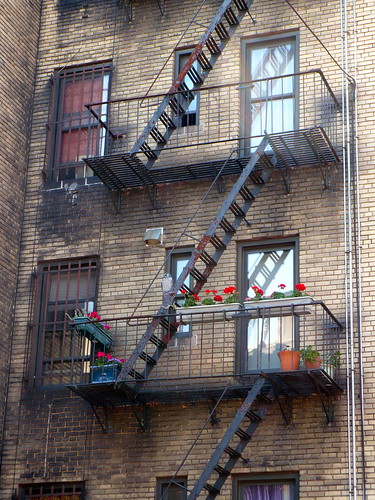
The first stop was the Trinity Church Cemetery of Upper Manhattan, which is associated with Trinity Church on Wall Street in Lower Manhattan. In the mid-1800s, Trinity Church ran out of room to bury people in Lower Manhattan, so this Washington Heights cemetery became an extension.
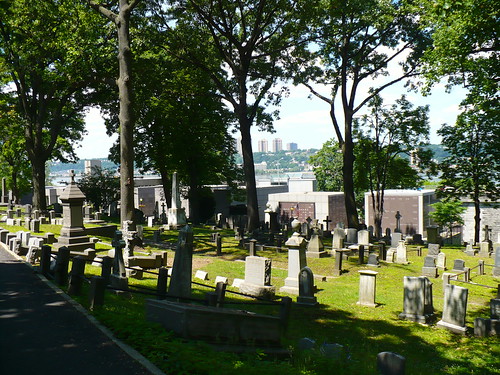
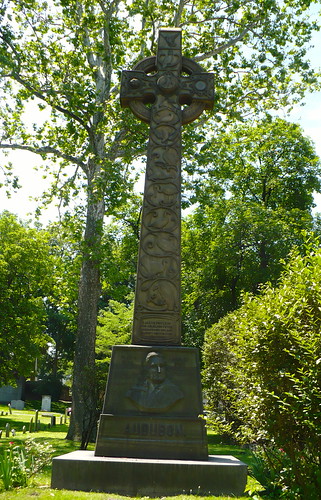
Among the people interred there are Ralph Ellison (Invisible Man author), Clement Clarke Moore (who wrote "Twas the Night Before Christmas"), Jerry Orbach (Law & Order just wasn't the same without him), Alfred Tennyson Dickens (one of Charles Dickens' sons, who died in NYC's Astor Hotel while participating as guest of honor in the Dickens Centennial), and John James Audubon, whose tombstone unsurprisingly features different kinds of birds.
Former NYC mayor Ed Koch, who didn't want to leave Manhattan after death, also secured a burial spot here; the cemetery is non-denominational and the only active one in Manhattan (though at this point, people can arrange to get interred only above ground in a mausoleum). Koch is buried near an entrance to the cemetery grounds called the Jewish Gate.
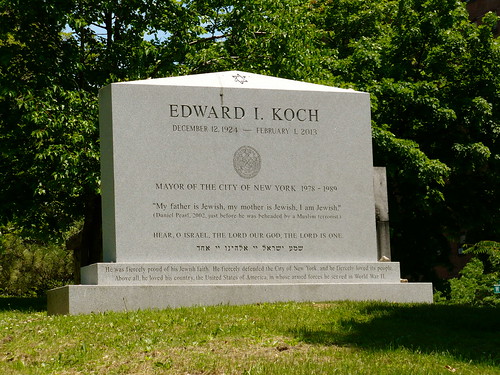
The stone has a verse of the Shema Prayer inscribed on it, "Shema Yisrael," which is of huge significance to Jews; even those who aren't particularly observant often know these words and recite them.
Also, Koch chose to inscribe the final words of journalist Daniel Pearl on the tombstone. It surprised me when I first saw it. Part of what it conveys to me is that Koch saw his Jewishness as central to who he was not only in times of peace but also in times of war and persecution (for instance, he had served as an infantryman in Europe during World War II). He had specified what he wanted on his tombstone before his death, and interestingly, he wound up dying exactly 11 years after Pearl - on the same date (February 1st).
Prior to seeing his tombstone, one of the people in the group jokingly wondered if it would have his slogan, "How'm I doin'?" inscribed on it.
The first stop was the Trinity Church Cemetery of Upper Manhattan, which is associated with Trinity Church on Wall Street in Lower Manhattan. In the mid-1800s, Trinity Church ran out of room to bury people in Lower Manhattan, so this Washington Heights cemetery became an extension.
Among the people interred there are Ralph Ellison (Invisible Man author), Clement Clarke Moore (who wrote "Twas the Night Before Christmas"), Jerry Orbach (Law & Order just wasn't the same without him), Alfred Tennyson Dickens (one of Charles Dickens' sons, who died in NYC's Astor Hotel while participating as guest of honor in the Dickens Centennial), and John James Audubon, whose tombstone unsurprisingly features different kinds of birds.
Former NYC mayor Ed Koch, who didn't want to leave Manhattan after death, also secured a burial spot here; the cemetery is non-denominational and the only active one in Manhattan (though at this point, people can arrange to get interred only above ground in a mausoleum). Koch is buried near an entrance to the cemetery grounds called the Jewish Gate.
The stone has a verse of the Shema Prayer inscribed on it, "Shema Yisrael," which is of huge significance to Jews; even those who aren't particularly observant often know these words and recite them.
Also, Koch chose to inscribe the final words of journalist Daniel Pearl on the tombstone. It surprised me when I first saw it. Part of what it conveys to me is that Koch saw his Jewishness as central to who he was not only in times of peace but also in times of war and persecution (for instance, he had served as an infantryman in Europe during World War II). He had specified what he wanted on his tombstone before his death, and interestingly, he wound up dying exactly 11 years after Pearl - on the same date (February 1st).
Prior to seeing his tombstone, one of the people in the group jokingly wondered if it would have his slogan, "How'm I doin'?" inscribed on it.
Week in Seven Words #216 & 217
216
helpless
No one knows who he is, only that he's fallen to the pavement and is sobbing so hard he can't speak.
needed
Garbage bags bulging with skirts, blouses and sweaters.
oasitic
Footsteps echo in the atrium, and faint voices, but all the sounds arrive as from a distance. Birds skim the vaulting glass. There's no breeze, but the trees rustle.
rigidity
He considers the model of masculinity people tried to make him live up to: No feelings, except for anger and physical appetites. No tenderness. An internal world made up of steel girders with huge blank spaces in between.
sapor
Knowledge is a treasure to them and a pleasure to all the senses. They taste new facts. They savor what they learn.
stricken
She looks perpetually stunned by the indifference and cruelty around her. The magnitude of it empties her eyes. She's left with a smile that creases her face but never reaches her eyes.
uninhibited
Actors try to banish their self-conscious impulses. They howl and prance in public. They pretend to be jaguars and squirrels.
217
body
I'm uncomfortable among people who are being cued to do the same thing at the same time: chant, scream, clap or stomp their feet. If they're a large crowd and look like they're really into it, this puts me on edge even more.
exhort
At her age, she's both exploring new opportunities and also warning younger people not to make the same mistakes she made. But they don't all agree with her on what is or isn't a mistake.
gall
She usually likes it when other people are worse off than she is. At the same time, she doesn't want to be uncaring. So she offers comfort and advice. Only there's a bitter satisfaction in her tone that make people turn away from her anyway.
nerves
Branches spasm in the wind.
persevere
Her first impulse is to say it's too difficult and to back off. But then she weighs the disappointment that might come from a failed attempt against the greater regret of never trying.
rumble
The ground is trembling with the trains passing beneath it.
sopping
The vestibule is soaked in the heavy smell of wet coats.
Tuesday, May 20, 2014
Where is the boy going in Les quatre cents coups (1959)?
Title: The 400 Blows (Les quatre cents coups)
Director: François Truffaut
Language: French
Rating: Unrated
At the heart of this beautiful movie is a boy who's unloved. Antoine Doniel's mother tolerates him, or tries to. His father is friendly with him, but they don't have a close relationship. At school, Antoine repeatedly gets in trouble. The one bright spot in his life is his friend, René, who seems a light and friendly spirit, out for some adventure.
The movie isn't melodramatic. It isn't always sad. For a boy of Antoine's age, there are pleasures and fun pranks. He can try to strike out on his own. During one part of the movie, he's staying with René without his parents or René's parents knowing; he's just dropped off the grid. He's walking a fine line between the pleasurable part of running away from home, the childish fantasy of it, and the darker side of it. Who at home cares that he's gone?

In the movie, there's a funny scene where a group of boys jog through the streets of Paris behind their gym teacher, and then in twos and threes they peel away, until the man is basically jogging on this own. That's the playful side of escaping authority. The movie also shows the dark and more desperate side of it. Antoine's truancy eventually leads to petty crime and lands him in a juvenile correctional facility. At one point, during an outdoor sports game, he flees. He's heading for the sea, which he's never seen. But once he's there on the beach, where else is there to go? Once you've reached the limits of yourself, what comes next? The sea no longer represents escape; it's another barrier.
Antoine can't run away from himself. All of his problems are seeded in him. He's long taken into himself the knowledge that he's unloved and unwanted, and he carries it everywhere. What can he make of himself when he has all of this in him? He doesn't need to think about it or talk about it for it to be there. The authorities offer him nothing. Whether it's the police or a psychiatrist or a teacher, they set up pens to put people in. What Antoine carries in him doesn't change, and what he longs for doesn't materialize.
At different points, he tries to take from other people to make himself free and whole, to reinvent himself perhaps or start over. He plagiarizes a paper from a famous writer and steals a typewriter to pawn off for cash. His experiences blur the lines between childhood and adulthood. If only he were an adult, that would mean freedom, because for most of the movie he hangs onto his optimism about adulthood as a liberating force. But take a look at the adults around him. In what sense are they wise or self-sufficient or free? He's running from them too and what they represent.
The movie starts with the camera prowling the streets of Paris. In the shots, The Eiffel Tower is always obstructed or glimpsed from strange angles. There is, from the start, a feeling of hunger. The camera keeps going down one street after another, but where is there to go? After he reaches the sea, Antoine has an expression on his face that says, among other things, "Is this it?"
Monday, May 19, 2014
Week in Seven Words #214 & 215
214
encrusted
Thoughts of taxes are like barnacles I want to scrape off of my brain.
fancies
One of those wild days when we talk about ideas for hours. I feel closest to him then.
overbooked
He trudges along in his karate uniform, with a violin in one hand and a tennis racket slung over his shoulder.
parts
I'm an ear, and she's a mouth.
price
Having a ready-made role to step into can be a relief, but what are you sacrificing for the extra comfort?
quailing
Their arrogance keeps them from confronting the fears that have hollowed them out.
yoked
This is the arrangement they've come up with: He's cut down on his leisure time, and she's compromised her dignity.
215
blank
For years, he hasn't dared to dream about anything.
chemistry
There are fascinating stories behind each element on the table.
dainties
Three small identical dogs, leashed to a bike rack, peer into the bakery that promises so many treats.
microscopic
Toddlers want to go at their own pace, examining sidewalk cracks and clods of dirt, and not just be tugged along all the time.
secure
Throwing pebbles, a child tries to knock birds out of a tree. Some twigs crackle, but the birds stick around.
unwasteful
With his finger, chasing the last of the whipped cream in the paper cup.
wavering
He continues to tip his chair back, frightened but excited about the moment of reckoning: a mastery of balance or a humiliating fall.
Subscribe to:
Posts (Atom)