This covers the week of 10/20/19 - 10/26/19.
campus
Her campus is embedded into a hillside. She leads us up and down flights of stairs and shows us her favorite corners, like a nook in the library or a bench on a quiet lawn. In different corners, lemon, grapefruit, and olive trees grow.
citadel
A golden light has settled on the hill. On the remnants of a fortress, a chunky, plastic playground has sprung up.
colliding
I walk among peach-colored blossoms, and geese waggling their butts, and cats dozing in high grass. A booming noise, like the sound of car meeting concrete, ruptures the afternoon. It turns out not to be car-on-concrete, but one car glancing against the other, with thankfully no one hurt, though one adult is shouting and a baby is wailing.
illuminating
The sun presses like a warm hand on my arm and head. When the pressure gets to be too much, I find refuge in the scented shade of the garden. Later, we slip into the museum, which is laid out brilliantly, especially its archaeology wing. From room to room, with detours into adjacent civilizations, it's easy to follow the historical timeline.
purity
Parts of the day are marked by clean air, and clean, sharp flavors and scents. In the morning, we're in a forest with evergreens, and the purity of the air is stunning. Later in the day, I drink a rich, foamy, tart, sweet juice of pomegranate and red apple. Towards evening, we stop in a shaded yard. The air is cool, and the flowers spray from the shrubbery as from a fountain.
share
Dinner is served on many small plates, which we pass from one person to another while helping ourselves to dollops. The conversation gushes along, and into it we pack many missed conversations from over the years. Afterwards, we walk along broad, well-lit, empty streets.
whisking
The ceiling fan in the bedroom whisks air over me cool as milk.
Showing posts with label Israel. Show all posts
Showing posts with label Israel. Show all posts
Sunday, May 31, 2020
Monday, May 11, 2020
Recommending Scenes from Village Life by Amos Oz
Tel Ilan, a pioneer village, already a century old, was surrounded by fields and orchards. Vineyards sprawled down the east-facing slopes. Almond trees lined the approach road. Tile roofs bathed in the thick greenery of ancient trees.
In Scenes from Village Life, Amos Oz opens windows into the lives of different characters living in a village in Israel. Many of the residents continue to operate farms, but the face of the village is changing. People have opened up restaurants and galleries and have leased out land. They're making a living from tenants or from visitors who come by each weekend to search for art, furniture, and other items of interest. Along with the external changes in the village, there are private transformations, unsettling and destabilizing occurrences experienced quietly.
These are some of the qualities of the book that stood out most:
- So many of the descriptions enfold you, the sensory details chosen with sensitivity, hitting the right notes ("A deep, wide silence lay on the garden...")
- In many of the episodes in the book, an absence is what brings people new insights or forces them to confront what they've been avoiding. A nephew who doesn't show up, a wife who disappears after leaving an ambiguous note... during each incident, the characters who remain behind discover something important about their lives, such as a truth they've ignored or denied.
- Characters probe at the limits of what they can understand about themselves, other people, or life. For instance, in one part of the novel, a man shines a flashlight under a bed. In this dark space, a teenager had previously killed himself. What does the flashlight illuminate? ("I had no further reason to turn my back on despair." Does despair still linger in that empty space in tangible form?)
- The novel captures the village's instability, not just in the way that personal relationships become unstable and unpredictable, but also in how the village has changed. Its connections to its farming days are weakening. The future is uncertain. Long-standing residents aren't sure what comes next in their own lives and for the community as a whole. At the same time, there's much that remains familiar. The things that haven't changed may accentuate everything that's different.


Sunday, January 10, 2016
Week in Seven Words #274
blue
The town is most memorable in its shades of blue: on walls, on signs, on balconies painted midnight. Also in the way its art galleries are strung together along narrow stone paths. Sculptures flow like melting wax. Painted bodies have been broken into basic geometric shapes, each a different color, some in shades of blue.
froth
Every day she acts out painful, unexamined feelings from her childhood. Her behavior stirs up frustration and anger in other people, and in herself. Maybe these familiar emotions are comforting; they generate a lot of surface churn, deflecting attention from the deeper damage.
hushfully
A peaceful stroll around a lake. The grass is riddled with abstract sculptures. Strange birds peck at the soil and slip into the water.
littoral
The coast changes its character along the way: golden sand and columns, a harbor shimmering in the heat, porous rocks pounded by the surf.
nibbles
Bins brimming with nuts and candies, the air rich and sweet.
passageways
The apartment complex is like a small, intricate city. Perched on a hill overlooking empty fields, it's full of winding lanes, narrow doors, and rough stone walls that open onto hidden courtyards.
sup
You get acquainted with their distinct personalities. There's the server who's everyone's favorite long lost son; he doles out soup with a smile and a self-deprecating joke. Another server makes motherly noises at you and gives you meatless bones that she claims are pieces of chicken. The cook is begrudgingly kind and clearly wishes she were elsewhere, maybe getting a pedicure or at home reading magazines and eating pickles.
The town is most memorable in its shades of blue: on walls, on signs, on balconies painted midnight. Also in the way its art galleries are strung together along narrow stone paths. Sculptures flow like melting wax. Painted bodies have been broken into basic geometric shapes, each a different color, some in shades of blue.
froth
Every day she acts out painful, unexamined feelings from her childhood. Her behavior stirs up frustration and anger in other people, and in herself. Maybe these familiar emotions are comforting; they generate a lot of surface churn, deflecting attention from the deeper damage.
hushfully
A peaceful stroll around a lake. The grass is riddled with abstract sculptures. Strange birds peck at the soil and slip into the water.
littoral
The coast changes its character along the way: golden sand and columns, a harbor shimmering in the heat, porous rocks pounded by the surf.
nibbles
Bins brimming with nuts and candies, the air rich and sweet.
passageways
The apartment complex is like a small, intricate city. Perched on a hill overlooking empty fields, it's full of winding lanes, narrow doors, and rough stone walls that open onto hidden courtyards.
sup
You get acquainted with their distinct personalities. There's the server who's everyone's favorite long lost son; he doles out soup with a smile and a self-deprecating joke. Another server makes motherly noises at you and gives you meatless bones that she claims are pieces of chicken. The cook is begrudgingly kind and clearly wishes she were elsewhere, maybe getting a pedicure or at home reading magazines and eating pickles.
Monday, January 4, 2016
Week in Seven Words #273
auroral
Gray and pink light in the early morning. The trees stirring, birds in song.
brown
Shades of cedar in the desert, umber and hickory. Cliffs the color of roasted sesame seeds.
festive
The dark pink flowers form an arc from the wall to the cars parked on the curb.
fruitless
He tries to tell a story, but his sentences wind up chasing words he can't remember.
hypersaline
People turning pink in the sun, their bodies stung with salt water. A burning cut on my leg. Cacti springing out of the salty dirt like coils of hair.
keenly
The song reminds her of her parents. She gives me the words to tuck into the back of my book and take with me home.
olid
A woman rolls down her stockings and washes her feet in a reeking rest stop.
Gray and pink light in the early morning. The trees stirring, birds in song.
brown
Shades of cedar in the desert, umber and hickory. Cliffs the color of roasted sesame seeds.
festive
The dark pink flowers form an arc from the wall to the cars parked on the curb.
fruitless
He tries to tell a story, but his sentences wind up chasing words he can't remember.
hypersaline
People turning pink in the sun, their bodies stung with salt water. A burning cut on my leg. Cacti springing out of the salty dirt like coils of hair.
keenly
The song reminds her of her parents. She gives me the words to tuck into the back of my book and take with me home.
olid
A woman rolls down her stockings and washes her feet in a reeking rest stop.
Thursday, April 30, 2015
Israel Trip Highlights (Part 2 of 7): Art
Metal work and other art in Old Akko
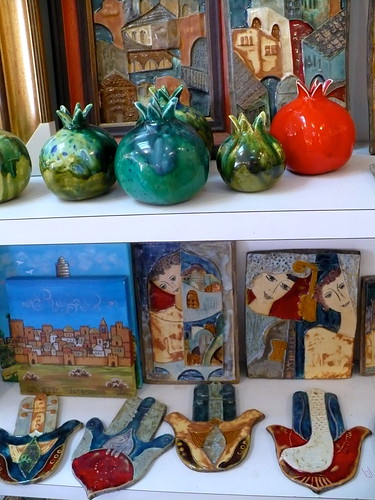
In the city of Akko (Acre in English), one place we stopped by was David Miro:
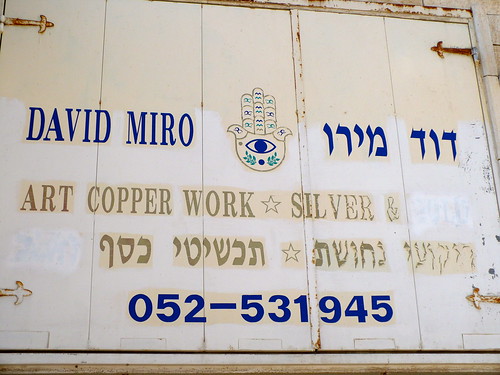
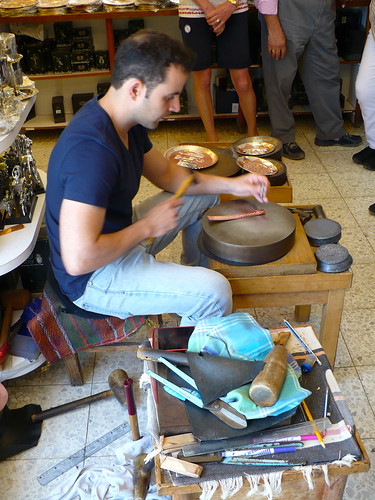
It's a family business (they moved to Israel from Iraq in the early 1950s). The son, who plans to lead the business one day as the next generation metal-worker, artist and craftsman, demonstrated how to make a simple copper bracelet. He then gave it to a woman in the audience.
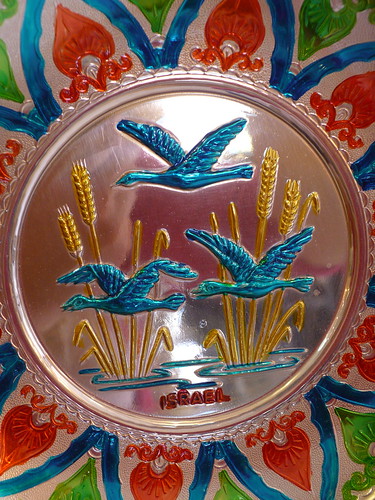
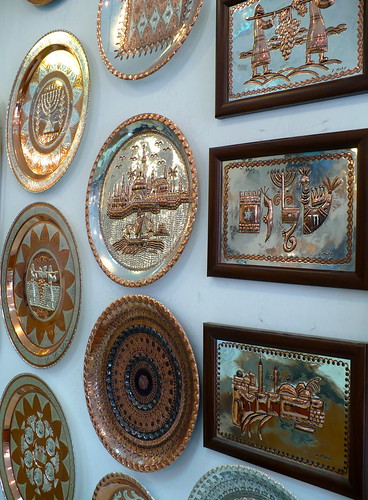
There's much more to see at the store. (I wound up not buying anything, but I admired a lot of what I saw.)
In the city of Akko (Acre in English), one place we stopped by was David Miro:
It's a family business (they moved to Israel from Iraq in the early 1950s). The son, who plans to lead the business one day as the next generation metal-worker, artist and craftsman, demonstrated how to make a simple copper bracelet. He then gave it to a woman in the audience.
There's much more to see at the store. (I wound up not buying anything, but I admired a lot of what I saw.)
Tuesday, April 28, 2015
Israel Trip Highlights (Part 1 of 7): Fauna
Street cat
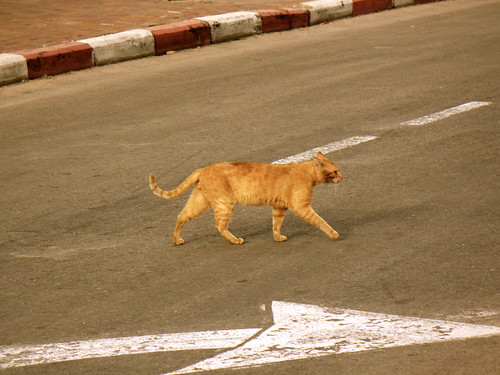
They're everywhere. And they're begging to be the main characters in stories about secret feline societies.
Roadside dog
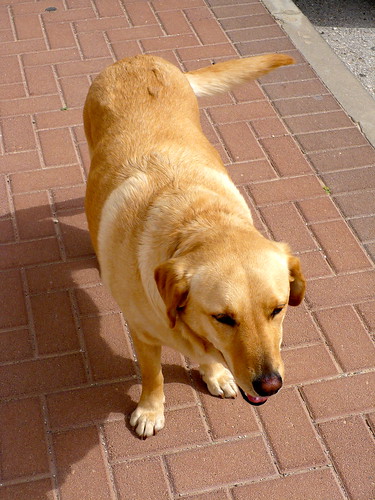
Her name is Luna. She belongs to a food vendor who's stationed in the Judean Desert, en route to the Dead Sea, at the point on the road marked 'sea level.' (You're traveling from the heights of Jerusalem to the Dead Sea, which is the lowest point on Earth - or at least on dry Earth. Reaching sea level is a milestone along the way.)
Luna is used to strangers, and walked over to everyone to get petted and photographed.
They're everywhere. And they're begging to be the main characters in stories about secret feline societies.
Roadside dog
Her name is Luna. She belongs to a food vendor who's stationed in the Judean Desert, en route to the Dead Sea, at the point on the road marked 'sea level.' (You're traveling from the heights of Jerusalem to the Dead Sea, which is the lowest point on Earth - or at least on dry Earth. Reaching sea level is a milestone along the way.)
Luna is used to strangers, and walked over to everyone to get petted and photographed.
Wednesday, May 2, 2012
Week in Seven Words #117
compressed
Am I really in Israel? More than once I ask myself that. I leave the U.S. on Sunday afternoon, land in Ben-Gurion airport early Monday morning. The funeral is that afternoon, and I spend many hours in my maternal grandma's apartment at the nursing home, where shiva is being held. And then Wednesday night it's time to go back. I see a lot of my family in those few days (grandmothers, uncles, an aunt, cousins, the spouses and children and in-laws of cousins), and it's the first time in years that the members of my immediate family have been in Israel together. As for the country itself, I get glimpses of it. A walk around the lake in the local park among moorhens, geese and hooded crows. Sitting wedged in the back seat of a taxi cab as it loses its way in Tel Aviv traffic. Running through a crowded souk like a video game character who loses points every time she bumps into someone. Eating delicious breakfasts and going out to lunch at a place that serves shish-kebabs and salad platters with hummous, falafels and Moroccan cigars. On Wednesday night fireworks go off; it's the eve of Independence Day. I catch some of the fireworks from the backseat of the cab that drives us to the airport.
filaments
The plane flies over the northern coast of Spain, all dark at night except for strings and clumps of golden light, shaped like cobwebs, snowflakes and amoebas.
funeral
At the funeral for my maternal grandpa, Saba Yossef (Grandpa Joseph) of blessed memory, whom I wrote about in the previous post, there's an atmosphere of sorrow and reunion as people arrive - many of them I don't know, others remember me when I was three feet tall (I don't remember them), and some I know well but haven't seen for years. Here they all are, mingling outdoors, waiting for my grandpa's body to arrive. The Israeli cemetery looks like a desert, full of stone, bright dirt, cacti and flowering shrubs, strange birds crying out from a handful of trees. The main part of the service is held indoors, my grandpa's body wrapped in a shroud and laid out in the center of a cool dim room. I know it's his body, but at the same time it's difficult to accept that it's really him. It doesn't seem like him; it's only his fragile shell. Where he lies in the middle of the room as a shrouded figure there's emptiness. His presence is felt not in this emptiness but in the surrounding people - in the thoughts they have of him, their prayers, their love, their words of remembrance, their grief, the fact that they're all there. The Hebrew word for funeral is "halvayah"(הלוויה), which at the root of it means "accompaniment." Some of his relatives and family friends carry his body out of the room on a pallet and take him outdoors into the cemetery, and everyone else goes with them, accompanying him on a long walk to where his grave is waiting. There's some recitation of lines from psalms and some more quiet reminiscences. When everyone arrives at his grave his body is lowered in, still in its shroud; there's some sort of receptacle at the bottom (I can't see it clearly), which is then covered by stone slabs. After that the grave is filled in, mostly by one of the men from the burial society, but also by family and friends who take turns shoveling in some dirt. Then everyone walks by, placing small stones on the grave. We stare and stare at this mound of earth dotted with many stones.
granddads
A visit to the grave of my paternal grandpa, Saba David (Grandpa David) of blessed memory, who passed away in 2005. Like my maternal grandpa, he died of an infection - in the very same hospital - after living the last few years of his life in a poor state of mental and physical health. Like my maternal grandpa, he was a fighter. He was a war veteran. He also survived the Holocaust (his tombstone bears the names of close family members who didn't). As a very young child he survived smallpox, after the doctors told his mother that he was a lost cause. Luckily for us, she kept taking care of him.
shiva (שבעה)
While sitting shiva, mourners are not meant to be left alone to brood, to sink too deep into grief. Visitors come bringing comfort, conversation, inappropriate funny jokes, and food. Some of them also bring small children who distract and delight with their antics. It's all a mix: tears, laughter, religious musings, mundane conversation, reminiscences, an airing of personal troubles, and silence.
standstill
On Yom Hazikaron - The Day of Remembrance, Israel's Memorial Day - a nationwide siren sounds twice: a minute-long siren in the evening, and a two-minute siren in the late morning. It's a haunting mournful sound, fitting for a day honoring fallen soldiers and victims of terrorism attacks. When it starts up, playing all over the country, everyone stops what they're doing and stands in silence. Cars and motorbikes stop in the middle of the road; the drivers get up and out and stand beside their vehicles. For those three minutes day-to-day life comes to a halt.
whispered
A heart-to-heart with my maternal grandma, who is used to taking care of everyone else and needs time to sit and talk and consider herself too.
Am I really in Israel? More than once I ask myself that. I leave the U.S. on Sunday afternoon, land in Ben-Gurion airport early Monday morning. The funeral is that afternoon, and I spend many hours in my maternal grandma's apartment at the nursing home, where shiva is being held. And then Wednesday night it's time to go back. I see a lot of my family in those few days (grandmothers, uncles, an aunt, cousins, the spouses and children and in-laws of cousins), and it's the first time in years that the members of my immediate family have been in Israel together. As for the country itself, I get glimpses of it. A walk around the lake in the local park among moorhens, geese and hooded crows. Sitting wedged in the back seat of a taxi cab as it loses its way in Tel Aviv traffic. Running through a crowded souk like a video game character who loses points every time she bumps into someone. Eating delicious breakfasts and going out to lunch at a place that serves shish-kebabs and salad platters with hummous, falafels and Moroccan cigars. On Wednesday night fireworks go off; it's the eve of Independence Day. I catch some of the fireworks from the backseat of the cab that drives us to the airport.
filaments
The plane flies over the northern coast of Spain, all dark at night except for strings and clumps of golden light, shaped like cobwebs, snowflakes and amoebas.
funeral
At the funeral for my maternal grandpa, Saba Yossef (Grandpa Joseph) of blessed memory, whom I wrote about in the previous post, there's an atmosphere of sorrow and reunion as people arrive - many of them I don't know, others remember me when I was three feet tall (I don't remember them), and some I know well but haven't seen for years. Here they all are, mingling outdoors, waiting for my grandpa's body to arrive. The Israeli cemetery looks like a desert, full of stone, bright dirt, cacti and flowering shrubs, strange birds crying out from a handful of trees. The main part of the service is held indoors, my grandpa's body wrapped in a shroud and laid out in the center of a cool dim room. I know it's his body, but at the same time it's difficult to accept that it's really him. It doesn't seem like him; it's only his fragile shell. Where he lies in the middle of the room as a shrouded figure there's emptiness. His presence is felt not in this emptiness but in the surrounding people - in the thoughts they have of him, their prayers, their love, their words of remembrance, their grief, the fact that they're all there. The Hebrew word for funeral is "halvayah"(הלוויה), which at the root of it means "accompaniment." Some of his relatives and family friends carry his body out of the room on a pallet and take him outdoors into the cemetery, and everyone else goes with them, accompanying him on a long walk to where his grave is waiting. There's some recitation of lines from psalms and some more quiet reminiscences. When everyone arrives at his grave his body is lowered in, still in its shroud; there's some sort of receptacle at the bottom (I can't see it clearly), which is then covered by stone slabs. After that the grave is filled in, mostly by one of the men from the burial society, but also by family and friends who take turns shoveling in some dirt. Then everyone walks by, placing small stones on the grave. We stare and stare at this mound of earth dotted with many stones.
granddads
A visit to the grave of my paternal grandpa, Saba David (Grandpa David) of blessed memory, who passed away in 2005. Like my maternal grandpa, he died of an infection - in the very same hospital - after living the last few years of his life in a poor state of mental and physical health. Like my maternal grandpa, he was a fighter. He was a war veteran. He also survived the Holocaust (his tombstone bears the names of close family members who didn't). As a very young child he survived smallpox, after the doctors told his mother that he was a lost cause. Luckily for us, she kept taking care of him.
shiva (שבעה)
While sitting shiva, mourners are not meant to be left alone to brood, to sink too deep into grief. Visitors come bringing comfort, conversation, inappropriate funny jokes, and food. Some of them also bring small children who distract and delight with their antics. It's all a mix: tears, laughter, religious musings, mundane conversation, reminiscences, an airing of personal troubles, and silence.
standstill
On Yom Hazikaron - The Day of Remembrance, Israel's Memorial Day - a nationwide siren sounds twice: a minute-long siren in the evening, and a two-minute siren in the late morning. It's a haunting mournful sound, fitting for a day honoring fallen soldiers and victims of terrorism attacks. When it starts up, playing all over the country, everyone stops what they're doing and stands in silence. Cars and motorbikes stop in the middle of the road; the drivers get up and out and stand beside their vehicles. For those three minutes day-to-day life comes to a halt.
whispered
A heart-to-heart with my maternal grandma, who is used to taking care of everyone else and needs time to sit and talk and consider herself too.
Tuesday, May 10, 2011
Hatikva
Someone sent me this video today:
Violin maker Amnon Weinstein painstakingly collected and restored violins that were used by Holocaust victims, and here they're played at a 2008 concert in Jerusalem; one of the victims was a 12 year old boy who smuggled explosives in his violin case - these explosives were used against German troops in Eastern Europe.
Hatikva ("The Hope") is the Israeli national anthem. The melody is based on a Renaissance era Italian song, La Mantovana - from the Renaissance onwards this melody appeared in a number of different folk songs across Europe from Scotland to Poland; it was also used by the 19th-century composer Smetana in his piece, Vltava or Die Moldau - one of a group of several symphonic poems he wrote in tribute to Bohemia, his homeland (the Vltava is a river that runs through Prague).
Think of the music played on these violins prior to the Holocaust - klezmer and other folk music for instance; their owners might have once played the melody of La Mantovana on them in one form or another (or if they were classical musicians, maybe they performed Vltava in a concert hall). In any case these instruments, which were in pieces (at least one of them found buried in a concentration camp) are whole again, a legacy from the people who owned them and made music on them.
Violin maker Amnon Weinstein painstakingly collected and restored violins that were used by Holocaust victims, and here they're played at a 2008 concert in Jerusalem; one of the victims was a 12 year old boy who smuggled explosives in his violin case - these explosives were used against German troops in Eastern Europe.
Hatikva ("The Hope") is the Israeli national anthem. The melody is based on a Renaissance era Italian song, La Mantovana - from the Renaissance onwards this melody appeared in a number of different folk songs across Europe from Scotland to Poland; it was also used by the 19th-century composer Smetana in his piece, Vltava or Die Moldau - one of a group of several symphonic poems he wrote in tribute to Bohemia, his homeland (the Vltava is a river that runs through Prague).
Think of the music played on these violins prior to the Holocaust - klezmer and other folk music for instance; their owners might have once played the melody of La Mantovana on them in one form or another (or if they were classical musicians, maybe they performed Vltava in a concert hall). In any case these instruments, which were in pieces (at least one of them found buried in a concentration camp) are whole again, a legacy from the people who owned them and made music on them.
Tuesday, January 19, 2010
"They have actual operating rooms... and it's just amazing."
Two videos from CNN on the amazing work carried out by the Israeli army medical corps in Haiti:
They've got a state of the art field hospital set up. They're saving lives, treating difficult medical cases that other makeshift facilities are not yet equipped to handle, and doing so with efficiency, order, compassion, and calm. There's such a disaster in Haiti, but people like these professionals, who've come from so far away and do such great work - they're a fierce bright light in an abyss, a steady strength amid chaos.
They've got a state of the art field hospital set up. They're saving lives, treating difficult medical cases that other makeshift facilities are not yet equipped to handle, and doing so with efficiency, order, compassion, and calm. There's such a disaster in Haiti, but people like these professionals, who've come from so far away and do such great work - they're a fierce bright light in an abyss, a steady strength amid chaos.
Subscribe to:
Posts (Atom)