Showing posts with label history. Show all posts

Friday, October 15, 2021

Week in Seven Words #560

This covers the week of 10/11/20 - 10/17/20.

discoursing
I like how these three female figures from history are posed – around a table in a discussion that one can almost overhear.

flattening
Petulant people with paper-thin identities and a simplistic way of viewing the world try to dictate what others should read, write, and think about. 

glows
I admire the green-gold pattern of leaves in the autumn light. The light glowing gold on the grass.

pushing
Have I tried enough, or have I wilted too quickly at rejection?

ranging
Some of my favorite work assignments are the ones that teach me completely new things. Could be a topic in medicine, technology, or the environment. Could be a travel or tourism assignment, though those are scarcer in a pandemic year. Lately, many assignments have been about psychological problems, such as addiction, anxiety, and various effects of isolation.

scrambled
The class is disjointed and confusing. I catch at passing facts like pebbles tumbling on a stream bed, but I'm missing some of the bigger picture.

softening
It's been a while since we've spoken, and I'm touched by his kind words.

Sunday, May 31, 2020

Week in Seven Words #509

This covers the week of 10/20/19 - 10/26/19.

campus
Her campus is embedded into a hillside. She leads us up and down flights of stairs and shows us her favorite corners, like a nook in the library or a bench on a quiet lawn. In different corners, lemon, grapefruit, and olive trees grow.

citadel
A golden light has settled on the hill. On the remnants of a fortress, a chunky, plastic playground has sprung up.

colliding
I walk among peach-colored blossoms, and geese waggling their butts, and cats dozing in high grass. A booming noise, like the sound of car meeting concrete, ruptures the afternoon. It turns out not to be car-on-concrete, but one car glancing against the other, with thankfully no one hurt, though one adult is shouting and a baby is wailing.

illuminating
The sun presses like a warm hand on my arm and head. When the pressure gets to be too much, I find refuge in the scented shade of the garden. Later, we slip into the museum, which is laid out brilliantly, especially its archaeology wing. From room to room, with detours into adjacent civilizations, it's easy to follow the historical timeline.

purity
Parts of the day are marked by clean air, and clean, sharp flavors and scents. In the morning, we're in a forest with evergreens, and the purity of the air is stunning. Later in the day, I drink a rich, foamy, tart, sweet juice of pomegranate and red apple. Towards evening, we stop in a shaded yard. The air is cool, and the flowers spray from the shrubbery as from a fountain.

share
Dinner is served on many small plates, which we pass from one person to another while helping ourselves to dollops. The conversation gushes along, and into it we pack many missed conversations from over the years. Afterwards, we walk along broad, well-lit, empty streets.

whisking
The ceiling fan in the bedroom whisks air over me cool as milk.

Monday, July 2, 2018

New York City Sites for the Fourth of July (All Five Boroughs)

If you're visiting New York City around the Fourth of July (or want to go armchair traveling), and you're interested in American history, this is the post for you. These sites are either connected to the American Revolution or show something of NYC's colonial period.

This list is limited to sites I have visited (so you won't see a photo from the Prison Ship Martyrs Monument in Fort Greene, for instance). For each site, I also mention other neighborhood attractions. Enjoy!

The Bronx


Stockbridge Indian Memorial (Van Cortlandt Park)

IMG_0418

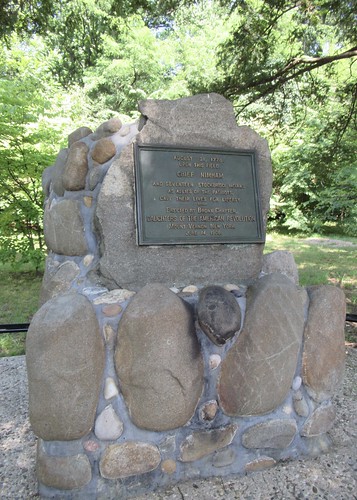
You'll find this memorial in the northeast part of Van Cortlandt Park. It's a tribute to a group of Native Americans, allied with the colonists, who died in August 1778 in a clash with an overwhelmingly larger number of British and Hessian troops. (Here's an article that goes into greater depth about the Stockbridge-Mohican community.)

In the neighborhood: Van Cortlandt Park is massive (one of the city's largest parks) and has golf courses, sports fields, and miles of hiking trails. The Van Cortlandt House Museum on the west side of the park dates from the 18th century, and during the Revolutionary War, both Washington and General William Howe, the commander of the British troops, made use of it. If you're in the area, you can also visit Woodlawn Cemetery, where a variety of historic figures are buried. The cemetery is close to the east side of the park.

Saturday, April 21, 2018

Week in Seven Words #398

breathtaking
There's a beach by a quarry, and it's one of the best places I've been to, beautiful and invigorating. It's made up of slabs of rock strewn along the shore. Just picking one to sit on is a pleasure. I rest for a while with the sun on my shoulders. I could have spent days there.

kayaker
A river wends through red, green, and gold grass. A kayak emerges from under a bridge, and sunlight shimmers in its wake.

seaside
Walking to the farthest reach of the jetty, I have a feeling of being embraced by blue. The sky, with some blue-white smears of cloud, the harbor spreading out on all sides, and the water trickling through the clumsy string of rocks - blue all around.

secretive
It's an old house, with enormous trees fussing around it and petting it with their branches, and shrubs rearing up to screen it protectively. It keeps silent about the people who lived there and what they saw from its windows. What we have are some facts embellished by imagination.

sweeten
It's a town of fudge and ice cream and pastels, flowers in window boxes and clapboard churches overlooking the ocean.

visage
In an art museum, I like the portraits best. They're characters expressing stories.

wondrous
The sound of a blue whale's heartbeat.

Monday, March 12, 2018

Week in Seven Words #390

abandoning
The loose grouping of historic buildings has the air of a ghost town. The grass in some places is unkempt. A mother and daughter fighting from opposite sides of a bench pierce the quiet but soon leave, as if they were spirits who hadn't known how to find rest. The crackle of bees from a wide porch, a cat sprawled on shaded gravel, highlight the absence of people.

bus
When the buses aren't too crowded, they can be relaxing. They roll and curve gently, sigh when they come to a temporary stop. The other passengers tend to be quiet, mostly caught up in phones or in staring out the window. When in pairs or small groups, they talk only now and then. At one point, a mother, son, and grandmother climb on board. The son lolls in his mother's lap as the bus glides on.

gifted
A mistake following the trail takes me to a quiet, stifling pond, bright green with algae. The air is still and hot. I wonder what I'm doing here, where I can go next, when a heron unfolds and takes flight.

matchsticks
There's a fragile atmosphere in this home, as if a misaligned paper on a desk will prod an ugly argument to life and ruin the evening.

reach
The real estate agent trots up and down the street, as she explains to someone over the phone that she's misplaced her car keys.

screened
It's a tiny museum; the air is cool and smells dusty. If I knew more ahead of time about Tibetan Buddhism, I would understand more about what I'm seeing. There are labels, but few explanations. The shelves are lined with placid gleaming statues and ornate metalwork. The gardens, set on a hill, are walled in by trees and stone and lined with prayer flags.

wariness
The deer watches me in stillness, a question in its eyes. It retreats because it doesn't want to risk the answer I might give it.

Sunday, December 31, 2017

Week in Seven Words #377

behold
Revisiting the same text, I find in it something new. Better yet, I have someone to discuss it with.

charmed
There's a snow globe approach to history that preserves a golden moment. It's untainted and unchanging, this little world of pretty homes and valleys and people smiling without end. It never existed outside of the glass, but that doesn't matter to the people who admire it.

gritted
The meal is in some ways about endurance. It's about not losing my temper when faced with crassness, disrespect, and a smarminess that's tempting to smack off someone's face.

obsolescence
As he opens his mouth, he realizes that no one he wants to talk to is paying attention. He looks around the room once more, hoping for eye contact, before settling back in his chair and staring at his plate.

peep
The tree leans over the path to inspect the fire hydrant hidden in the shrub.

pinch
The mistake was preventable, I was careless, and I hurt someone else too.

satisfying
The soup makes for a complete meal. Each spoonful of this amazing soup is a blessing.

Thursday, August 10, 2017

Week in Seven Words #354

apply
He's bored reading about U.S. labor laws from the early 20th century. Then he comes across a YouTube video about the labor conditions for smartphone manufacturing. He starts to pay more attention, make connections.

captivating
The fountain has three statues of women spinning in dance, hand-in-hand. It's ringed by flowers, and as the flowers draw bees, the fountain draws people to take photos, and to kneel by its side and run their fingers through the dark water.

driving
The storm whips up dirt and litter. In the stinging rain, discarded cups whirl around. With clothes soaked, I wait under an awning with several others. The wind steers the rain to us.

gift
A handful of hours made for a walk on wooded paths along pools and streams.

pocket
The park is a handful of benches and a bit of greenery in an alley. The bricks catch at the sunlight, and flies swarm in the moist shade.

pup
A woman relaxes on a blanket with a dog tucked against the curve of her waist.

sharp
An insect bite crackling with pain.

Sunday, February 12, 2017

Week in Seven Words #329

apiary
I don't know about the beekeeping on the premises until suddenly there are clouds of them around box hives on each side of the path. The part of my brain that isn't screaming reminds me that conserving bees is important, so isn't this wonderful? So wonderful.

cames
Petals lit up like stained glass in the low-slanting afternoon light.

ossicones
A man and child dressed as giraffes are reading by a pond. They could be characters from the picture book spread out between them.

parried
The ambulance circles through the cemetery's front drive, to where an old woman sits with her head in her hands on a bench. The EMTs kneel beside her for awhile. Eventually, she waves them off and leaves under her own power.

picking
On a search for a subway platform that isn't blocked by construction, I walk through a part of the city new to me. The buildings are indistinct in afternoon haze. A man on a stoop toys with a guitar.

rooted
Leaves and blossoms draped over weathered stone. Small American flags on a bright yellow lawn.

vexation
He's at my elbow, telling me I'm taking photos of the wrong things. "What's so interesting about that? Take a picture of this! See?"

Sunday, January 22, 2017

Two Winter Walks in NYC

One on New Year's Day, the other on Martin Luther King Jr. Day. They covered different neighborhoods in Northern Manhattan, including Inwood and Harlem.

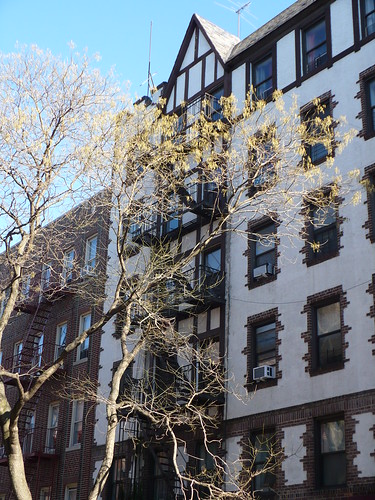
Walking from the George Washington Bridge bus station to Fort Tryon Park takes you through some beautiful residential neighborhoods in Washington Heights. These apartments aren't far from Bennett Park, which is the highest bit of land in Manhattan (just a little over 265 feet above sea level). Like other places in Washington Heights, it's a site of Revolutionary War military action (mostly Washington resisting but ultimately retreating from British forces, as they pushed him out of Manhattan).

P1080874

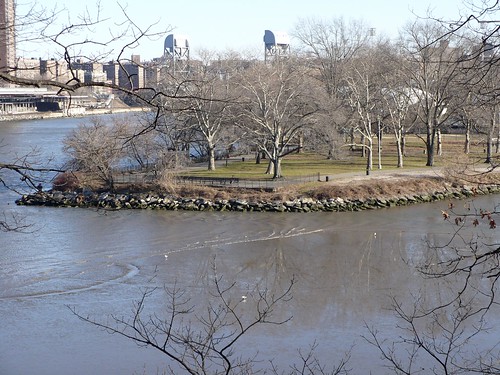
From Inwood Hill Park at the northern tip of Manhattan, a view of Spuyten Duyvil Creek, and beyond it, Marble Hill and the Bronx:

P1080902

Monday, May 30, 2016

A bit of American Civil War History: Prentiss Brothers

A few weeks ago, I visited Green-Wood Cemetery in Brooklyn. It's a National Historic Landmark, and various well-known people are buried there, including Samuel Morse, Elias Howe, and Leonard Bernstein. And Boss Tweed, who is one of the city's most famous corrupt politicians.

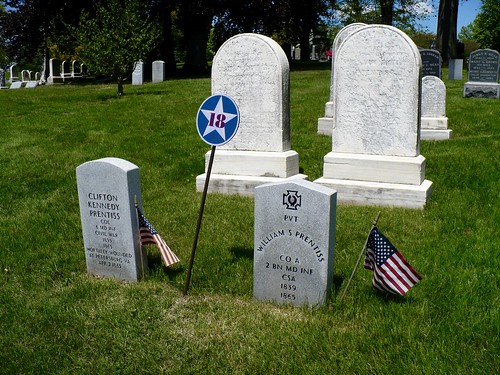
There are also thousands of Civil War veterans buried at Green-Wood. Among them are two brothers from Maryland, Clifton and William Prentiss.

P1080380

They fought on opposite sides of the war, Clifton for the Union and William for the Confederacy. Both died of injuries sustained at the Battle of Petersburg. Their nurse at Washington's Armory Square Hospital was Walt Whitman. And I didn't realize it until a few minutes ago, but he wrote about them in Specimen Days: Two Brothers, One South, One North.

Thursday, October 1, 2015

Week in Seven Words #263

absented
Historic plaques in grotty subway stations. The subway system is teeming with stories no one knows, because people don't like to look around when they're waiting on a platform. They pretend they're elsewhere, maybe already at their destination, and not underground in the stale air and filth.

hindsight
When I walk along the dead lawns, I imagine meeting my younger self, taking her by the shoulders, and telling her a thing or two.

linked
I hear them chanting, and their voices are like chains of silver.

obscure
You find it in the folds of her robes: an owl. Few people would spot it or think to look for it. It will never venture out of its sheltered spot.

projected
I know I have a craving for chocolate when every large brown boulder reminds me of fudge.

pronounced
Heliotrope lipstick and hair a traffic cone shade of orange. She's lit up like a flare in the gray neighborhood.

somnolence
The interior of the historic church is made of dust, marble and roses. A man in the pews bows his head - praying, or coaxed to sleep by incense and warmth.

Tuesday, September 8, 2015

The Sheer Prettiness of Provincetown

I recently visited Boston for a few days and made a day trip to Provincetown with a ferry (the Boston Harbor Cruises one). I'd never been to Provincetown (or any other part of Cape Cod), and it was a treat. Even the parts of town that were most blatantly a tourist trap were still lovely.

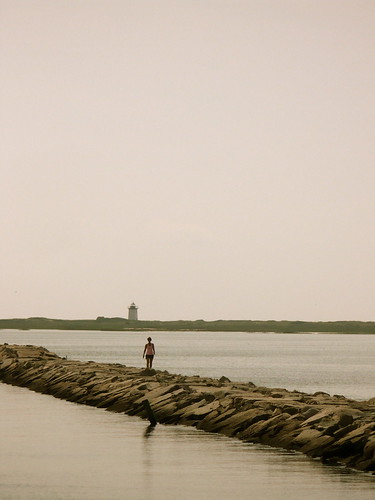
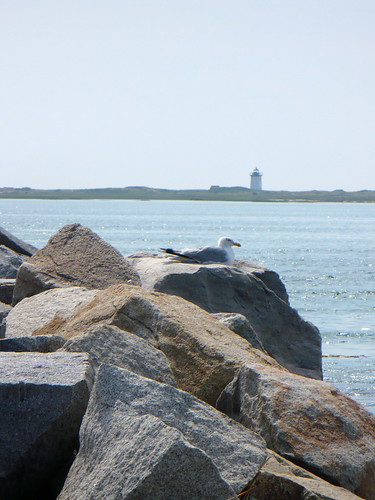
I stuck to Commercial Street, first walking all the way west to where it begins near the spot where the Pilgrims first landed in the 1600s (it wasn't at Plymouth, but Provincetown - they moved on to Plymouth a little later). At the spot historians determined is likely the one where they made their stop, there's a plaque and a small park (Pilgrims' First Landing Park). Off the park, a small beach and a jetty made of large rocks.

P1070740

I walked out onto the jetty for a while. I loved listening to the water rushing under the rocks (where I also found some smashed shells, probably from sea gulls dropping them on the rocks to get at the meat inside).

P1070766

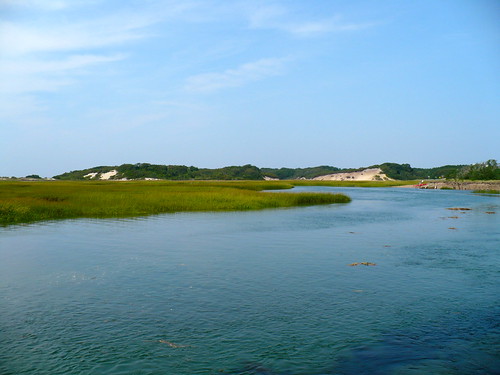
And I loved the smell of the salt marsh all around.

P1070754

Tuesday, December 2, 2014

Week in Seven Words #235

carousel
Paintings, mirrors, glassy music, kids bobbing on waves of color and noise.

fetching
A winsome, curly-haired lawyer picking her away through old warehouses and artist lofts.

genuine
People talking about what they love or what they're interested in, without competitiveness or preening.

patrol
Wasps swooping over a green plot where Lincoln sits and listens.

platinoid
Skyscrapers that look like they were made entirely of platinum group metals: ruthenium windows, iridium roofs.

sunny
Yellow brick, bright as fruit, a backdrop for trees.

traces
In a neighborhood saturated with history, I wonder who once stood beside the lampposts or looked out the windows with the white shutters.

Tuesday, July 22, 2014

Visiting Brooklyn Heights and DUMBO

This past Sunday had ideal summer walking weather. For the most part, it wasn't too hot out; not too unrelentingly sunny. Lots of cool breezes. A great day to be outdoors. Granted, part of my trip to Brooklyn Heights was an indoor historical lecture/tour, a really good one, but after that I walked along the beautiful waterfront.

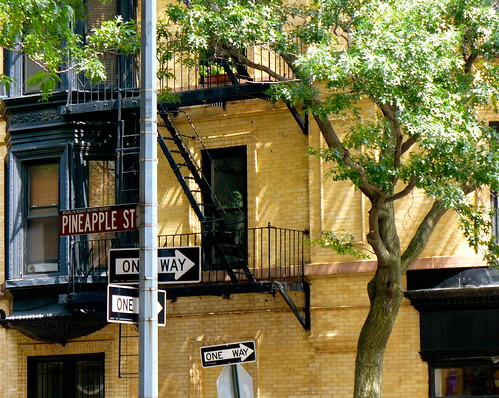
The visit began at the Clark Street subway stop in Brooklyn Heights. One of the first things I noticed is that a few of the streets have fruit names, apparently because lots of fruit used to be delivered to warehouses here. Here is Pineapple Street, with buildings of a suitable color.

P1060416

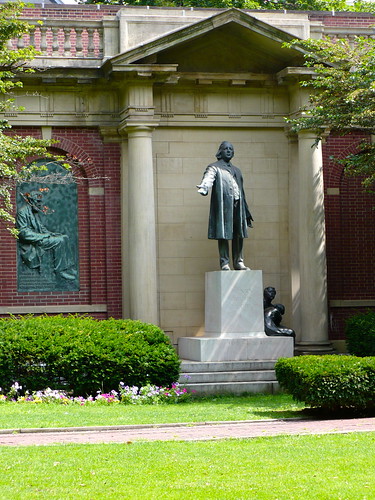
A little bit north of that, between Orange and Cranberry Streets, was where the history lesson began. This was at Plymouth Church, where the famous 19th century abolitionist preacher, Henry Ward Beecher, used to take to the pulpit to speak out against slavery.

P1060420

That's his statue, and to the left of him, an engraving of Lincoln, who prayed a couple of times at the church. In addition to serving as a platform for abolitionist preaching, the church was also a station on the Underground Railroad, the series of homes and other potential hiding spots that runaway slaves used to escape north.

Even in NY they weren't safe. Although slavery was abolished in NY state by 1827 and other northern states had also struck down slavery, southern slaveowners still had a claim to the escaped slaves. Northerners were obligated by law to hand them back over or risk getting fine or going to jail. There were also bounty hunters or slave catchers who actively pursued escaped slaves (and sometimes, if they didn't find who they were looking for, would capture a freeborn person who fit the description more or less). Runaway slaves generally tried to make it to Canada.

Monday, June 30, 2014

Hopping over to Staten Island: Snug Harbor Gardens and Alice Austen House

Staten Island was the only New York City borough I'd never been to - until today.

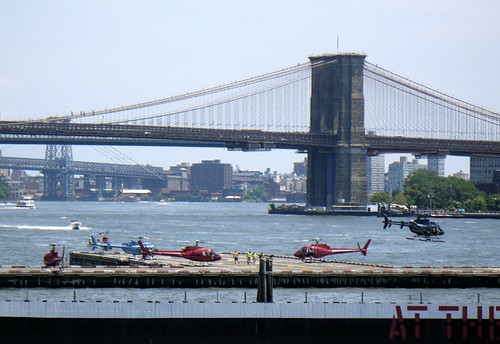
The best way to get there is with the free ferry that leaves the southern tip of Manhattan. Some people just ride the ferry back and forth for the amazing views of the NYC harbor, Manhattan, Brooklyn, New Jersey, the Statue of Liberty, Ellis Island, Governor's Island, bridges connecting different islands… Like here, you see a bunch of helicopters against a backdrop of the Brooklyn Bridge and Manhattan Bridge:

P1060310

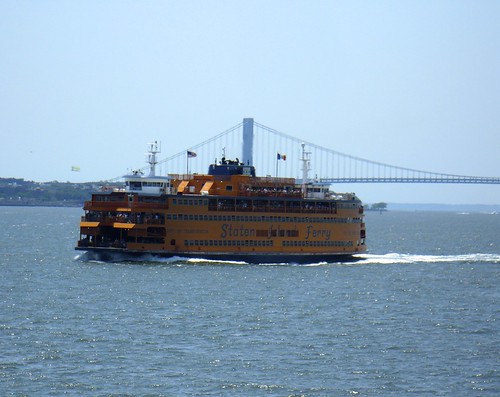
And here's the Verrazano Bridge connecting Brooklyn and Staten Island (with a Manhattan-bound Staten Island ferry passing us by in the foreground):

P1060320

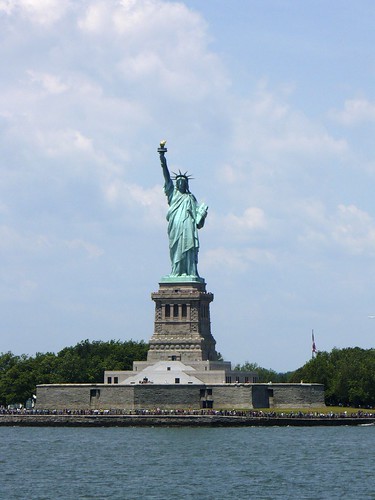
You can't not take a photo of the Statue of Liberty too. It's a compulsion.

P1060318

The ferry terminal on Staten Island conveniently has a bunch of bus terminals radiating off of it, with buses ready to take you to different parts of the island. This visit we stuck to the northeast part of the island, first taking the S40 bus to the Snug Harbor Cultural Center and Botanical Garden. Crossing the two-lane road from the S40 bus stop to the back entrance of Snug Harbor is a treat, because there are no traffic lights and crosswalk, and cars are zooming at you from both directions (in one direction hidden by a bend in the road). So you've got to time things just right and then hustle.

Friday, June 13, 2014

Walking in Washington Heights

Tourist maps of NYC that I've come across often don't include Northern Manhattan (starting from around Harlem and north of that). And yet, there are many gems in this part of the city. Last Sunday, with a group that organizes all kinds of walks in and around the city, I visited some places in the Washington Heights neighborhood that I hadn't known about or looked into before, even though I'd been to the Heights many times.
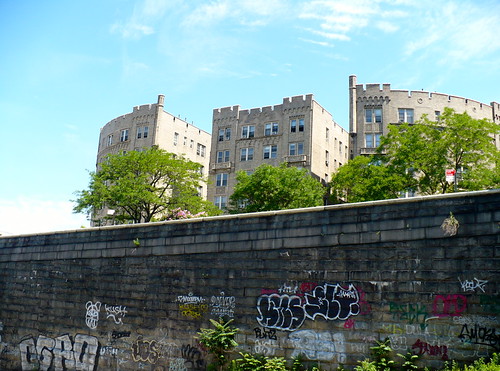
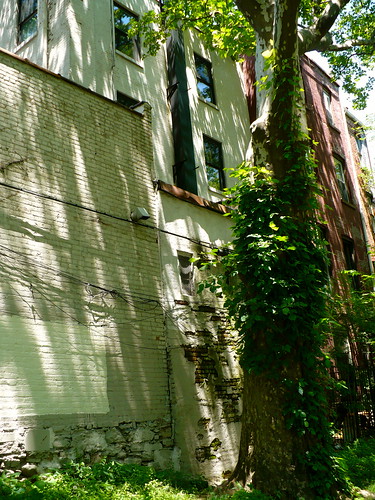
P1060208

P1060248

P1060304

The first stop was the Trinity Church Cemetery of Upper Manhattan, which is associated with Trinity Church on Wall Street in Lower Manhattan. In the mid-1800s, Trinity Church ran out of room to bury people in Lower Manhattan, so this Washington Heights cemetery became an extension.
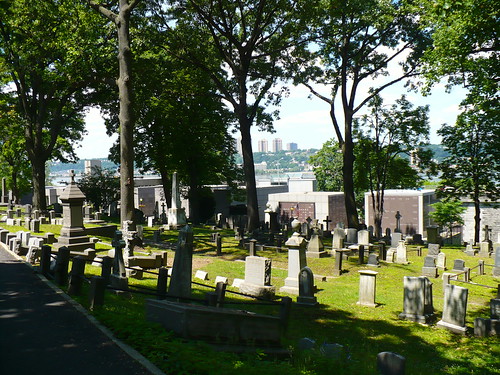
P1060219

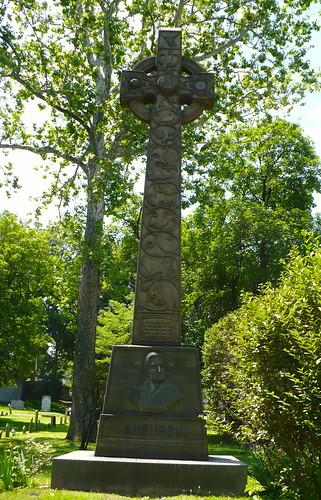
Among the people interred there are Ralph Ellison (Invisible Man author), Clement Clarke Moore (who wrote "Twas the Night Before Christmas"), Jerry Orbach (Law & Order just wasn't the same without him), Alfred Tennyson Dickens (one of Charles Dickens' sons, who died in NYC's Astor Hotel while participating as guest of honor in the Dickens Centennial), and John James Audubon, whose tombstone unsurprisingly features different kinds of birds.
P1060238

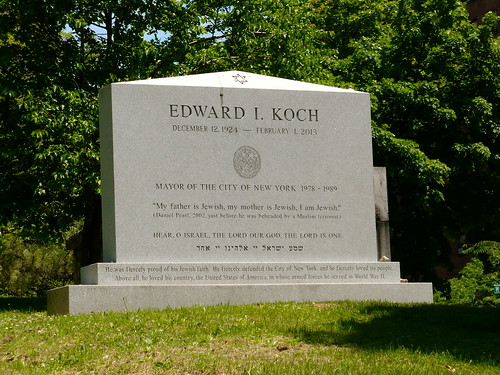
Former NYC mayor Ed Koch, who didn't want to leave Manhattan after death, also secured a burial spot here; the cemetery is non-denominational and the only active one in Manhattan (though at this point, people can arrange to get interred only above ground in a mausoleum). Koch is buried near an entrance to the cemetery grounds called the Jewish Gate.
P1060245

The stone has a verse of the Shema Prayer inscribed on it, "Shema Yisrael," which is of huge significance to Jews; even those who aren't particularly observant often know these words and recite them.

Also, Koch chose to inscribe the final words of journalist Daniel Pearl on the tombstone. It surprised me when I first saw it. Part of what it conveys to me is that Koch saw his Jewishness as central to who he was not only in times of peace but also in times of war and persecution (for instance, he had served as an infantryman in Europe during World War II). He had specified what he wanted on his tombstone before his death, and interestingly, he wound up dying exactly 11 years after Pearl - on the same date (February 1st).

Prior to seeing his tombstone, one of the people in the group jokingly wondered if it would have his slogan, "How'm I doin'?" inscribed on it.

Friday, May 31, 2013

Nonfiction Book of the Month: Why Nations Fail by Daron Acemoglu and James A. Robinson

Cover image for Why Nations Fail

The authors advance the thesis that the primary reason behind a nation's economic failure or success is its political system. For instance, does a given society have more inclusive political and economic institutions that allow meaningful participation from a broader variety of people, including various groups with competing interests? Or is the distribution of power much more limited, with those in power extracting wealth from others and using it largely to stay in power and advance their own narrower interests?

The authors offer a wide variety of examples from all different parts of the world and periods in history. For example, they discuss why the Industrial Revolution took off in a place like Great Britain, while technological progress was slower in other parts of Europe (with progress generally much more limited in Eastern vs. Western Europe). What was it about the changes in Great Britain's society leading up to the late 18th and early 19th century that helped lay the groundwork for the Industrial Revolution, especially given that Britain was poor and underdeveloped for so much of its history? What was the legacy of colonialism in different parts of the world, given the different kinds of political institutions put in place by colonial powers (including the way they used existing institutions in the lands they took over)?

The editing of the book could have been much better. The book often gets repetitive, sometimes with the same point repeated across consecutive paragraphs. Still, it's a thought-provoking and worthwhile read.

Monday, March 25, 2013

Nonfiction Book of the Month: Women's Letters

Title: Women's Letters: America from the Revolutionary War to the Present
Editors: Lisa Grunwald & Stephen J. Adler

I'm thinking of starting a monthly feature where I highlight a good nonfiction book I've read. Because March is Women's History Month, this is my selection for the month.

The cover for Women's Letters: America from the Revolutionary War to the Present

I read this one cover to cover, though it's also possible to skip around the book and sample different letters. A number of these American letter writers are famous (e.g. Abigail Adams, Emily Dickinson, Clara Barton, Julia Child), while others are obscure, though not less interesting.

The topics are enormous in range. You'll see arguments on multiple sides of important political and moral issues in the U.S., including slavery, the persecution of Native Americans, major wars, the suffragist movement, civil rights, and birth control and abortion.

The women here write about love, sex, academics, travel, religion, pregnancy, their jobs inside and out of the home, fashion, family issues, illness, and death.

Some of them served in the military (including a military nurse with multiple battle stars giving an account of treating concentration camp survivors at the end of WW2). Others never seemed to have ventured out of their home state. Some of the writers were slaves or former slaves (including women who didn't know how to read or write, dictating their letters). Within pages of each other, one woman describes a party game involving poetry and another describes undergoing a mastectomy without any anesthetics. You don't know for sure what you'll come across as you turn to a given page.

For each letter, the editors have provided some historical and biographical background, so you can get a sense of the letter's context.

Friday, January 4, 2013

Week in Seven Words #151 & #152

Week in Seven Words #151

affective
When the book I've worked on makes its way into the world I feel a nervous happiness.

kick
Short clips of improv comedy are like shots of an energy drink.

perpetual
The blink of the cursor measures time.

ploy
She tries to give me 'supercalifragalisticexpialidocious' as a mathematical solution. I am unmoved.

progress
Step 1: Recognizing a problem. Step 3: Doing something about it. Step 2: Inertia.

scattered
At the front of the line there's usually someone whose library card is lost among a hundred compartments in a purse or whose money is floating around in a bottomless coat pocket.

sheeted
The water is beaten down by the wind.

------------

Week in Seven Words #152

evacuation
He isn't toilet-trained but he's started to seek out privacy when nature calls. He tries to find a quiet spot in the house where he can stand or sit in his diaper, and if you approach him, he warns you off with a plaintive "No, no..." until he's done.

fluidity
I see the sculpture in the wan cloudy light of a winter afternoon, so I don't realize at first that it has color sliding through it - a pale lavender flowing like liquid through its metal veins.

impressionistic
The view from the window is one gray smear, like a Monet painting of London.

palimpsest
I like historical tours of downtown where you learn that criminals were hanged and traitors shot in the peaceful square where people now eat their lunches by the fountain and text each other.

pragmatically
His expectation of instantaneous results have given way to pragmatism; there's so much more work to do, so much farther to go.

prioritizing
I had a feeling she'd stop being angry with me, because she'd want to know how my date went.

shortcut
He's been asked to sort his toys neatly into drawers. But there are so many of them, and he'd rather be playing than organizing his room. So he labels one drawer the 'everything drawer' and piles as much stuff as possible into it. Unfortunately it doesn't pass inspection.

Thursday, January 26, 2012

Week in Seven Words #103

bibliophilic
The takeout sushi and blaring battery-powered car have distracted him for long enough. He crawls to the bookcase in the corner of the room and uses a shelf to pull himself up and stand before it. We think it's wonderful that he's interested in books at his tender preliterate age, and when he starts to scratch the spines of the books, up and down, it looks like he's trying to break through them to get to the good stuff inside. One of his older siblings tells us that he likes scratching them because of the funny sounds they make, a raspy choir of book spines; we shouldn't start calling him a scholar yet. But maybe that's how a kid starts loving books, because of the weird sounds and sensations, the look and feel of them.

concealing
Snow coming down like curtains around the world.

inspired
He tells me what he needs for inspiration. It isn't the recreation room with its tables full of old folks bent over pieces of paper. It isn't the ballet playing on the large T.V. in the corner, though he watches it from time to time with a far-off look in his eye, Romeo locked in dance with Juliet to the music of Prokofiev. What he needs is a room with a piano and sunlight and peaceful solitude.

phlebotomy
I stare out the window and pretend that the lab technician is not currently rooting around in the crook of my elbow trying to coax blood out of my vein.

propel
Blow up a balloon and pinch the end shut between your fingers. Then tape it to a straw. Slip the straw onto a wire or long piece of string, and tie the wire/string between two chairs or the walls of a room. Release the balloon. As the air flows out, the balloon-straw contraption rockets forward. Most of the time. Sometimes the balloon makes a horrible whining noise and deflates in agony without moving.

reconstructive
On Martin Luther King Day there's a sing-a-long at the nursing home. The pianist and singer, who isn't much younger than the residents, grew up in the segregated South. The audience, mostly wheelchair-bound and living in different states of lucidity and coherence, were a part of that era too; it's likely that there are civil rights protesters and activists among them, and people who went to hear King speak. Some of them remember, and for others this is a pleasant interlude of songs unconnected to anything past or future. But often they know the words; the words and melodies and sentiments of old beloved songs stay with them even when other things crumble.

subterrane
People expect cutesyness from young kids. They want to imagine that a first or second grader for instance doesn't have any serious fears or frighteningly complicated thoughts. Probably because as adults we often can't handle those kinds of thoughts well ourselves, and we hope that children won't demand more of us than the regular pat reassurances.