Showing posts with label war. Show all posts

Thursday, October 4, 2018

Two Very Different Movies Full of Poignant, Painful Hope

Title: Awakenings (1990)
Director: Penny Marshall
Language: English
Rating: PG-13


Based on a memoir by Oliver Sacks (which is on my to-read list), Awakenings tells the story of a treatment administered in the late 1960s to a group of patients who had been stricken decades earlier by encephalitis lethargica. The disease left them in a catatonic state. They stopped moving and talking. They seemed to stare into space all day. They were written off by hospital staff as incurable.

And perhaps there is no permanent cure, but when Dr. Malcolm Sayer (Robin Williams) gets appointed to the psychiatric ward where these patients have been shelved, he notices that they exhibit some responses. For example, catching a pair of glasses that have almost fallen to the floor. They may not be 'dead inside,' which is the received wisdom. It's horrifying to consider that they live with awareness while trapped in their unresponsive bodies.

Sayer experiments with administering L-dopa to these patients. (L-dopa started being used as a treatment for Parkinson's disease, and a possible similarity between Parkinson's and what these patients were suffering was the impetus for trying the treatment.) To people's astonishment, L-dopa has a positive effect, at first. The patients wake up.

A central theme explored in this movie (and captured in the title) is what it means to be awake, alive. One of the patients, Leonard Lowe (Robert De Niro), was struck down by encephalitis lethargica as a boy. His doting mother (played by Ruth Nelson) has stayed by his side throughout his catatonia. He awakens to find himself decades older. As with other patients, his reactions are a mix of wonder, joy, trepidation, sorrow, and frustration. Leonard has a deep thirst for life. There's a beautiful scene, set to "Time of the Season" sung by The Zombies, where he and Sayer leave the hospital and explore the outside world for a bit. Leonard is thrilled. Being alive and awake feels so fantastic, and at one point he says of other people:
"They've forgotten what it is to be alive! The joy of life, the gift of life, the freedom of life, the wonderment of life!"
He also becomes increasingly impatient at not being able to leave the hospital permanently to live on his own. He wants to be a man, an adult, after being long deprived of the opportunity. But he and the other patients need to remain under supervision until it's clear that the drug works. As it turns out, its effects are short-lived.

Sayer, meantime, is discovering a deeper meaning to life. He's a shy, reclusive man. Prior to working in the ward, he conducted experiments on earthworms. Humans seem to bewilder him. At first, he doesn't understand Leonard's thoughts on the joy of life, those beautiful words tossed through a window that's been briefly opened. A window that's sliding shut again in the final part of the film. Sayer's most meaningful human contact, possibly in all of his adult life, is with these people who are grasping at life before the window closes. Leonard becomes his friend, in a relationship that sometimes turns antagonistic. A nurse working on the ward, Eleanor Costello (Julie Kavner), might also become a friend or girlfriend, if given a chance. It's a chance Sayer decides to take, at the end.

This is my favorite Robin Williams role, of the movies of his that I've watched so far. Except for one moment where he comes across as Williams the Entertainer, he fully slips into Sayer's gentle, withdrawn character. De Niro also gives a whole-hearted performance, throwing himself into it physically and emotionally.

What I especially like about Awakenings is the refusal to give in to despair. I'm speaking not just of the characters but of the tone of the movie as a whole. What happened to these patients' lives is horrifying. The movie shows the consequences of missing decades and trying to discover who you now are, even as the treatment keeping you awakened may fail. But there are also scenes of dancing, including a lingering slow dance for Leonard and Paula (Penelope Ann Miller), a woman visiting her father at the hospital. There's delight in music and insight in poetry, as in the scene where a poem by Rilke, "The Panther," strikes Sayer as a window into the minds of his catatonic patients. And there's love and a need for companionship, long denied by Sayer, though by the end he realizes that he needs other people to truly live.

Monday, May 28, 2018

Some thoughts on Home by Toni Morrison

In this Toni Morrison novel, two siblings leave their backwoods Georgia home, get even more scarred out in the world, and come back to find that home is a more complicated place than they’d ever thought. Not as stifling as in their childhood, and offering possibilities for rebuilding their lives.

The novel is set in the 1950s, and one of the siblings, Frank, has returned to the U.S. from the Korean War. He brings with him post-traumatic stress and memories that make it difficult for him to live with himself. He’s also black, and needs to transition from a recently desegregated army back to a society where segregation is still the norm, through official enforcement in some places and unofficial enforcement in others.

Meanwhile, his younger sister, Cee (nickname for Ycidra), flees her hateful grandmother by running off to Atlanta with a man who dumps her. Her search for better paying work brings her to the home of an unscrupulous doctor who hires her as his assistant and conducts unethical medical experiments on her and others.

It’s relatively rare to see novels featuring Korean War vets (and black vets, more generally). During the war, Frank has seen and done things that he can’t come back from. (“Back was the free-floating rage, the self-loathing disguised as somebody else’s fault.”) He has discovered things about himself that he would never have guessed at and that he doesn’t know how to confront.

The novel explores the question of what a home truly is. The characters lead precarious lives, and they could be driven out of their homes all too easily. So how does someone create a home when violence, destruction, illness, and complete destitution are nipping at the borders and can spill in at any moment?

Home is not simply a place, it’s a set of relationships and connections, and deep impressions on the mind and heart. The characters have perpetrated or witnessed profound violations in the world. Home is a place where you’re not degraded and where you ought to be free of those violations. At home, you can confront the demons and have people stand beside you.

Cee gains new strength with the help of women who stand in for the lack of a mother figure in her life. Chief among them is Ethel Fordham, who tells her, “Somewhere inside you is that free person I’m talking about. Locate her and let her do some good in the world.”

So home is where you can heal, among people who find worth in you, and it’s where you can do worthy things, even in the face of harsh odds. Of Ethel’s garden:
Her garden was not Eden; it was so much more than that. For her the whole predatory world threatened her garden, competing with its nourishment, its beauty, its benefits, and its demands. And she loved it.
Morrison doesn’t sentimentalize home or make the folks of this backwoods town charming and endearingly simple. Other authors might have gone down that path and trivialized the story and the struggle of these scarred characters.

Saturday, November 11, 2017

Movie about veterans: The Best Years of Our Lives (1946)

Title: The Best Years of Our Lives
Director: William Wyler
Language: English
Rating: Unrated

In The Best Years of Our Lives, three men return home from WWII and struggle to adjust to civilian life. Al (Frederic March), Fred (Dana Andrews), and Homer (Harold Russell) live in the same city, and though they've only just met on the plane home, their lives intersect in important ways throughout the movie.


Although they each enjoy happy or hopeful endings, the movie shows the ways in which their lives could have derailed (or still could derail after the closing credits). Al is welcomed back by his loving family, and the well-paid position he held at a bank remains open to him. However, he has taken to drinking heavily and isn't at ease either at home or at work. Fred can't find a good job, and his marriage is strained. He's also suffering from post-traumatic stress. Homer lost both his hands during the war and fears that his fiancee is sticking with him only out of pity. He also begins to isolate himself after receiving pitying and uncomfortable looks from family and friends. (Harold Russell actually did lose his hands during WWII, and this was his first movie role.)

Wednesday, October 11, 2017

Week in Seven Words #366

association
A fun evening of Code Names, drinks, and food.

offbeat
They're helping her learn the distinction between cool weird and uncool weird. Cool weird is when you make silly faces with your friends for Instagram, maybe use a filter or app that gives you puppy ears and big glasses. Uncool weird isn't a sanctioned strangeness. Even if it's creative and doesn't harm anyone, it's suspect.

origami
She folds Trident gum wrappers into birds.

pickle
The alarm over the door begins to shriek. A worker approaches it with a grimace, then walks away. A minute later, another worker comes along, grimaces and walks away. Another minute goes by, with another grimace.

problematic
The word 'problematic' has started to bug me. People often use it in a way that's lazy and full of insinuation. "That book is problematic." Meaning? A vague unease, a condemnation without a coherent argument.

thump
Hearing about war gives him a thrill. It's the swagger of war he likes, the way deep-voiced media figures growl a threat of reprisal.

unproductive
An empty plaza framed by ads, shrubs, and an office building that looks like a fort.

Tuesday, July 4, 2017

Eight stories of Americans making journeys

Title: Going After Cacciato
Author: Tim O’Brien
Where I Read It: Breaking Into Print

A soldier stationed in Vietnam decides to walk to France. Other members of his squad try to stop him. Cacciato has a reputation for being dim-witted (a "rockhead," he's called), and his idea is absurd, but at the same time it doesn't seem all that crazy to try to get away, no matter how. The way they've been living so far, with comrades dying in gruesome ways and days full of pointlessness and ugly nonsense, it doesn't seem that crazy for someone to want to walk off into the distance. But that would be desertion, and the rest of them can't let him do that, can they?

O'Brien later developed this story into a novel, which I haven't read, but already in this story he fleshes out distinct characters - some petty and eager to kill, others more sympathetic and thoughtful.

Title: The Halfway Diner
Author: John Sayles
Where I Read It: American Voices

A group of women makes a round-trip by bus each Sunday to visit their men at a state penitentiary. The diner is the halfway point on the trip.

The bus is their world in this story. The women break into different groups, sometimes forming friendships, but what happens in the prison may affect their own relationships. To what extent will they take up the battles between their men and reenact it among themselves? The story unfolds through the eyes of one of the Latinas - who has a well-written voice - and I love how the inside of that bus becomes an entire world, and so does the dismal diner. Sayles also has a gift for writing female characters as realistic people, instead of walking bundles of cliches (the same holds true in what I've watched of his movies so far - Passion Fish and The Secret of Roan Inish).

Monday, May 29, 2017

Two 1940s movies with WWII vets struggling in post-war life

Title: Act of Violence (1949)
Director: Fred Zinnemann
Language: English
Rating: Unrated


At first, Act of Violence seems like a straightforward crime thriller set in post-war suburbia. Joe Parkson (Robert Ryan) is a stalker menacing a peaceful home. He carries a gun and looks like he could use it without flinching. But Joe isn't a criminal, though he may become a murderer by the movie's end.

The man he is after is Frank Enley (Van Heflin). They served together in the war and spent time in a German POW camp. Frank now has a wife, Edith (Janet Leigh), and a baby son. He's well-respected in his community; people consider him a war hero. To Joe, Frank's cheerful, prosperous life is an injustice. Joe remembers what Frank did in the POW camp, and what his fellow POWs suffered for it. Joe is permanently injured and easily written off as crazy, but at least he survived and will now have his vengeance.

Act of Violence should be a better known movie for its strong acting, the tone of uneasiness throughout, and the difficult questions it raises. What would you do to stay alive? How do you manage to live with yourself, if you've either deliberately committed evil or made a terrible mistake? Are things you did under extraordinary circumstances reflective of your everyday character?

Joe and Frank wrestle with these questions post-war. As do the women in their lives - Edith, who learns disturbing information about her husband; Ann (Phyllis Thaxter), who as Joe's girlfriend tries to persuade him to abandon his revenge mission; and an aging prostitute, Pat (Mary Astor), who finds Frank when he's trying to hide from Joe. The movie doesn't make the mistake of turning Joe into a righteous hero and Frank into a full-fledged villain; Frank's reasons for acting as he did during the war are muddled, and Joe is so consumed by anger that he's becoming less of a person and more of a destructive force that will burn itself out.

Monday, February 20, 2017

The letdown in "The Dream" by Winston Churchill

When I chose “The Dream” for Deal Me In 2017, I assumed from the title that Winston Churchill would be discussing some vision of the future. Instead, he describes an incident in November 1947, where he was painting in a cottage and imagined a visit from his dead father.

They have a conversation. Much of it is Winston filling his father in on some of the developments in politics and world affairs since the late 1800s. And war - with more said of the Boer War than either World War I or II, until Churchill offers a brief, blunt assessment of the costs of both wars towards the end of “The Dream.”

What does this piece say of Churchill? In some ways, it comes across as impersonal. The conversation might as well not take place between a father and son; the father is a prop. At various points Churchill seems to elbow his readers in the ribs or shooting them a meaningful glance, intending that they note his opinions on various political figures and subjects.

But there are also moments where the father-son connection (or the absence of one) comes into focus. The distance between them, the fact that his father may not have thought much of him. And at the end, Churchill’s disappointment in himself and what he’s perhaps failed to achieve or live up to. Turbulent personal feelings emerge now and then, sometimes shadowing the casual, more amiable parts of the conversation. Mostly, they’re held in restraint.

Monday, May 30, 2016

A bit of American Civil War History: Prentiss Brothers

A few weeks ago, I visited Green-Wood Cemetery in Brooklyn. It's a National Historic Landmark, and various well-known people are buried there, including Samuel Morse, Elias Howe, and Leonard Bernstein. And Boss Tweed, who is one of the city's most famous corrupt politicians.

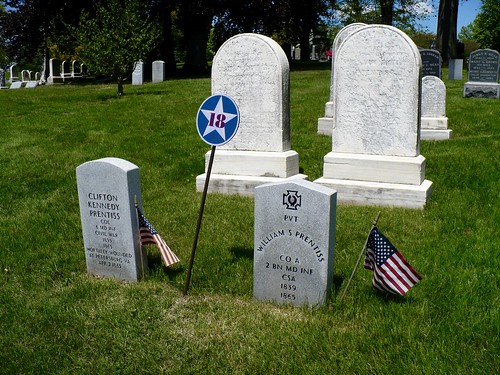
There are also thousands of Civil War veterans buried at Green-Wood. Among them are two brothers from Maryland, Clifton and William Prentiss.

P1080380

They fought on opposite sides of the war, Clifton for the Union and William for the Confederacy. Both died of injuries sustained at the Battle of Petersburg. Their nurse at Washington's Armory Square Hospital was Walt Whitman. And I didn't realize it until a few minutes ago, but he wrote about them in Specimen Days: Two Brothers, One South, One North.

Tuesday, November 10, 2015

Veterans Day Viewing: Debt of Honor

Title: Debt of Honor: Disabled Veterans in American History
Director: Ric Burns
Language: English
Rating: PG

I watched a free screening last night for a documentary that will be airing on PBS tonight, 11/10, at 9 p.m. eastern time. Debt of Honor looks at the way the U.S. has responded to returning wounded veterans from major wars across history.

With advances in medicine and technology, there are many more people who survive serious injuries in the line of duty, but they might return with missing limbs, paralysis or with visible scars. These permanent injuries are among the challenges to returning to civilian life.

The documentary also focuses on mental health, particularly post-traumatic stress, in returning veterans. As far as we can tell, mental trauma has always been a part of war, with different names for post-traumatic stress ("soldier's heart" after the Civil War, "shellshock" after WWI), and our understanding of it increased greatly after the Vietnam War. But there's still much that we don't understand and a stigma remains. Often, it's the psychological issues (including but not limited to PTSD) that keep returning troops from merging back into daily life successfully. It's also a matter of redefining or readjusting their identity after spending time in a combat zone or military setting. And if they're injured or mentally traumatized, they need to find a way to make sense of life.

General attitudes have also varied, from one war to another, towards returning veterans and how to respond to those injured; and the documentary makes the point that since Vietnam, the military and the mainstream population have gone separate ways. There's a disconnect between them. We don't have a draft. Civilians may not even really feel any direct effects of war, and may live in ignorance of complex battles fought in places they wouldn't be able to find on a map. So when soldiers return, it might as well be from an alien world. Meantime, there are high rates of suicide among veterans and soldiers in active duty.

The film is well worth watching, so if you have time tonight and have access to PBS please check it out (or get the DVD at some other point). After the screening last night, there was a discussion panel that covered several topics, including inadequate care for veterans. For instance, Guam has a super-high rate of U.S. military service, but it's terribly short on VA resources. (Here's a short video on that.)

Sunday, October 20, 2013

Three Short Stories About War from Around the World

Story Collection: World Literature: An Anthology of Great Short Stories, Drama, and Poetry
Editor: Donna Rosenberg


Title: One Soldier
Author: Katai Tayama
Translator: Jai Ratan

This story is more or less a one-man death march, and the soldier it focuses on could be anyone. He's Japanese, fighting against Russia in the Russo-Japanese War, but the details of the war don't matter. All we see is him, leaving a military hospital prematurely because he can't stand to be there anymore, and trying to catch up with the other soldiers in his company. He realizes, while marching through the countryside, that he's still sick with beriberi, a horrible condition brought about by thiamine deficiency. He thinks about the glorious ideas that made him eager to participate in the war, and the possibility of dying from cardiac arrest after straining to walk for miles with beriberi. Or, even if he survives, the thought that he'll be trapped anyway, gunned down somewhere. War is a giant trap, and every moment he's alive he's in pain. The heart of the story is his terrible cry: "This pain, this pain, this pain!"

Title: The Soldier
Author: Krishan Chandar
Translator: (Info not provided)

Shortly after the end of World War II, a Pakistani soldier returns to his village. He wishes with everything in him that life will continue as before, only with the added benefit of people regarding him as a hero. But he knows, from the start, that everything will be different. He's lost his leg, and people notice the loss of the leg more than the medals he's received for his heroics; the glory of his sacrifice is tarnished by pity. Others have moved on with their lives, and there he is, an object of pity among them, beloved to them but also strange and upsetting. What does he live for at the end?

Title: War
Author: Luigi Pirandello
Translator: (Info not provided)

Although it's set against a backdrop of war, the story is not so much about war, but more about the difference between people's thoughts and the misleading impressions they give with what they say. There are a group of parents in a train car whose sons have enlisted in the military. They squabble about who has cause to worry most, and one passenger delivers a monologue on patriotism, and how "our children do not belong to us, they belong to the Country..." He nearly convinces one woman that she hasn't risen to the occasion and that she should resign herself to the possibility of her son dying in war. But all it takes is one innocent question to expose his own love and grief, which can't be quieted by any amount of tribute paid to abstract principles.

Thursday, April 11, 2013

Good Short Fiction: Several Tales from 50 Great American Short Stories

Collection: 50 Great American Short Stories
Editor: Milton Crane


Title: Cluney McFarrar's Hardtack
Author: John McNulty

During the Second World War, a veteran of the First World War talks about some of his experiences fighting overseas. He focuses on one night, after a battle, when he doubles back to snatch up some hardtack dropped by a fallen soldier. Everything in the story gathers towards the moment when he's about to enter the dark and silent wood full of the bodies of dead soldiers.

-------------

Title: A Dead Issue
Author: Charles M. Flandrau

This one is written elegantly and incisively, about a man in his early thirties who turns out looking foolish when he returns to teach at his alma mater, Harvard. Even though he's at least a decade older than most of them, he fraternizes with the undergraduates at the club he used to belong to when he was a student; at the same time, he feels isolated from people closer to his own age.

The story brilliantly shows his need to be liked and to belong somewhere, and how he has trouble leaving the security of that old club and its easy associations. Maybe he recalls with nostalgia the friendship of his own classmates, bonds of fellowship that he thought would stay with him and support him throughout his life; he thinks he can recreate those bonds with a younger generation. Because he hasn't moved on, he risks compromising his principles as a teacher to be chummy with the students. They're young and self-centered and carefree, and they show him an easygoing friendliness that doesn't mean much. How will the main character find his place in life as he grows older, with his face still turned towards the past?

Thursday, March 14, 2013

Good Short Fiction: 3 Tales from 40 Short Stories

Collection: 40 Short Stories: A Portable Anthology (1st ed.)
Editor: Beverly Lawn


Title: Civil Peace
Author: Chinua Achebe

Soon after his country's civil war, a decent man counts his blessings and tries to make a life for himself and his family again. But the end of war doesn't guarantee stability, and everything that he and his family work for and try to save could easily be taken from them. Life is precarious in both war and peacetime, and sometimes the man wonders if there's any form of justice in the world that people can understand. He can't explain why good things or bad things happen; all he can do is make the best of what he has, try to survive, and leave the bigger questions unanswered. Achebe's story has a sweet, bewildered tone; even when robbers show up at the man's house, there's a sad sing-song quality to their words and the writing as a whole, like the voice of their child-selves in a world that makes little sense.

-------------

Title: The Lottery
Author: Shirley Jackson

Even knowing what would happen at the end (this was my second reading), I was tense throughout. I was also able to pick up on more of the foreshadowing this time around.

The story is set in a small town, where people are pleasant to each other, very neighborly, and there's excitement and nervousness about an upcoming lottery. The lottery is a regularly held ritual calling for the participation of all citizens, young and old.

When this story was first published in the late 1940s, it struck a nerve. Jackson had set The Lottery in a location resembling an ordinary small American town. She made a good choice; small American towns with their neighborly people have been the sites of brutal group violence. No matter what its history, there isn't a single community that can allow itself to be complacent; setting a barbaric ritual in what appears to be a pleasant, ordinary place highlights this. The story also questions the foundation of people's lives. If an otherwise friendly bunch of people perpetrate a savage ritual, one that has no apparent purpose, what does this say about the rest of their lives or the way they think? On what principles does their society rest - on traditions upheld without question? Why do they need this ritual?

-------------

Title: What We Talk About When We Talk about Love
Author: Raymond Carver

Four people sit around drinking and talking about love, or what they think love is. It's not as if they reach a consensus. One of them is a cardiologist, this time talking about the heart in another sense.

Throughout the story, some examples of "love" are offered up. One person defines the actions of an abusive ex-boyfriend as love. Another talks about an elderly couple who've landed in the ICU after a car accident.

I like the story for its quietness, its skilled use of dialogue, and the way it raises many questions about love and our perceptions of it. What are the narratives about love that we live by, for better or worse?
There was a time when I thought I loved my first wife more than life itself. But now I hate her guts. I do. How do you explain that? What happened to that love?
The characters are in a quiet room, and they all seem detached from their lives, probably because they're drinking and reminiscing, and are also trying to step back and evaluate experiences they usually don't think about. (What, if anything, will they make of their thoughts? Will they change anything in their lives, or are these thoughts on love only left to quiet moments with a drink on hand?) There's minimal information about their surroundings, but sometimes a detail jumps out, like the presence of leaves at a window.

-------------

Other recommended stories in this collection include The Cask of Amontillado (by Edgar Allan Poe), Paul's Case (by Willa Cather), A Good Man Is Hard to Find (by Flannery O'Connor), The Metamorphosis (by Franz Kafka), A White Heron (by Sarah Orne Jewett), and The Open Boat (by Stephen Crane).

[Updated 1/2015]

Thursday, April 19, 2012

Holocaust Remembrance Day (Yom HaShoah)


The song in the video, sung by Sophie Milman, is "Eli, Eli" - a poem written by Hannah Senesh and set to a melody composed by David Zahavi.

Senesh (1921-1944) was a Jewish parachutist who was captured by the Nazis and their collaborators in Hungary in 1944. After subjecting her to months of torture, through which they tried and failed to get information out of her about her mission, they executed her by firing squad.

Here's an English translation from the Hebrew of "Eli, Eli":

My God, my God,
May these things never end,
The sand and the sea,
The murmur of the water,
The lightning of the heavens,
The prayer of man.
אלי, אלי
שלא יגמר לעולם
החול והים
רשרוש של המים
ברק השמים
תפילת האדם


Wednesday, November 30, 2011

Good Short Fiction: 3 tales from The Oxford Book of English Short Stories

Collection: The Oxford Book of English Short Stories
Editor: A.S. Byatt


Title: The Destructors
Author: Graham Greene

In London several boys have formed a gang. They content themselves with playing games and committing petty infractions, until a new member makes a more radical suggestion: to destroy the one house in the neighborhood that wasn't bombed during the Blitz. The man who lives there knows some of the boys, and they have nothing against him personally. But the thought of tearing down the home and everything in it - every possession, every piece of furniture, every plank and pipe and wall panel - is irresistible. They wait for the man to leave his house on a brief holiday, and they begin their work.

As I read this I thought of William Golding's Lord of the Flies and found Greene's story to be more chilling in some ways. The destruction here takes place in the heart of civilization, and it isn't driven by anything like revenge, anger, bloodlust or other out-of-control emotions. The boys don't steal anything, and they even admit that they don't hate the homeowner. In systematically destroying the house from the inside, while leaving the outer walls to collapse last, they work like single-minded termites. It's a kind of pure impersonal evil, not fueled by any emotion or ideology, except perhaps for the excitement of destruction and some deep-seated antipathy towards anything beautiful and worthwhile; maybe this uncompromising need to destroy lies at the core of every evil act. They spare nothing in the house, and wipe out every vestige of the man's identity within it. That this happens in a neighborhood already scarred by the Second World War makes it even more disturbing. The house survived the bombings only to succumb to a different manifestation of evil that seems inescapable; it's a part of day-to-day life, in wartime and peacetime, and exists even in the hearts of children.

-------------

Title: Solid Objects
Author: Virginia Woolf

The story begins with two men arguing politics as they walk along a beach. We don't hear the substance of their argument, and soon they give it up in favor of resting on the sand for a while. One of them throws pieces of slate out onto the ocean, letting them skim over the waves; the other man, whose name is John, wriggles his fingers into the sand - a childlike gesture - and finds a piece of green glass resembling a gemstone.

From then on he becomes obsessed with finding broken discarded objects that have an interesting appearance, such as fantastically shaped pieces of pottery and china, smooth lumps of iron and chunks of rock.
Anything so long as it was an object of some kind, more or less round, perhaps with a dying flame deep sunk in its mass, anything—china, glass, amber, rock, marble—even the smooth oval egg of a prehistoric bird would do.

As he combs through alleys, shrubs, and train tracks, his political career quietly implodes. Human affairs seem like background noise or faded wallpaper in comparison to the vivid objects that John finds; the objects endure as John's life slips by in his constant search for more of them. Each new find has to be more interesting than the last one. John's ambitions have been diverted into strange channels; the story never touches on what his political positions were, or what he had hoped to get out of life before discovering that first piece of green glass on the beach. None of it seems to matter.

-------------

Title: The Toys of Peace
Author: Saki (Hector Hugh Munro)


Harvey Bope has been asked by his sister to buy some peaceful toys for her sons, Bertie and Eric, when he next visits. The National Peace Council has recommended that boys be given toys that have nothing to do with war, so as to foster more peaceful impulses in them. Harvey is skeptical that "peace toys" will have any impact on his nephews' inclinations, but he decides to try the experiment. He brings them something altogether different from "the 'Siege of Adrianople' toy" they received from their Aunt Susan:
"It's a fort!" exclaimed Bertie.

"It isn't, it's the palace of the Mpret of Albania," said Eric, immensely proud of his knowledge of the exotic title; "it's got no windows, you see, so that passers-by can't fire in at the Royal Family."

"It's a municipal dust-bin," said Harvey hurriedly; "you see all the refuse and litter of a town is collected there, instead of lying about and injuring the health of the citizens."

In addition to the municipal dust-bin he's brought other civic buildings (including a municipal wash-house), along with figurines of civilian leaders. The kinds of toys, and the boys' reaction to them, are hilarious. The boys' resourcefulness is also a delight, as they turn the peaceful figurines and buildings into war toys:
Peeping in through the doorway Harvey observed that the municipal dustbin had been pierced with holes to accommodate the muzzles of imaginary cannon...

Clever and funny as the story is, it also has an underlying sadness. When Harvey observes at the end that he and his sister "have begun too late" in their peace toy experiment, you sense that he's not just talking about how old the boys are but about humanity as a whole.

Bertie and Eric, inspired by the riveting accounts of past battles they've read about, play at war with swashbuckling dialogue and cheerful slaughter. There's still an innocence to their play, because they don't know what it's like to be in real battle. In their lifetime there will be two world wars. H.H. Munro himself didn't survive WWI; when the war began he voluntarily fought as a soldier and was killed in France in 1916. The collection in which this story first appeared, The Toys of Peace, and Other Papers, was published posthumously in 1919.

-------------

Other recommended stories in this collection include At Hiruharama (by Penelope Fitzgerald) and Nuns at Luncheon (by Aldous Huxley).

Monday, October 31, 2011

Worth Watching: The King's Speech (2010)

Title: The King's Speech
Director: Tom Hooper
Language: English
Rating: R (because His Royal Highness doesn't stammer when he's cursing a blue streak)

Synopsis
The Duke of York (Colin Firth), known as "Bertie" to his family, is second in line to the throne after his older brother. Bertie prefers to stay out of the public eye; the few speeches required of him are disastrous on account of his stammer. At the arrangement of his wife, Elizabeth (Helena Bonham Carter), he undergoes speech therapy with Lionel Logue (Geoffrey Rush), who demands great effort and openness from him. In spite of some progress, Bertie still stumbles during moments of nerves and high emotion. After his father, George V (Michael Gambon), dies and his brother, Edward VIII (Guy Pearce), abdicates the throne, Bertie becomes King George VI. On the eve of WWII he's required to broadcast an important speech with a strength and eloquence he's convinced he'll never possess.


The King's Speech movie poster


Characters
Lionel Logue is passionate, wry, and just a little bit bonkers (in a manner unique to Geoffrey Rush). His character is also deepened by personal disappointments and struggles, such as his inability to start up a career as a Shakespearean actor.


Lionel Logue


From Colin Firth's Bertie you get a sense of a decent man who's fun to be around when he can relax, which isn't often. The few people who make him feel at ease are his wife and daughters (the elder of the two became Queen Elizabeth II in 1952). As his wife, Helena Bonham Carter is good at mixing upper-class restraint and properness with the sense of fun and play that she's brought to other very different movie roles.

I got a kick out of the fact that they made Winston Churchill a character, though I laughed too because I recognized the actor who plays him (Timothy Spall) from only one other role: Peter Pettigrew in the Harry Potter films. He doesn't look sufficiently different from Peter here and doesn't have a large enough part to make himself a distinct character, so I kept thinking of him as an animagus politician. Another "cross-over" moment that briefly threw me out of the film was the scene where Lionel Logue's wife, Myrtle (Elizabeth Ehle), meets Bertie for the first time. Ehle starred as Elizabeth Bennet in the BBC's grand 1995 production of Pride and Prejudice, which also made Colin Firth famous as Mr. Darcy; it's probably still the role that Firth is most strongly associated with. So to have the two of them meet in a quiet room tipped the movie back into the Regency era for a few seconds, and I expected him to launch into a pompous marriage proposal. But then I was tilted right back to the 1930s, because Myrtle Logue treated the king with a nervous deference that Elizabeth Bennet would never have felt in the presence of Mr. Darcy.

Relationships and conflicts
Bertie and Lionel become friends, though it's a struggle, and they fight along the way. Bertie hates appearing vulnerable, and he's had to deal with so many quacks that it takes him time to trust someone; he's also conscious of the difference in station between him and Lionel, and it isn't easy for him to get used to Lionel's informality. Add to that the pressure of his public duties and the fact that he had thought, with great relief, that he'd never be king, and friction between the two men is inevitable. With the exception of his wife and daughters, Bertie tends to be reserved around everyone, in part as a defense mechanism against the mocking he's endured over his stuttering.

Bertie is sweet to his daughters and has a steady source of warm support and companionship from his wife, who consoles him, cheers him up, banters with him, and occasionally sits on him or stuffs things into his mouth. Firth and Bonham Carter play well off each other.


Bertie and Elizabeth


Memorable sights and sounds
Lionel runs Bertie through various exercises that lend themselves to interesting visuals (like Bertie rolling around on the floor) and sounds (vowels belted out with mixed dignity and silliness). At a few points in the movie, Bertie also speaks in song; if he couches his sentences in the melody of a familiar song, he stutters much less or not at all. This use of song sometimes has a comic effect but at other times is used to highlight a personal melancholy.

I also loved Bertie's expression as he hears himself deliver a soliloquy from Hamlet. Lionel had him record it while being drowned out by music so that he couldn't actually hear himself speak. Later on, after breaking off in disgust from Lionel Logue and his unconventional methods, Bertie listens to his own voice speaking steadily, and it's a wonderful moment of revelation. Shakespeare in general is woven nicely into the movie (including Lionel's audition for the part of Richard III).

Stand-out scenes
The King Edward's Chair scene. Bertie's confidence initially lapses, and it seems that he's going to give up again on working with Lionel. But after Lionel insolently drapes himself over King Edward's Chair, which is the throne used during a monarch's coronation, Bertie's anger at Lionel's presumption prompts him to eventually shout out that he has a voice! Bertie also shows himself to have a feeling and respect for tradition that contrasts with his older brother's depicted carelessness in abdicating the throne to be with Mrs. Wallis Simpson.

Another great scene is the climactic delivery of the speech on the eve of WWII ("In this grave hour, perhaps the most fateful in our history..."). The movie cuts back and forth between Bertie picking his way through it word by word, with Lionel standing opposite him, gesturing and coaching, and the king's large audience including various people in their homes, Bertie's family in the palace, and his older brother and Mrs. Simpson.

Further thoughts
Though the movie isn't a documentary and was made to show a man overcoming challenges to rise to the occasion, it still interests me to think about how the filmmakers played around with history and with the characters. For the sake of drama, the relationship between Lionel and Bertie was compressed to a shorter period of time, when in fact they had been working together since the 1920s; and who knows if they ever got to be this informal with one another by the end. I haven't read enough about the characters in general to venture a guess as to what they were like with each other. The movie also omits the whole issue of Neville Chamberlain and appeasement (along with George VI's public show of support for Chamberlain after the Munich Pact) and depicts Churchill and George VI as being friendly and supportive of one another from the very beginning. The filmmakers shape it so that everyone seems more or less united at the war's start, with George VI hoping that his speech impediment won't prevent him from being a resolute figurehead, a symbol of strength and resistance. And it's true that during the war, he and his wife appeared often in public, and visited various places in the UK and abroad, to boost morale.

Here's an actual recording of George VI, delivering the speech on September 3rd, 1939:


The text of the speech is here.

*All images link back to their source (Flixster community).

Sunday, September 11, 2011

Across the street from the WTC

Across the street from the World Trade Center site is St. Paul's Chapel.

P1000881


The church dates from the American colonial era and is the oldest continuously used public building in NYC. It didn't sustain structural damage on 9/11/01; trees in the churchyard took the brunt of the falling debris as the twin towers collapsed.

P1000363


On his inauguration day in 1789, George Washington prayed there (NYC was the U.S. capital then) with members of Congress.

P1000357


Two hundred and twelve years later, St. Paul's Chapel became a base for workers involved in rescue, recovery and clean-up following the attacks on the World Trade Center. In between shifts they could come to the church for food, foot rubs, back massages, conversation, counseling, prayers, comfort, a shoulder to cry on, soothing music, a place to sleep. The church was packed with volunteers, helping out 24/7.

Messages of support also came in from around the U.S. and the world.

P1000354


P1000876


If you visit the church these days you'll find 9/11 exhibits and memorials. They're often personal and very moving. The deceased are remembered (including those who died in the act of saving other people or trying to); the exhibits also recount the many acts of love, healing, assistance and selflessness that followed, along with the nightmarish work undertaken by the first responders, recovery and clean-up workers.

P1000875


P1000356


I was in Manhattan on 9/11; thankfully many blocks away from Ground Zero. My first sight of the attacks was an enormous mass of smoke against an otherwise lovely blue sky. I have just fragments of memory from the rest of the day: hearing on an elevator that the second tower had collapsed, and spending most of the day going from one place to another looking at TV screens for updates. Also calling and IM'ing family and friends. Thinking back on it I remember how people didn't want to be alone, but were leaving apartments, offices, dorms to gather into groups and try to make sense of what was going on.

My first bus ride down there felt like an approach towards a large, open wound. Last time I was there in late December '09 the feeling wasn't as strong but it was still present.

P1000877

View of the WTC site from the churchyard of St. Paul's Chapel, December '09.


No matter how extensive the rebuilding and restoration, the place will always feel raw.

I've had many discussions with people about the attacks, their evil and their global and political ramifications. I was a teenager at the time. The attacks, and the discourse surrounding them, markedly shaped my thoughts about the world and how I evaluated other people's worldview.

P1000337

WTC site, August '08.


What I've kept returning to are memories of how people rose to the occasion in the aftermath, in large and small ways. Thinking about this doesn't solve the bigger problems, it doesn't erase the horror, but it's an antidote to unhealthy pessimism and a reminder of how people can continue to be decent, brave, and unselfish even in an inferno.

P1000886

WTC site, December '09.


The salvation of man is through love and in love. - Viktor Frankl

Thursday, August 18, 2011

Week in Seven Words #80

all-purpose
When in doubt, buy them a gift card for a book store.

assurance
I half-expect an angry email. Instead I get concern, what sounds like a willingness to understand. I'm surprised. Years ago it would have been different. I wish I had possessed the confidence and faith to speak sooner.

clunky
Sitting on the floor gives me a strange perspective of the table and its unsteady piles of intermingled books, papers, notebooks, and journals. A water bottle looks like an alien totem, and the lamp towers solemnly over the laptop. Everything seems large and somewhat foolish, like children's toys meant to be tossed around and banged up.

curdled
No matter how many papers I go through, by the end of the day I'm no closer to having it figured out.

dovelike
The reading of the Book of Lamentations starts unexpectedly from a soft-spoken man at the back of the shul.

forbearing
About an hour before the fast ends, I start getting distracted with thoughts of food. My stomach isn't rumbling, but there's an odd clench to it, as if it's disgruntled but too polite to whine.

maquis
I feel like I should have learned about Nancy Wake prior to her death at age 98. She hasn't passed unnoticed, but she and others like her ought to be better known.

Monday, February 21, 2011

For Presidents Day - a bit of Valley Forge

After reading this interesting Smithsonian Magazine piece on George Washington's skill with maps and his extensive use of them, I thought I'd post some photos from a visit this past summer to Valley Forge, Pennsylvania where the Continental Army was encamped the winter of 1777-78.

The army held its drills on these fields, under the supervision of Baron von Steuben (there would have been ice, mud and snow everywhere):

P1010962

George Washington's Headquarters:

P1010948

P1010950

P1010949

The accommodations for the soldiers guarding the house were more spare:

P1010952

There was rampant disease and scarce supplies; over two thousand soldiers died over the course of the winter.

At the Washington Memorial Chapel, the "Grieving Mother" statue:

P1010976

Some of the mothers of these soldiers would have been with them at Valley Forge (along with wives, sisters, children...); the estimated 500 women encamped there worked primarily as nurses and to repair and launder clothes.

P1010967

From a letter that Washington wrote from Valley Forge to George Clinton, governor of NY:
I am calling upon all those, whose stations and influence enable them to contribute their aid upons so important an occasion... tho' you may not be able to contribute materially to our relief, you can perhaps do something towards it; and any assistance, however trifling in itself, will be of great moment at so critical a juncture, and will conduce to keeping the army together till the Commissary's department can be put upon a better footing, and effectual measures concerted to secure a permanent and competent supply.

Several years later he was addressing a meeting of his officers, who had serious grievances against Congress (with the danger of there being a clash between the army and the civilian government). At one point he said, in the middle of reading a letter written by a Congressman explaining the financial difficulties that made it difficult to adequately recompense the troops: "Gentlemen... you will permit me to put on my spectacles, for I have not only grown gray but almost blind in the service of my country." Neither his speech (he wasn't the best of public speakers), nor the words he'd read to that point, seemed to move them as much as that little bit of human frailty.

It's amazing to think about all the turning points of history in which he was a key figure.

Tuesday, January 11, 2011

Extracts: "The better angels of our nature"

We are not enemies, but friends. We must not be enemies. Though passion may have strained it must not break our bonds of affection. The mystic chords of memory, stretching from every battlefield and patriot grave to every living heart and hearthstone all over this broad land, will yet swell the chorus of the Union, when again touched, as surely they will be, by the better angels of our nature. - from Lincoln's First Inaugural Address, 1861

Much-needed perspective.