Showing posts with label medical issues. Show all posts

Sunday, January 10, 2021

Week in Seven Words #532

This covers the week of 3/29/20 - 4/4/20.

attending
The convenience store is a cube of white light on a dark street. A masked cashier listens to 80s rock while staring out the window.

clanging
In every building on the block, people are at their windows cheering on healthcare workers. They shout, clap, whoop, bang on pots, and blow on trumpets and recorders. Overall, it's a cheerful sound, but I can't help thinking of jail inmates banging their metal cups against the bars.

distant
This feels like a lost springtime. There are blossoming trees and other kinds of loveliness, but it all seems out of reach, as if it's in a parallel world.

emergencies
Streets emptier and sirens more prevalent.

prettiness
A magnolia blossom cradled in the split trunk of a tree.

restlessness
I don't know where I want to walk. I just walk.

undermines
He wears gloves every time he needs to open a door. With a gloved hand he also pulls down his mask and scratches his face. 

Saturday, November 23, 2019

Week in Seven Words #484

bug
At the lecture hall, the walls are a Pepto Bismol pink. I sip Diet Coke to try settling my stomach, before realizing that I probably won't be able to sit upright for two hours, not with this 24-hour bug churning in me.

laptop
A sleek gray rectangle with an impressive amount of power.

renovation
Wires have burst from the walls like intestines. It's a cold and dusty room.

screening
The rooms are in gray and white, the lights are bright, the professionals simulate kindness.

tossed
The birthday card spurts from his hand and splats on the table, where a newspaper will soon slink over it.

trips
Staying up late to look at models of RVs. I imagine fitting one out and just driving for months.

well-wisher
I wish them all well, while feeling out of place among them.

Wednesday, August 23, 2017

Week in Seven Words #357

dessert
Pumpkin pie filling rises between the tines of my fork.

hooked
The choice of entertainment falls to the youngest child. He picks a documentary on fish that weigh a lot. Everyone winds up gathering at the TV to watch.

hushing
She calms her patients with soft string music, a dish-sized fountain, and a murmured mantra.

inordinate
A parent, embarrassed by his children's bickering, loses his temper. His overreaction is significantly more embarrassing than anything his children have done.

juxtaposition
One of the apps on her phone lets her make movie trailers. The latest one features a bad-tempered dance instructor and the floating head of a unicorn.

membrane
The waiting room is part of a suite of doctors' offices. The sofa cushions are stiff. I toy with a book, without reading it. Through a thin wall, I hear wracking coughs and a low, anxious voice.

reconnecting
It's been a year since we last spoke, and it would be a shame if we never spoke again. I email her, and she replies with warmth and surprise. We're still friends.

Friday, June 9, 2017

Some articles on the state of healthcare in the US...

One article I read for Deal Me In - "Bitter Pill: Why Medical Bills Are Killing Us" by Steven Brill - is a depressing look at medical costs in the US. Although it was written before the ACA (Affordable Care Act) really went into effect, the problems are still prevalent in our messed up healthcare system. For instance, the article gives examples of the lack of transparency in hospital bills and their inexplicable charges, and how hospitals can charge patients multiple times for the same item (a pill, a pair of latex gloves, etc. etc.) at inflated prices.

And this article only gets at some of the issues that make our system unworkable in the long-run. One sign of a good article is that it motivates you to immediately look for others on the same topic, which is how I found this one, also worth reading.

Another critical part of the healthcare problem lies with our habits and choices, too little emphasis on prevention and an industry bent on getting us to live off of junk food (topic of a different essay). Plus, wages aren't keeping up with the costs of healthcare (and housing and education).

I don't know what to say about all of this. So I'm just dumping it here in a grim heap for you to pick through.

Sunday, May 3, 2015

Week in Seven Words #254

accompaniment
As I'm walking, I hear a man sing. He has a beautiful voice. He's behind me, walking and singing to himself. I don't ask him what he's singing or otherwise speak with him. But I slow down so his voice can follow me for longer.

conduction
The electric shock feels like a rubber band snapping hard against my fingers.

costly
Though he no longer smokes, he still keeps careful track of cigarette costs. He likes to imagine himself buying cigarettes, while reminding himself of how much money he's saving by resisting the impulse.

electromyogram
A short, thin needle goes into the arm. The muscles flex. The monitor crackles. Muscle activity turns into a roar.

hunched
At the table, he presses his face into a book, his body radiating embarrassment.

listless
Red flags on his cheeks, a feverish glaze on his eyes.

ultimata
Behind each question is the same insistent, unspoken question: "Do you measure up exactly to my standards?" And the unspoken follow-up: "You'd better, or else."

Monday, November 18, 2013

Three Du Maurier Stories from Don't Look Now

Collection: Don't Look Now: Selected Stories of Daphne du Maurier
Author: Daphne du Maurier


For some of the stories, I didn't accept the premise; sometimes there was an over-reliance on coincidence and clairvoyance. But even in those cases, I enjoyed the atmosphere of the story.

Du Maurier is great at upending reality and writing about people who, in one way or another, are trapped in their own minds. They perceive a reality that they can't communicate to others; other people don't want to (or can't) understand them or believe them. Everywhere they go, they're failed by family, friends, the police, doctors, everyone we usually think can help. She understands this kind of terror and isolation. Even when one of her characters experiences clairvoyance, which you'd think would give them a greater understanding of what's going on around them, they're still blind in all the ways that matter.

Her stories will definitely stick with you. These are the three I liked best:

Friday, March 16, 2012

Week in Seven Words #110

choice
On Purim I discover two new synagogues. One is more formal, ordered, and elegant. The other is smaller and more relaxed, with an atmosphere of scrappiness and inspiration, impassioned talks that spill over their time limit. I'm drawn more to the second one than the first, but they both have interesting programs; I like that they're only several blocks apart, making it easier for me to bounce back and forth between them.

fair
In kindergarten one of the first phrases he picked up was 'no fair.' He uses it in a complaining tone for just about anything that doesn't go his way, sometimes with justification, other times not. I don't know if he understands what 'fair' really means, aside from "things didn't happen the way I thought they should" - but then again many adults use that as the operative definition of 'fair' as well.

flexibility
As she grows older she has a more flexible way of playing with her toys. Instead of sticking to a rigid script, she's more apt to improvise or respond to improvisation, to start up longer conversations and interactions between the characters. It makes an hour of My Little Ponies more entertaining.

hilarity
As I watch them howling with laughter at the dining room table, I smile and remember how as a child just about anything could set me off when I was in a certain mood, and I'd be laughing so hard my stomach would hurt. It still happens these days - this doubled-over, knee-slapping happiness - but much more rarely. (It reminds me of my favorite scene in Mary Poppins: the tea party on the ceiling and that wonderful song, "I Love to Laugh.")

pathogenic
When people need to stay in a hospital they're fighting not only the original illness or condition that landed them there; in too many cases they're also battling medical incompetence and strains of bacteria resistant to antibiotics.

smooch
The day has a warm and expansive personality, greeting me with a kiss to the cheek as I step out the door.

terminology
In the middle of a Foosball game I can't come up with a word for the spinning bars on which the player figurines are mounted, so I just call them 'shish-kebabs.'

Saturday, August 7, 2010

Week in Seven Words #27

airy
I'm happy to see her in a sustained good mood, when she seems lighter on her feet and is prone to laughter.

cochlear
Our sensory perceptions are limited by our brains and bodies; there are colors and frequencies for instance that we can't sense unaided, and everything we do sense is filtered through our unique composition of cells - it's the only physical reality we know. The man lecturing at the front of the room used to rely on a hearing aid, but after becoming completely deaf he began using a cochlear implant - a small computer that's now a part of his body; he speaks of how his brain adjusted to it, and of what it's like to experience auditory perception through such a device.

fizzy
Popsicles melting together on a paper plate - lime, strawberry, wild berry - a psychedelic puddle.

fork
It's not that I fail to notice that the road splits in two - I notice it, vaguely - it's just that I walk down the wrong fork; actually it's less walking and more a determined barreling stride, because I'm already running late, and I don't want to keep my friend waiting. I don't notice anything amiss until I'm at a quiet residential street (cue crickets chirping), just past an enormous domed church, and my friend calls my cellphone and describes landmarks I don't see.

lush
They're so fine and bright and moist, those green grapes; we pretend to pluck them out of the painting and pop them in our mouths.

scale
Stones and columns from other continents and eras, reassembled in dark dramatic rooms. People stroll past and study the pillars, statues, and slabs of stone; they pose with a self-conscious smile in front of carvings with wild blank eyes, or they unfold their cell phones and snap up the heavy granite in quick pictures.

whirligig
All of the actors in this production of A Midsummer Night's Dream have a sense of playfulness and fun. Some of them have a sense of the words too, the cadence, letting the poetry roll off their tongue as they clatter around the stage; those who don't have a feel for the words tend to swallow them or scream them and rely mostly on slapstick fights and comic faces to pull them through. The best blend of well-spoken lines, comic timing, and physical humor is in the rendition of Pyramus and Thisbe at the end - with Bottom giving Pyramus one of the goriest deaths ever, after which the actress playing Thisbe tiptoes up to his self-mutilated, gutted, decapitated, flayed, disemboweled corpse (because in his great anguish he couldn't just stab himself) and whispers, "Asleep, my love?"

Sunday, May 16, 2010

Bodies can tell such strange sad tales

This afternoon I visited the Mütter Museum of The College of Physicians of Philadelphia.


It's a fascinating and disturbing place, containing collections of preserved skeletons, tissues and organs (including a large number of diseased ones), a woman's adipoceric corpse (where the decomposing flesh had changed into a soap-like waxy substance, adipocere, that has kept the body intact), and also a number of fetuses in jars.

The fetuses were particularly poignant and wrenching to look at. Many of them had serious physiological defects of some kind. The first one I encountered was a fetus with anencephaly - absence of a forebrain (which includes the cerebral cortex), and with it a flat skull. It was inexplicably placed in a jar apart from the other fetuses - in a bottom corner next to a section of intestine. Its tongue was protruding slightly. I didn't find this horrifying, just very sad. Other fetuses included triplets, all sharing a jar. Others were conjoined twins. There were others, tiny and embedded in tissue, who had arisen from ectopic pregnancies, which develop outside of the uterus and the amniotic sac in places like the fallopian tubes. What I kept thinking was that all of these fetuses were displaced from a uterus; they were in fluid-filled jars instead, locked inside of cabinets. Unclaimed and nameless and lost along the way.


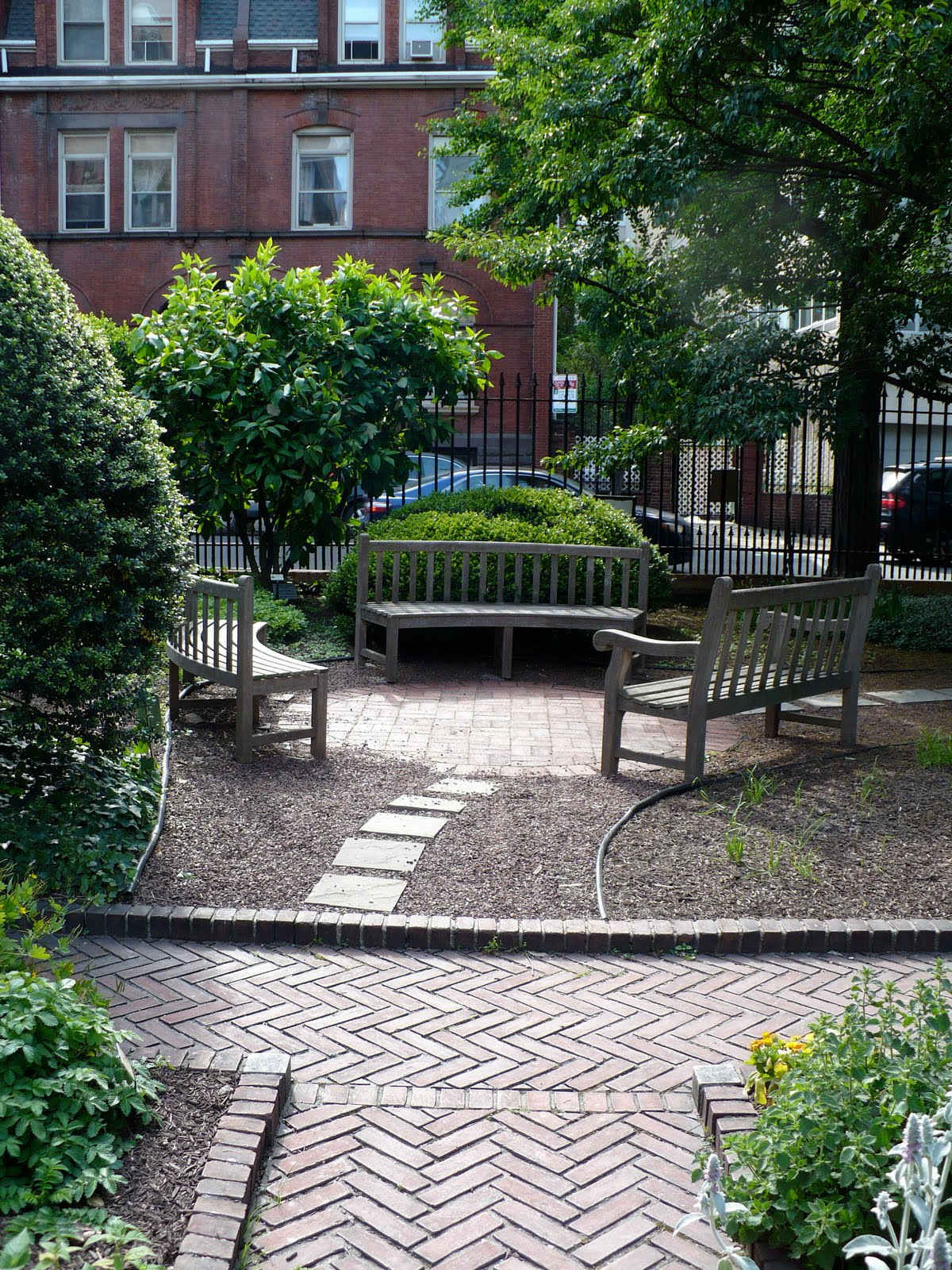
This statue is from the adjacent herb garden. It was refreshing to go there afterwards. Butterflies, birds, flowers and herbs, along with a circle of benches:


I jotted down some of the other things I saw:
- an exhibit on Lincoln and John Wilkes Booth (including thoracic tissue taken from Booth's body during his autopsy), and also a parallel exhibit of James Garfield and his assassin, Charles Guiteau, (and some preserved skin from Garfield, who with better medical care probably would have survived instead of experiencing a lingering painful descent into death).
- Dr. Politzer, the "father of otology", a man who did groundbreaking work on the ear
- suspended skeletons, some of them with obvious blunt trauma to their skulls or horrible curvature to the spine (as seen in Pott's Disease)
- various brains, from fish to human
- an enormous colon
- a small collection of body-related art, including one piece ("Hide" by Christina West), which is a sculpture of a nude woman, bent over, her hands against the wall (to see the sculpture's face you have to squat - if it even occurs to you to seek out her face).

There's a story for everyone and everything (down to the slightest bit of deviant tissue - it came from someone, under some set of circumstances).

Displayed in the museum, a quote by Thomas Hardy:

Why should a man's mind have been thrown into such close, sad, sensational, inexplicable relations with such a precarious object as his body?

We're frail. We know horror. We settle down and make our music anyway.

Tuesday, January 19, 2010

"They have actual operating rooms... and it's just amazing."

Two videos from CNN on the amazing work carried out by the Israeli army medical corps in Haiti:


They've got a state of the art field hospital set up. They're saving lives, treating difficult medical cases that other makeshift facilities are not yet equipped to handle, and doing so with efficiency, order, compassion, and calm. There's such a disaster in Haiti, but people like these professionals, who've come from so far away and do such great work - they're a fierce bright light in an abyss, a steady strength amid chaos.