Title: Detour (1945)
Director: Edgar G. Ulmer
Language: English
Rating: Unrated
Detour was made on a shoestring budget, which works for its overall mood. A musician, Al Roberts (Tom Neal), hitch-hikes across the US to get to his fiancée in California. She represents the sort of life that a schlimazel and, ultimately, murderer like him will never enjoy. He's not only unlucky, but wallows in his unluckiness, seems to rush out to meet opportunities that will further make him unlucky. One of the best shots is of his face, full of stubble and despair, as he sits in a diner.
The only time he seems to struggle against his character and fate is when he plays piano. The music feels like a protest against his worst impulses.
Most memorable of all is Vera, a woman Al meets on the road. Ann Savage plays Vera as a wildly creepy sexual hellcat, full of rage and bitterness. Her eyes alone promise torment. She could have been one of the Furies in a Greek tragedy. I like how Savage's performance evokes both a particular woman and vengeance incarnate. Al is almost definitely not the worst man Vera has ever had to deal with, but he's there, in her path, ready to embrace unluckiness.
Title: The Hitch-Hiker (1953)
Director: Ida Lupino
Language: English and some Spanish
Rating: Unrated
Two men on a fishing trip pick up a stranded motorist. He's Emmett Myers (William Talman), a psychotic criminal who has escaped from prison. One of his eyes never fully closes, so even when his victims think he might have fallen asleep (and they can maybe make a break for it), they aren't sure if he's watching them.
The filmmakers maintain strong psychological tension throughout the movie. Roy (Edmond O'Brien) and Gilbert (Frank Lovejoy), the fishing trip buddies, know that at some point Emmett will kill them. They just don't know when. (A fact that he torments them with.) Subtle contrasts emerge between them, in how they react to their likely fate, while struggling to stick together, stay sane, and find an opportunity to fight back.
There's an excellent use of music in this film, including some classical music in a scene out in a desert by a well where a killer may be disposed to drop bodies. There's also light Mexican folk music in a moment where Roy and Gilbert may very well die. The suspense is especially strong during one scene involving a long walk on a dock through shadows.
Part of the movie is set in Baja California, and notably it portrays the locals as people, not as caricatures of another culture. Another impression the movie made on me is how it never gets melodramatic. It just lets the tension stretch out, the feelings churn and from time to time erupt.
Showing posts with label road trip. Show all posts
Showing posts with label road trip. Show all posts
Thursday, October 27, 2016
Sunday, July 28, 2013
Week in Seven Words #177
curiosities
What do we learn in museums? Sometimes it's only 'oohs' and 'ahhs' and a fact or two. How many times do we really connect with what we're seeing - immerse ourselves in it?
discomposure
He flies around the souvenir shop like an agitated moth, landing on treasures and launching off them again. Finally, he clutches a prize to his chest, but keeps circling as he's told to put it down again.
flirtation
A butterfly lands on her shirt front, right on her breasts. She stares at it, eyebrows raised, until it flutters off. "Must be a boy," she says.
hives
Palatial buildings are home to the offices of petty bureaucrats.
jigsaw
The White House is beautiful, but in a strange way looks like a hollow 3D puzzle of itself.
morphemes
Fun word games give structure to the hours we spend on the road.
natation
Swimming through images captured by Hubble. Strolling in a warm, gray drizzle. Looking out from between low-hanging branches at the Tidal Basin and Jefferson's pale monument.
What do we learn in museums? Sometimes it's only 'oohs' and 'ahhs' and a fact or two. How many times do we really connect with what we're seeing - immerse ourselves in it?
discomposure
He flies around the souvenir shop like an agitated moth, landing on treasures and launching off them again. Finally, he clutches a prize to his chest, but keeps circling as he's told to put it down again.
flirtation
A butterfly lands on her shirt front, right on her breasts. She stares at it, eyebrows raised, until it flutters off. "Must be a boy," she says.
hives
Palatial buildings are home to the offices of petty bureaucrats.
jigsaw
The White House is beautiful, but in a strange way looks like a hollow 3D puzzle of itself.
morphemes
Fun word games give structure to the hours we spend on the road.
natation
Swimming through images captured by Hubble. Strolling in a warm, gray drizzle. Looking out from between low-hanging branches at the Tidal Basin and Jefferson's pale monument.


Monday, January 30, 2012
Worth Watching: Planes, Trains and Automobiles (1987)
Title: Planes, Trains and Automobiles
Director: John Hughes
Language: English
Rating: R (because of the f-word monologue)
Synopsis
A couple of days before Thanksgiving, Neal Page (Steve Martin) is wrapping up a tedious business meeting in New York City and plans to fly home to Chicago right after. When he leaves the meeting to rush to the airport, he doesn't expect the stressful convoluted journey that follows: a snow storm diverting his flight from Chicago to Wichita, and from there a scramble to get to Chicago via train, bus and car, in the company of a cheerful blabber-mouthed shower curtain ring salesman, Del Griffith (John Candy), who makes it his personal mission to get Neal home in time for Thanksgiving dinner.
Characters
This is a good buddy film and road trip movie, because it's funny, because Steve Martin and John Candy are wonderful here (the best I've seen them), and because the movie has surprising moments of depth and sadness. Beneath the humor there's sometimes a good amount of pain, and you don't expect it in a movie like this. The characters have humanity.

Del blabs on and on, leaves a mess behind him and laughs at corny jokes. He's big-hearted and friendly, has a large body, lugs a heavy trunk around - a big guy in a number of ways. You can't not notice him. He strikes me as someone who's grateful for any good company or bit of friendliness that comes his way. Happy with little pleasures. He's expansive when it comes to laughter and conversation (or one-sided chatter) but when he's hurt he handles his feelings with restraint, with a bruised dignity; his eyes show a wounded defiance.
It isn't surprising that Neal hurts Del a few times during the movie. Neal is fastidious and reserved, jealous of his personal space. To be thrown into close quarters with a loud messy stranger while his travel plans fall apart is painful for him. He tends to seethe and wince for a while and then snap, hitting at Del or at others with pointed sarcastic insults. But just as Del can be both annoying and lovable, Neal can be "a cold-hearted cynic" (as Del puts it) without coming across as really hateful; inside he's just tired and wants to get home to his wife and kids.
Relationships
From Del, Neal learns to lighten up a little and be more compassionate to others. From Neal, Del learns... it's hard to say. I guess he realizes at one point, sitting in a burned out shell of a car on a snowy night, that he could try to shut up from time to time. Because Neal is the more finicky character, the one who lacks the common touch, his subtle and gradual change of heart is the real focus of the movie.
Del is his friend, whether Neal likes it or not, and most of the time he really doesn't like it; for much of the movie he goes along with Del out of desperation, because he wants to get home. So that's Del's job: to bring him home, and to wear him down while also unintentionally showing him how to be a better person. And they do have some lovely moments of bonding.

Memorable sights and sounds
Owen. Owen wins for memorable sights and sounds. He's a minor character but he looms large in the mind and senses. The way he says "Stubbville." The way he snorts - not a long loud snort, but a little hog noise that makes his unsmiling face contort. And the look on Neal and Del's faces as they take him in, sort of marveling at him and at the circumstances that have brought him into their lives.
Then there's one of my favorite moments in the film: John Candy doing the Mess Around. It's night. Del is driving while Neal sleeps in the passenger seat. And suddenly Ray Charles is on the radio. This is a beautiful moment, because Del is shimmying and bopping his head and puffing on a cigarette as he pretends to play the piano on the dashboard. John Candy, you are missed.
Stand-out scenes
There are a number of little lines and scenes that jump out. Some of the lines don't sound like much when you aren't familiar with the movie. For instance, "you're going the wrong way." But the "you're going the wrong way" scene is a great example of how the filmmakers and actors took what could have been a conventional scenario in a road trip movie and turned it into something unique and funny.
The same can be said for Neal's f-word monologue. It isn't just about the f-word and its gratuitous use. The lines are delivered with exquisite timing and emphasis (Steve Martin I suspect had a lot of fun with this scene). For reasons that I'll leave you to discover, Neal has sort of lost it, broken down a little from the stress and frustration. But he doesn't rave at people. He still has a certain composure. He can explain himself reasonably well. On the receiving end of his monologue is a woman who works at a car rental agency. She has sweet plump cheeks and a hint of poison in her smile. And the final word belongs to her. (She's played by Edie McClurg, who's also the school secretary in Ferris Bueller's Day Off.) One of the things I like about this movie is that as far as I can remember Neal never gets away with being insulting or rude to anyone; there are always consequences for him, or some sort of sharp wake-up call.
Finally when talking about stand-out scenes I have to mention the part where Neal and Del reach Chicago. It gets to me every time.
Further thoughts
One of the reasons I like this movie is because I grew up with it. This might have been the first R-rated film I watched (except for some of the language most of the film is pretty tame, especially by today's standards). I've lost count of how many times I've watched it or parts of it over the years, usually around Thanksgiving. It's a kind of comfort movie for me.

*All images link back to their source (Rottentomatoes)
Director: John Hughes
Language: English
Rating: R (because of the f-word monologue)
Synopsis
A couple of days before Thanksgiving, Neal Page (Steve Martin) is wrapping up a tedious business meeting in New York City and plans to fly home to Chicago right after. When he leaves the meeting to rush to the airport, he doesn't expect the stressful convoluted journey that follows: a snow storm diverting his flight from Chicago to Wichita, and from there a scramble to get to Chicago via train, bus and car, in the company of a cheerful blabber-mouthed shower curtain ring salesman, Del Griffith (John Candy), who makes it his personal mission to get Neal home in time for Thanksgiving dinner.
Characters
This is a good buddy film and road trip movie, because it's funny, because Steve Martin and John Candy are wonderful here (the best I've seen them), and because the movie has surprising moments of depth and sadness. Beneath the humor there's sometimes a good amount of pain, and you don't expect it in a movie like this. The characters have humanity.
Del blabs on and on, leaves a mess behind him and laughs at corny jokes. He's big-hearted and friendly, has a large body, lugs a heavy trunk around - a big guy in a number of ways. You can't not notice him. He strikes me as someone who's grateful for any good company or bit of friendliness that comes his way. Happy with little pleasures. He's expansive when it comes to laughter and conversation (or one-sided chatter) but when he's hurt he handles his feelings with restraint, with a bruised dignity; his eyes show a wounded defiance.
It isn't surprising that Neal hurts Del a few times during the movie. Neal is fastidious and reserved, jealous of his personal space. To be thrown into close quarters with a loud messy stranger while his travel plans fall apart is painful for him. He tends to seethe and wince for a while and then snap, hitting at Del or at others with pointed sarcastic insults. But just as Del can be both annoying and lovable, Neal can be "a cold-hearted cynic" (as Del puts it) without coming across as really hateful; inside he's just tired and wants to get home to his wife and kids.
Relationships
From Del, Neal learns to lighten up a little and be more compassionate to others. From Neal, Del learns... it's hard to say. I guess he realizes at one point, sitting in a burned out shell of a car on a snowy night, that he could try to shut up from time to time. Because Neal is the more finicky character, the one who lacks the common touch, his subtle and gradual change of heart is the real focus of the movie.
Del is his friend, whether Neal likes it or not, and most of the time he really doesn't like it; for much of the movie he goes along with Del out of desperation, because he wants to get home. So that's Del's job: to bring him home, and to wear him down while also unintentionally showing him how to be a better person. And they do have some lovely moments of bonding.
Memorable sights and sounds
Owen. Owen wins for memorable sights and sounds. He's a minor character but he looms large in the mind and senses. The way he says "Stubbville." The way he snorts - not a long loud snort, but a little hog noise that makes his unsmiling face contort. And the look on Neal and Del's faces as they take him in, sort of marveling at him and at the circumstances that have brought him into their lives.
Then there's one of my favorite moments in the film: John Candy doing the Mess Around. It's night. Del is driving while Neal sleeps in the passenger seat. And suddenly Ray Charles is on the radio. This is a beautiful moment, because Del is shimmying and bopping his head and puffing on a cigarette as he pretends to play the piano on the dashboard. John Candy, you are missed.
Stand-out scenes
There are a number of little lines and scenes that jump out. Some of the lines don't sound like much when you aren't familiar with the movie. For instance, "you're going the wrong way." But the "you're going the wrong way" scene is a great example of how the filmmakers and actors took what could have been a conventional scenario in a road trip movie and turned it into something unique and funny.
The same can be said for Neal's f-word monologue. It isn't just about the f-word and its gratuitous use. The lines are delivered with exquisite timing and emphasis (Steve Martin I suspect had a lot of fun with this scene). For reasons that I'll leave you to discover, Neal has sort of lost it, broken down a little from the stress and frustration. But he doesn't rave at people. He still has a certain composure. He can explain himself reasonably well. On the receiving end of his monologue is a woman who works at a car rental agency. She has sweet plump cheeks and a hint of poison in her smile. And the final word belongs to her. (She's played by Edie McClurg, who's also the school secretary in Ferris Bueller's Day Off.) One of the things I like about this movie is that as far as I can remember Neal never gets away with being insulting or rude to anyone; there are always consequences for him, or some sort of sharp wake-up call.
Finally when talking about stand-out scenes I have to mention the part where Neal and Del reach Chicago. It gets to me every time.
Further thoughts
One of the reasons I like this movie is because I grew up with it. This might have been the first R-rated film I watched (except for some of the language most of the film is pretty tame, especially by today's standards). I've lost count of how many times I've watched it or parts of it over the years, usually around Thanksgiving. It's a kind of comfort movie for me.
*All images link back to their source (Rottentomatoes)
Wednesday, May 25, 2011
Worth Watching: Alice Doesn't Live Here Anymore (1974)
Title: Alice Doesn't Live Here Anymore
Director: Martin Scorsese
Language: English
Rating: PG (though I'd make it PG-13, mostly for Harvey Keitel's character)
Synopsis
Alice Hyatt (Ellen Burstyn) is a widow who plans to move with her 11-year-old son, Tommy (Alfred Lutter), from their home in New Mexico to Monterey, California where she had lived as a girl. Short on cash, they need to stop along the way at different cities for Alice to earn some more money - ideally as a singer (which has always been her dream) but, if necessary, as a waitress too. As she and Tommy meet and tangle with all kinds of people, they find themselves changing their plans.
Ten reasons the film is worth watching
1) Alice is a wonderful, complex character - blunt, goofy, incisive, and self-doubting. Ellen Burstyn's performance is terrific and got her a well-deserved Best Actress Oscar; it never feels like she's acting, but that Alice is in fact a real person. She's the heart of the film.
2) The relationship between Alice and Tommy is well-written, with natural and often funny back-and-forth between them; at the heart of it they're kindred spirits. I liked the kid, mostly because he comes across as a real kid and not a cutesy child caricature.
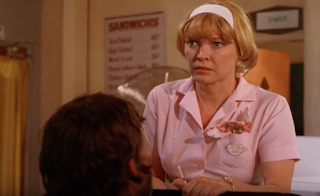
3) There are memorable secondary characters too, and they're written and acted without self-consciousness; as odd as they sometimes get, their eccentricity just seems a natural part of things and not something that's forced out for laughs. I especially like the two waitresses at the diner in Tucson: Flo (Diane Ladd) and Vera (Valerie Curtin). Flo is tough, brassy, and swears creatively, but there are other sides of her that you discover as the movie progresses. And Vera is just strangely likeable and happily unexplainable.
4) Harvey Keitel also crops up as Ben, a man eight years younger than Alice who knows how to make her laugh, is kind of silly and persistent. Because he's played by Harvey Keitel, grinning like a cat, I kept waiting for the other shoe to drop...
5) There's a romance angle to the film in the form of David (Kris Kristofferson), a lonely clear-eyed rancher. Just like the rest of the movie the romance isn't cute or sentimental. There's genuine chemistry and friendship between Alice and David, along with a few rough patches they need to work through. The scene where they're in his kitchen after making love, and she's telling him about the stage act she used to do with her brother, is one example of how the movie keeps this relationship fresh. It's between two particular people - not a canned Hollywood romance.
6) The film is well-paced with some beautiful camera work. There are several scenes and sequences that stand out in particular, like when Alice is looking for a job in Phoenix. The last time she worked as a singer was before her marriage, and now she's older, her voice is charming but rusty, and she's going in heels and a new dress to all these different bars trying to find someone who will hire her. The pressure and fear of failure are palpable, the scrutiny from others is something that as a viewer you can feel even though it's directed at her, and Alice is a picture of determination and desperation - she not only needs the money, but needs to be able to tell her son (who's waiting for her in a rundown motel room) that she landed a job.
7) It's worth saying again that Burstyn's performance is one-of-a-kind. She also had a lot of creative control over this film, ideas of what it should be like, and selected Scorsese as the director.
8) Strong dialogue and character development in Robert Getchell's screenplay.
9) If you're a fan of Jodie Foster, she's here too as a guitar-playing tomboy. Not a large part, but she's got some funny moments as Tommy's new friend in Tucson. (A few years after this film she appeared in Scorsese's Taxi Driver as a 12 year old prostitute exploited by Harvey Keitel's character, Sport, who lounges around in doorways grinning like a cat.)
10) The film shows Scorsese's range. No mobsters, no urban underbelly; the setting is the southwest US. He makes a movie about an interesting woman, her dreams, losses, loves, her choices good and bad, her friendship with other women (some great scenes between Alice and her friend Bea at the start of the film in New Mexico, and then her relationship with Flo). What she's like as a mother, a lover, a person on her own and among other people. A warm, funny and unsparing character portrait.
Director: Martin Scorsese
Language: English
Rating: PG (though I'd make it PG-13, mostly for Harvey Keitel's character)
Synopsis
Alice Hyatt (Ellen Burstyn) is a widow who plans to move with her 11-year-old son, Tommy (Alfred Lutter), from their home in New Mexico to Monterey, California where she had lived as a girl. Short on cash, they need to stop along the way at different cities for Alice to earn some more money - ideally as a singer (which has always been her dream) but, if necessary, as a waitress too. As she and Tommy meet and tangle with all kinds of people, they find themselves changing their plans.

Ten reasons the film is worth watching
1) Alice is a wonderful, complex character - blunt, goofy, incisive, and self-doubting. Ellen Burstyn's performance is terrific and got her a well-deserved Best Actress Oscar; it never feels like she's acting, but that Alice is in fact a real person. She's the heart of the film.
2) The relationship between Alice and Tommy is well-written, with natural and often funny back-and-forth between them; at the heart of it they're kindred spirits. I liked the kid, mostly because he comes across as a real kid and not a cutesy child caricature.
3) There are memorable secondary characters too, and they're written and acted without self-consciousness; as odd as they sometimes get, their eccentricity just seems a natural part of things and not something that's forced out for laughs. I especially like the two waitresses at the diner in Tucson: Flo (Diane Ladd) and Vera (Valerie Curtin). Flo is tough, brassy, and swears creatively, but there are other sides of her that you discover as the movie progresses. And Vera is just strangely likeable and happily unexplainable.
4) Harvey Keitel also crops up as Ben, a man eight years younger than Alice who knows how to make her laugh, is kind of silly and persistent. Because he's played by Harvey Keitel, grinning like a cat, I kept waiting for the other shoe to drop...
5) There's a romance angle to the film in the form of David (Kris Kristofferson), a lonely clear-eyed rancher. Just like the rest of the movie the romance isn't cute or sentimental. There's genuine chemistry and friendship between Alice and David, along with a few rough patches they need to work through. The scene where they're in his kitchen after making love, and she's telling him about the stage act she used to do with her brother, is one example of how the movie keeps this relationship fresh. It's between two particular people - not a canned Hollywood romance.
6) The film is well-paced with some beautiful camera work. There are several scenes and sequences that stand out in particular, like when Alice is looking for a job in Phoenix. The last time she worked as a singer was before her marriage, and now she's older, her voice is charming but rusty, and she's going in heels and a new dress to all these different bars trying to find someone who will hire her. The pressure and fear of failure are palpable, the scrutiny from others is something that as a viewer you can feel even though it's directed at her, and Alice is a picture of determination and desperation - she not only needs the money, but needs to be able to tell her son (who's waiting for her in a rundown motel room) that she landed a job.
7) It's worth saying again that Burstyn's performance is one-of-a-kind. She also had a lot of creative control over this film, ideas of what it should be like, and selected Scorsese as the director.
8) Strong dialogue and character development in Robert Getchell's screenplay.
9) If you're a fan of Jodie Foster, she's here too as a guitar-playing tomboy. Not a large part, but she's got some funny moments as Tommy's new friend in Tucson. (A few years after this film she appeared in Scorsese's Taxi Driver as a 12 year old prostitute exploited by Harvey Keitel's character, Sport, who lounges around in doorways grinning like a cat.)
10) The film shows Scorsese's range. No mobsters, no urban underbelly; the setting is the southwest US. He makes a movie about an interesting woman, her dreams, losses, loves, her choices good and bad, her friendship with other women (some great scenes between Alice and her friend Bea at the start of the film in New Mexico, and then her relationship with Flo). What she's like as a mother, a lover, a person on her own and among other people. A warm, funny and unsparing character portrait.
Subscribe to:
Posts (Atom)