bits
Floor-to-ceiling windows frame a cityscape that looks like the inside of a computer.
diminished
She used to strike me as formidable in social settings, able to charm anyone and steer a conversation to where she liked. This time she comes across as clumsy and out of her depth, as she cuts into other people's sentences or responds to them with expressionless politeness. I feel bad for her, and wish I had more social graces, to shield her.
permeability
Fiddling with a flute of champagne on the edges of a crowd.
pursuing
Her love of science, combined with her family's alarming medical history, have pushed her towards a career researching cancer.
shamed
On top of the mental illness is the stigma, keeping people from feeling human and connected with others.
sighing
His voice is weary when he greets us, as if he regrets remembering our names.
unsullied
On pristine plates, they present dollops of food - three elegant squares of ravioli, or three hillocks of rice with a spray of vegetables.
Showing posts with label research. Show all posts
Showing posts with label research. Show all posts
Thursday, April 2, 2015
Tuesday, February 12, 2013
Worth Watching: Desk Set (1957)
Title: Desk Set
Director: Walter Lang
Language: English
Rating: Unrated
Desk Set is a charming office romance featuring Bunny Watson (Katharine Hepburn), the head research librarian at a major TV network, and Richard Sumner (Spencer Tracy), an engineer whose giant computer might cost Bunny and her team of librarians their jobs.
One description I read of this movie claimed that Bunny and Richard clash dramatically, but I didn't find this to be true. The movie shows them slowly getting comfortable with each other and developing a mutual respect; both of them are quirky, middle-aged nerds, and their romance is gentle.

Bunny has a boyfriend at the beginning of the movie - one of the network executives, in fact (played by Gig Young) - but he desires her more for her dependability and usefulness and less for her personal qualities. Richard, on the other hand, just likes her as she is and respects her work. Given that Desk Set was filmed in the 1950s, I was surprised that the movie did a fairly decent job portraying a group of smart, hard-working women in the workplace who are friends and colleagues. These ladies are also very snappy dressers.
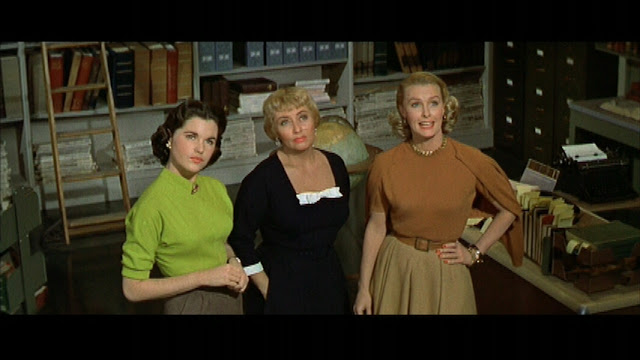
The only woman whose portrayal was off-the-mark was Richard's finicky lab assistant, who collapses into unnecessary and unrealistic hysterics at one point, because the filmmakers thought it would be funny.
I enjoyed the giant computer, EMERAC - really a sign of the times, how huge this computer was. And though computers have become much smaller, and more powerful and multifunctional, the concern raised in this movie is still relevant today: In what ways will computers take the place of people in the workplace? The movie's answer to that is rather sophisticated; it really takes into consideration the kinds of jobs people perform and the limitations of computers.
What else did I like? Bunny's friendship with her most senior employee, Peg (Joan Blondell), and their fun at an office holiday party.

I'm glad I came across Desk Set. It's low-key, lovely, with some well-written conversations and memorable scenes (including a rooftop lunch combined with a test of memory and logic). The screenplay was written by Nora Ephron's parents, Phoebe and Henry; I'm not that familiar with their work or with Nora's, but if you're a fan, that's another reason to check out this movie.
*All images link back to their sources (The Movie Projector and Glamamor).
Director: Walter Lang
Language: English
Rating: Unrated
Desk Set is a charming office romance featuring Bunny Watson (Katharine Hepburn), the head research librarian at a major TV network, and Richard Sumner (Spencer Tracy), an engineer whose giant computer might cost Bunny and her team of librarians their jobs.
One description I read of this movie claimed that Bunny and Richard clash dramatically, but I didn't find this to be true. The movie shows them slowly getting comfortable with each other and developing a mutual respect; both of them are quirky, middle-aged nerds, and their romance is gentle.
Bunny has a boyfriend at the beginning of the movie - one of the network executives, in fact (played by Gig Young) - but he desires her more for her dependability and usefulness and less for her personal qualities. Richard, on the other hand, just likes her as she is and respects her work. Given that Desk Set was filmed in the 1950s, I was surprised that the movie did a fairly decent job portraying a group of smart, hard-working women in the workplace who are friends and colleagues. These ladies are also very snappy dressers.
The only woman whose portrayal was off-the-mark was Richard's finicky lab assistant, who collapses into unnecessary and unrealistic hysterics at one point, because the filmmakers thought it would be funny.
I enjoyed the giant computer, EMERAC - really a sign of the times, how huge this computer was. And though computers have become much smaller, and more powerful and multifunctional, the concern raised in this movie is still relevant today: In what ways will computers take the place of people in the workplace? The movie's answer to that is rather sophisticated; it really takes into consideration the kinds of jobs people perform and the limitations of computers.
What else did I like? Bunny's friendship with her most senior employee, Peg (Joan Blondell), and their fun at an office holiday party.
I'm glad I came across Desk Set. It's low-key, lovely, with some well-written conversations and memorable scenes (including a rooftop lunch combined with a test of memory and logic). The screenplay was written by Nora Ephron's parents, Phoebe and Henry; I'm not that familiar with their work or with Nora's, but if you're a fan, that's another reason to check out this movie.
*All images link back to their sources (The Movie Projector and Glamamor).


Monday, June 25, 2012
Worth Watching: Footnote (2011)
Title: Footnote
Director: Joseph Cedar
Language: Hebrew
Rating: PG

Eliezer Shkolnik (Shlomo Bar-Aba) and his son, Uriel (Lior Ashkenazi), are both Israeli university professors and Talmudic scholars. Eliezer represents an older, unfashionable school of scholarship based on pain-staking life-long narrow work that may or may not lead to any noteworthy findings. At one point in his career, he had come close to publishing decades of his research in what might have been a ground-breaking book, but a chance discovery made by an academic rival, Yehuda Grossman (Micah Lewensohn), doomed Eliezer's manuscript to the city dump. When the movie begins, Eliezer has few publications and accolades to his name, and furthermore lacks the social skills to advance in the university. Shunted to the side, he buries himself in his study at home or in the shadowy corners of the national library. He also regards Uriel with great bitterness.
Uriel is in many ways the opposite of his father. He's charismatic and adept at schmoozing and departmental politicking. He's a bright and dazzling researcher who publishes prolifically on many different topics and has written popular books about his scholarship; he's also a well-regarded lecturer, delivering his talks with wit and passion. He tells a colleague at one point that it's important to keep moving forward, to be active, to write and publish and speak out about your ideas as much as you can even if you're not yet sure of their validity. Though he's only middle-aged, Uriel is already an academic titan whose success fuels Eliezer's bitterness and resentment, along with his contempt for Uriel's entire approach to scholarship.
For years, Uriel has been nominating Eliezer for the prestigious Israel Prize, coveted by academics. Uriel knows how much the prize would mean to his embittered father. But why would Eliezer want it so much? If he doesn't respect the current crop of academics and what they stand for, why would he crave their recognition? The answer to that lies at the heart of Footnote. Eliezer might be devoted to truth and objective scholarly pursuits, but he's human, isn't he? His ego still demands to be fed, even by people he considers unworthy. Maybe he doesn't care that the prize committee, in his opinion, is made up of intellectual lightweights. The prize itself could stand for truth and excellence irrespective of who's handing it out; in the recent past it may have been awarded to undeserving people, but Eliezer is proud enough to believe that he could polish off some of the tarnish it's accumulated over the years. He also wants to see himself recognized for once as more than just a scholarly footnote.
In Footnote, it's difficult to fathom the extent to which people are motivated by truth versus petty ego or pride. A great example of this toxic mix of truth and ego emerges in an intense, brilliantly written confrontation between Uriel and Yehuda Grossman, the professor who damaged Eliezer's academic career. Grossman's motives are left ambiguous. Did he undermine Eliezer's career because he genuinely thought that Eliezer was a plodding, problematic researcher? Or did he do it out of jealousy and spite? Or why not both?
The idea that academia is a bastion of objectivity often blinds people, including the academics themselves, to the very human and sometimes very ugly personal motives that they're all vulnerable to, no matter how high-minded or objective they think they are as scholars. Eliezer's contempt for his son's work, for example, stems not only from genuine scholarly disdain but from Eliezer's wounded ego. As long as he has the scholarly justification for his animosity, Eliezer can dismiss the deeper and messier truths in his life and ignore the ways in which he hurts his son.
The extent of Eliezer's petty rancor is never clear. He seems largely disconnected from emotions, both his own and other people's, and (at least from what we see on screen) is rarely open to others. Maybe most of his bitterness towards his son really is provoked by the sloppiness he perceives in Uriel's work and his disappointment in how academic standards have fallen more generally. His beef against Uriel and the wider academic world really could be driven mostly by scholarly considerations. But maybe his pride has blinded him to any excellence in his son's work. It's so easy for resentment and wounded pride to be mixed in deeply with more principled motives, until they're all indistinguishable.
When Eliezer receives a phone call out of the blue informing him that he's won the Israel Prize, the rush of emotion and the gratification to his ego is so great that he's blinded to details that he would have picked up on immediately under normal circumstances. What follows is the happiest day of his life. Finally he has it - the top prize, the place among his peers, the recognition of his life's work and proof perhaps that his approach to scholarship isn't obsolete.
A day later, Uriel also receives a phone call. It's from the Israel Prize committee, and they're summoning him to a private meeting. As it turns out, Uriel won the Israel Prize, but because of clerical carelessness his father was notified. Now the committee wants Uriel to inform Eliezer of the mistake.
Uriel objects. He argues that it would kill his father to not only get the prize taken from him but to see it awarded to his son. He claims that Eliezer in fact deserves the prize - has deserved it for years. Even later, when he realizes that his father's achievements maybe aren't so grand in scope, Uriel emphasizes the personal devastation and the irreparable blow to the father-son relationship that would result. It isn't as if Uriel is close to his father; Eliezer's personality and preoccupation with his work have made him distant from nearly everyone. But Uriel fears that his father would loathe him.
What if Uriel were to give up the prize and maintain the charade that it was intended for his father all along? He would spare his father from public humiliation and personal hurt but also make him an unwitting accomplice to a lie; Eliezer, in his scholarly work at least, has always been meticulous and accurate. Furthermore, Uriel loves recognition - one key way in which he's similar to his father. By passing on the award, will he ever be able to claim it for himself? Would he ever get recognition and respect from his father?
If Eliezer found out about the deception, how would he react, knowing that the award was granted to him thanks to his son's efforts? Uriel's actions may be self-sacrificing, but he has also trapped Eliezer in a fiction. Because Uriel wants to protect his father's ego from yet another blow, he maintains an illusion around him. Could Eliezer ever penetrate it? This is his one chance to be embraced by his academic peers, when for decades he's labored among a handful of like-minded scholars in the depths of the library, people coming to identify him primarily as 'Uriel's father' rather than as a notable academic in his own right. The award reflects what he feels he deserves, and what his son wants him to have in order to feel less embittered - but does he merit it? Does his fragile pride, and his son's need to protect it, trap them both in a lie? What does the award itself come to mean, compromised as it is?
The movie starts with a lie - an anecdote distorted by Uriel about a time his father supposedly inspired him, when instead Eliezer was acting out of pride (and not with much honesty, it seems). The movie ends with a public lie too, as far as we know. My first reaction to the ending was, "What a cop out!" but then I came to appreciate its thought-provoking quality. The movie in some ways is like an incomplete text. We're given some facts and footnotes about the characters, we witness their surface struggles and hear some general principles stated: that there are some things a son shouldn't know about his father, and that a man shouldn't envy his son or his pupil. But the characters also have dimensions only hinted at. Their relationships are shown in glimpses, brief emotional exchanges and meaningful silences, that suggest depths we can't readily access. Watching them, we're interpreters of a complex text.
Uriel for instance has children of his own, including a son, Josh (Daniel Markovich), who seems to have no ambitions in life. Has he tuned out because he grew up in the shadow of his father and grandfather, who are both obsessed with greatness? Does he recoil from the hypocrisies and pettiness so often found at the heart of ambitious enterprise? Maybe in observing Uriel and Eliezer he concludes that it's impossible for a son to truly please a father. We never find out what's going on with Josh, but those are some likely guesses. In the beginning of the movie, we hear that Eliezer's wife, Yehudit (Aliza Rosen), has the title of 'doctor' but never learn what kind of doctor she is; though she and her husband live under the same roof, they don't really live together - they sleep in separate rooms and engage in some stilted conversation - but we never find out why they're so distant from each other, though we can make guesses. Uriel's wife, Dikla (Alma Zack), is primarily his sounding board and occasionally punctures his pretensions about himself. We know relatively little about the wives and children, because everyone in the movie is secondary to the father and son, their egos and demands. And even the father and son aren't fully revealed to us, though I think by the end they learn a good deal about each other and maybe about themselves.
Both Shlomo Bar-Aba and Lior Ashkenazi give wonderful performances (Bar-Aba excels at playing a closed-off quietly tormented character). One problem I initially had with the ending was that I wanted a father-son confrontation; they barely speak to each other throughout the movie. Then I realized that they do have a confrontation, obliquely, through text. They communicate to each other through their scholarly habits and their use of language. One word that stands out is 'fortress.' A fortress can be a means of defense. It can also be a trap, shutting people away within its walls. A fortress can seem impregnable, when in reality it has fundamental weaknesses in its structure that you can spot and exploit if you know where to look.
Director: Joseph Cedar
Language: Hebrew
Rating: PG

Eliezer Shkolnik (Shlomo Bar-Aba) and his son, Uriel (Lior Ashkenazi), are both Israeli university professors and Talmudic scholars. Eliezer represents an older, unfashionable school of scholarship based on pain-staking life-long narrow work that may or may not lead to any noteworthy findings. At one point in his career, he had come close to publishing decades of his research in what might have been a ground-breaking book, but a chance discovery made by an academic rival, Yehuda Grossman (Micah Lewensohn), doomed Eliezer's manuscript to the city dump. When the movie begins, Eliezer has few publications and accolades to his name, and furthermore lacks the social skills to advance in the university. Shunted to the side, he buries himself in his study at home or in the shadowy corners of the national library. He also regards Uriel with great bitterness.
Uriel is in many ways the opposite of his father. He's charismatic and adept at schmoozing and departmental politicking. He's a bright and dazzling researcher who publishes prolifically on many different topics and has written popular books about his scholarship; he's also a well-regarded lecturer, delivering his talks with wit and passion. He tells a colleague at one point that it's important to keep moving forward, to be active, to write and publish and speak out about your ideas as much as you can even if you're not yet sure of their validity. Though he's only middle-aged, Uriel is already an academic titan whose success fuels Eliezer's bitterness and resentment, along with his contempt for Uriel's entire approach to scholarship.
For years, Uriel has been nominating Eliezer for the prestigious Israel Prize, coveted by academics. Uriel knows how much the prize would mean to his embittered father. But why would Eliezer want it so much? If he doesn't respect the current crop of academics and what they stand for, why would he crave their recognition? The answer to that lies at the heart of Footnote. Eliezer might be devoted to truth and objective scholarly pursuits, but he's human, isn't he? His ego still demands to be fed, even by people he considers unworthy. Maybe he doesn't care that the prize committee, in his opinion, is made up of intellectual lightweights. The prize itself could stand for truth and excellence irrespective of who's handing it out; in the recent past it may have been awarded to undeserving people, but Eliezer is proud enough to believe that he could polish off some of the tarnish it's accumulated over the years. He also wants to see himself recognized for once as more than just a scholarly footnote.
In Footnote, it's difficult to fathom the extent to which people are motivated by truth versus petty ego or pride. A great example of this toxic mix of truth and ego emerges in an intense, brilliantly written confrontation between Uriel and Yehuda Grossman, the professor who damaged Eliezer's academic career. Grossman's motives are left ambiguous. Did he undermine Eliezer's career because he genuinely thought that Eliezer was a plodding, problematic researcher? Or did he do it out of jealousy and spite? Or why not both?
The idea that academia is a bastion of objectivity often blinds people, including the academics themselves, to the very human and sometimes very ugly personal motives that they're all vulnerable to, no matter how high-minded or objective they think they are as scholars. Eliezer's contempt for his son's work, for example, stems not only from genuine scholarly disdain but from Eliezer's wounded ego. As long as he has the scholarly justification for his animosity, Eliezer can dismiss the deeper and messier truths in his life and ignore the ways in which he hurts his son.
The extent of Eliezer's petty rancor is never clear. He seems largely disconnected from emotions, both his own and other people's, and (at least from what we see on screen) is rarely open to others. Maybe most of his bitterness towards his son really is provoked by the sloppiness he perceives in Uriel's work and his disappointment in how academic standards have fallen more generally. His beef against Uriel and the wider academic world really could be driven mostly by scholarly considerations. But maybe his pride has blinded him to any excellence in his son's work. It's so easy for resentment and wounded pride to be mixed in deeply with more principled motives, until they're all indistinguishable.
When Eliezer receives a phone call out of the blue informing him that he's won the Israel Prize, the rush of emotion and the gratification to his ego is so great that he's blinded to details that he would have picked up on immediately under normal circumstances. What follows is the happiest day of his life. Finally he has it - the top prize, the place among his peers, the recognition of his life's work and proof perhaps that his approach to scholarship isn't obsolete.
A day later, Uriel also receives a phone call. It's from the Israel Prize committee, and they're summoning him to a private meeting. As it turns out, Uriel won the Israel Prize, but because of clerical carelessness his father was notified. Now the committee wants Uriel to inform Eliezer of the mistake.
Uriel objects. He argues that it would kill his father to not only get the prize taken from him but to see it awarded to his son. He claims that Eliezer in fact deserves the prize - has deserved it for years. Even later, when he realizes that his father's achievements maybe aren't so grand in scope, Uriel emphasizes the personal devastation and the irreparable blow to the father-son relationship that would result. It isn't as if Uriel is close to his father; Eliezer's personality and preoccupation with his work have made him distant from nearly everyone. But Uriel fears that his father would loathe him.
What if Uriel were to give up the prize and maintain the charade that it was intended for his father all along? He would spare his father from public humiliation and personal hurt but also make him an unwitting accomplice to a lie; Eliezer, in his scholarly work at least, has always been meticulous and accurate. Furthermore, Uriel loves recognition - one key way in which he's similar to his father. By passing on the award, will he ever be able to claim it for himself? Would he ever get recognition and respect from his father?
If Eliezer found out about the deception, how would he react, knowing that the award was granted to him thanks to his son's efforts? Uriel's actions may be self-sacrificing, but he has also trapped Eliezer in a fiction. Because Uriel wants to protect his father's ego from yet another blow, he maintains an illusion around him. Could Eliezer ever penetrate it? This is his one chance to be embraced by his academic peers, when for decades he's labored among a handful of like-minded scholars in the depths of the library, people coming to identify him primarily as 'Uriel's father' rather than as a notable academic in his own right. The award reflects what he feels he deserves, and what his son wants him to have in order to feel less embittered - but does he merit it? Does his fragile pride, and his son's need to protect it, trap them both in a lie? What does the award itself come to mean, compromised as it is?
The movie starts with a lie - an anecdote distorted by Uriel about a time his father supposedly inspired him, when instead Eliezer was acting out of pride (and not with much honesty, it seems). The movie ends with a public lie too, as far as we know. My first reaction to the ending was, "What a cop out!" but then I came to appreciate its thought-provoking quality. The movie in some ways is like an incomplete text. We're given some facts and footnotes about the characters, we witness their surface struggles and hear some general principles stated: that there are some things a son shouldn't know about his father, and that a man shouldn't envy his son or his pupil. But the characters also have dimensions only hinted at. Their relationships are shown in glimpses, brief emotional exchanges and meaningful silences, that suggest depths we can't readily access. Watching them, we're interpreters of a complex text.
Uriel for instance has children of his own, including a son, Josh (Daniel Markovich), who seems to have no ambitions in life. Has he tuned out because he grew up in the shadow of his father and grandfather, who are both obsessed with greatness? Does he recoil from the hypocrisies and pettiness so often found at the heart of ambitious enterprise? Maybe in observing Uriel and Eliezer he concludes that it's impossible for a son to truly please a father. We never find out what's going on with Josh, but those are some likely guesses. In the beginning of the movie, we hear that Eliezer's wife, Yehudit (Aliza Rosen), has the title of 'doctor' but never learn what kind of doctor she is; though she and her husband live under the same roof, they don't really live together - they sleep in separate rooms and engage in some stilted conversation - but we never find out why they're so distant from each other, though we can make guesses. Uriel's wife, Dikla (Alma Zack), is primarily his sounding board and occasionally punctures his pretensions about himself. We know relatively little about the wives and children, because everyone in the movie is secondary to the father and son, their egos and demands. And even the father and son aren't fully revealed to us, though I think by the end they learn a good deal about each other and maybe about themselves.
Both Shlomo Bar-Aba and Lior Ashkenazi give wonderful performances (Bar-Aba excels at playing a closed-off quietly tormented character). One problem I initially had with the ending was that I wanted a father-son confrontation; they barely speak to each other throughout the movie. Then I realized that they do have a confrontation, obliquely, through text. They communicate to each other through their scholarly habits and their use of language. One word that stands out is 'fortress.' A fortress can be a means of defense. It can also be a trap, shutting people away within its walls. A fortress can seem impregnable, when in reality it has fundamental weaknesses in its structure that you can spot and exploit if you know where to look.
Wednesday, January 20, 2010
Monkeying around
Only humans 'use laughter to mock or insult others' says this article (though I'm not sure if the claim is well-supported, at least based only on what's written here).
"How was work today, dear?"
"You know, the usual. Went to a meeting, analyzed some data, tickled a couple of apes."
And it's not just apes:
Researchers carried out "tickling sessions" on gorillas, chimpanzees and orangutans and compared the sounds to recordings of humans laughing.
"How was work today, dear?"
"You know, the usual. Went to a meeting, analyzed some data, tickled a couple of apes."
And it's not just apes:
The researchers also found that other animals, including bats, made different sounds when they were tickled, but that these may not be the same as laughter.
Subscribe to:
Posts (Atom)