Showing posts with label literature. Show all posts

Tuesday, September 26, 2017

Lucy Snowe from Charlotte Bronte's Villette is a fascinating narrator

Lucy Snowe, the narrator for Charlotte Bronte's Villette, starts her story in her godmother's house, where she's visiting. She's a teenager at the time and inhabits the house like a shadow. She says next to nothing about her birth family, which is unusual; all we know is that she's English. She observes other people closely, and she enjoys some quiet pleasures, unnoticed. Soon after this visit, she makes vague reference to events that lead her to fall out of touch with her godmother, and the tragedies and hardships that leave her alone in the world as a young woman. (No details on what exactly happens.) She winds up working in a French school, and her thoughts about her circumstances are realistic and complex.


Part of why I find this narrator fascinating is that she can be frank and blunt. But then she'll turn away suddenly, holding back information and withdrawing from the reader's sight. She is outwardly reserved - many people think her so - while emotions can run rampant in her. She isn't an unreliable narrator in the sense that she has sinister motives or strong delusions, but she's disconcerting. She understands how much she's confessing, and wants to keep some things to herself. Sometimes, she'll introduce a detail or observation that jars the reader out of the complacent belief that they've got the characters fixed in their mind. The reader is kept at an uneasy distance while still being absorbed in the narrative.

Thursday, July 16, 2015

Cleo and the Black Boston Elite in The Living Is Easy by Dorothy West

… she would cut off her arm for these sisters of hers with the same knife she held at the tenderest spot in their hearts.
That's Cleo, the main character of a book that brings to life the world of Boston's black elite shortly before and during the First World War.

Cleo is originally from the South, but after making her way north learns the social refinements of northern cities and marries a down-to-earth businessman, Bart Judson, whose money helps her maintain her social airs. She doesn't see herself as black so much as Bostonian, and wants to raise her daughter, Judy, to also be a little Bostonian lady.

Dorothy West's The Living Is Easy, which I read for the Classics Club Challenge, is fascinating for two main reasons.

Tuesday, June 30, 2015

Two different books unfolding in Little Women

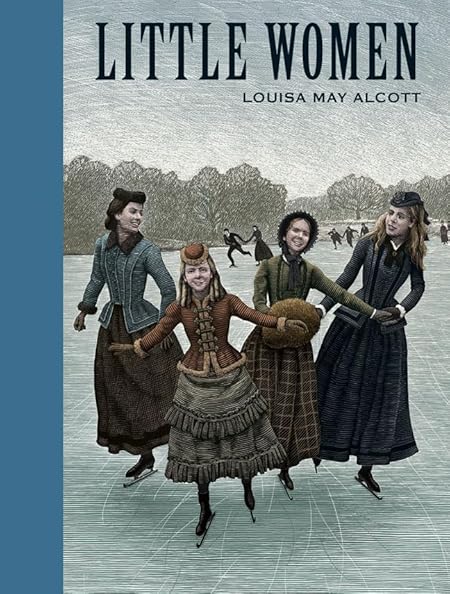
Little Women cover

Somehow my American girlhood went by without a single reading of Little Women. So for the Classics Club Challenge, I read it. I can't react to it anymore the way I probably would have as a teen, though I know I would have strongly identified with Jo and enjoyed the book as a whole.

What struck me, reading it now, is how throughout the book there's a tension between two authorial voices. It's almost as if there are two different books in Little Women, one of them brighter, more picturesque and calling more attention to itself, and the other one a subtle, shadowy book that adds disquiet to the story.

The vignettes in the lives of the four sisters - Meg, Jo, Amy and Beth - often get wrapped up neatly. Though Alcott's characters come across as real and not like cut-out figures serving as moral examples, there's a tidy lesson from many of these episodes. It's what you'd expect in a 19th-century book geared towards a younger audience; the girls need to become proper little women. On the other hand, throughout these vignettes there are some darker currents and some sources of tension that persist even after the tidier resolutions. Sometimes the text is sentimental, even verging on treacly; other times there's a surprising wry humor and unease.

Let's look at Jo, for instance. While capable of great devotion and care towards others, she's also the most spirited and unladylike of the girls and wishes she could have enjoyed a boy's greater freedom. Like Alcott, she's a writer. Jo settles into a more conventional role at the end (mothering boys, when she can't travel much or go to school like one) - though at the same time she keeps her ambitions to write. The resolution to her story is complicated; she has made major concessions to what's expected of her as a proper little woman, but her old restlessness and dreams are by no means entirely tamed (what will become of her dreams is left open-ended).

Death, poverty, the conflict between what you want or need for yourself and what's expected of you - all of these the novel touches on, in a more tidy way front and center, but with the rawness at the edges, unexplored territory on the margins. Alcott was deeply familiar with all of these themes and with the messiness of life. And the fact that she lets this untidiness into her book to varying degrees, and gives her own strong personality some room to play throughout the text, keeps it from being only charming or sentimentally affecting in a simple way.

Sunday, February 2, 2014

Educating Rita (1983): Worth watching for Caine and Walters, and for the questions it raises

Title: Educating Rita
Director: Lewis Gilbert
Language: English
Rating: PG

I like this movie mostly because of Michael Caine and Julie Walters, and what they bring to their characters. But the filmmakers could have taken more time to explore the way good books can change people and looked deeper into how people teach and discuss literature. (I would have also changed the soundtrack, which gets repetitive.)

But Michael Caine and Julie Walters working together make the movie worth watching.

Rita (Julie Walters) and Frank (Michael Caine) in Educating Rita

As Dr. Frank Bryant, Caine is a charming mess. He's a literature professor, witty and fun to talk to, but also burned out. He's got drinking problems that are endangering his job. He seems to have reached the limits of himself, taken himself as far as he thinks he can go, and now that he sees that it's gotten him nowhere and that the view is crap, he's self-destructing.

Susan (who calls herself Rita at the start of the movie) is a hairdresser who isn't satisfied with her life. She's married to a simple guy and should be happy making babies and going to the pub after work. Instead, she wants to study literature. She signs up for a course in adult education that winds up getting her one-on-one tutelage from Frank. Walters plays Susan with a no-nonsense freshness that's wonderful to watch. Even as her character becomes more sophisticated in the course of the movie, she manages more or less to stay steady and keep her refreshing directness; she changes, but her level-headedness and self-awareness will hopefully keep her from becoming like Frank.

That's one of the things that worries Frank - that Susan will turn into him. He likes Susan, and her untutored, honest opinions on the books she reads. He's afraid that the more she studies, the more she'll become like him or like too many of his colleagues: disillusioned, mannered, pretentious, all genuine enthusiasm lost. He wants to spare her from that. And, though he won't admit it, he's also afraid she won't have a use for him anymore. Not only will she leave him behind; with her education, she might also come to see right through him and perceive his emptiness. On the one hand, he doesn't want her to be blindly enamored of him; he wants her to read his own poetry and recognize that it's crap. On the other hand, he likes that she respects him and turns to him.

For Susan, the challenge is to study and grow without exchanging one narrow life for another. She leaves behind her working class neighborhood, but what if she gets trapped in another kind of narrow life (albeit one with more social cachet)? She wants to study literature to expand her mind and her possibilities in life. The danger is that instead of growing, she'll be contorting herself; not just polishing the roughness off her accent, but also blunting her eagerness and genuineness.

How will she stay genuine through it all? (Through some combination of her own wisdom, Frank's insights, and what she understands from her readings?) This could have been better explored; I wanted to see more of Frank and Rita really studying literature together, not just sharing some excerpts from books. What is transforming about literature? Why did Frank lose touch with the written word and get sucked in too much by the surrounding culture of pettiness and sophistication? What are the limits of books and their effect on us? Books change you, but you also have to bring yourself to the books; you have to let the text speak to you. In some ways, it's similar to how you connect with people.

The movie ends with Frank and Rita about to explore new possibilities in life. I won't say what these are, only their story shows how it's possible to stagnate and lose touch with yourself anywhere. This deep personal dissatisfaction can't be soothed with addictions (drink, in Frank's case) or by going along passively with the life that other people plan out for you, which in Susan's case would've been to have kids and not think too much.

*Image links back to its source (TheFilmReview.com).

Wednesday, October 24, 2012

Interview with Nancy Cudis

Nancy Cudis has a passion for writing, reading, and promoting great books and stories (especially little-known gems) on her blog, Simple Clockwork. Anyone who loves to read and write about short stories should participate in The Short Story Initiative on her blog, which has attracted a community of enthusiastic readers. I'm fortunate to count Nancy as an online friend and fellow blogger, and am happy to introduce her here.

Bio
Nancy is an award-winning blogger, writer, part-time student, full-time community development worker, and a former news reporter. She blogs about short stories, Philippine literature, poetry, books, and personal experiences at her blog, Simple Clockwork. She lives in Cebu, Philippines where she can trek the mountains or drive to the beach or party at a club at any time she wants because of their proximity. She pursues her Masters in Media Studies at a local university. She is active at Cebu Bloggers Society Inc. and recently formed with Geezelle Tapangan of geemiz.com the Cebu Book Club.

On to the interview...

HK: Why did you decide to take up blogging? What has been most rewarding about it (and what's been the biggest challenge)?
NC: Restlessness. It started with being restless more than a year ago. I had left a three-year news reporting stint that required me to submit at least two news stories a day six days a week; then I suddenly found myself in a new five-days-a-week office job that expected me to do more editing and coordination than writing. At the same time, I have more free time to do what I want, which I used for reading and traveling. But writing is something I have always loved doing. One morning, I woke up, feeling frustrated and knowing that I just have to write again. So I started with a personal blog in January 2011. Ten months later, after stumbling upon a supportive community of book bloggers, Simple Clockwork transformed into a book blog, although I did not completely veer away from personal non-book related accounts worth sharing.

At first, I was reading and blogging without direction. I was stretching myself thinly by being everywhere, in any genre that captures my fancy, for any author who took an interest in my efforts. It took me some time to discover what I really wanted to do for my blog. Eventually, blogging for a purpose has become more important to me. Sometimes I feel like a literary activist or an advocate, believing highly in the books, stories, and authors I feature and hoping just as highly that readers and visitors alike will pick them up and include them in their reading menu and be inspired to live better. And you know what’s rewarding about all these? Those special moments when I wake up, open my email, and receive out-of-the-blue comments on old posts telling me how much my blog has inspired them or helped them a lot. Naturally, these incidents would fire up my drive to blog more.

HK: How do you choose which books you'll read? Do you have a reading plan, or are your choices more spontaneous?
NC: Because of my spontaneous experience with starting a blog, it is no surprise I spontaneously choose the books or short stories I read. But when I really like a book or a short story, I really rally for it, but still open to the fact that not all will fall for it. That is one beauty of the book blogging community; there is a lot of positive energy going on and at the same time, there are constructive criticisms, too. If I had experienced otherwise, I would have left the book blogging scene a long time ago.

Rather than a reading plan, I have an editorial calendar, which determines what I read and blog for the month. It is something I did as a news reporter and which is an old habit I could not shake off. Fortunately, it is working for me pretty well in blogging. I have a good mix of short stories, Philippine literature, mythology, comics, children’s books, classics, and romance--genres that particularly hold a special place in my heart.

HK: When you think of books or short stories that you've loved, what qualities make them memorable to you?
NC: Whether it’s a book or a short story, what makes it memorable for me is the ability of the writer to gracefully capture my attention and bring me to a screeching climax and a heart-wrenching resolution. For me, the plot of a story is only as good as how the writer delivers it.

HK: What themes/topics/ideas are you most interested in exploring when you write your own fiction?
NC: I have long been writing short stories, several in high school and college and some just recently. I’m now attempting to write a novel. My eyebrows are always knotted together getting the story going. But all these stories have a common denominator--the dynamics of human relationships.

I’m perennially amazed at how people interact with each other, online or offline, and how we change a lot over time without us consciously aware of it. I think we are interconnected by an invisible thread and how we interact with each other will determine how long or how short that thread will become. I’m equally interested in how people think and how their thinking impels their actions. I’m a reflective person, perhaps a little introverted. So human relationships and human thinking are some things I would like to explore in my future fiction.

HK: If you could choose any three authors, dead or alive, to meet with you to discuss literature and give you feedback on your writing, who would they be and why?
NC: American writer O. Henry, English crime writer Ruth Rendell, and Filipino writer Amador Daguio.

As I have often written in my blog posts, reading O. Henry’s works is like having a glass of wine with him on the balcony and watching the world unfold before our eyes. His works reflect his laidback and relaxed personality yet he delivered many powerful and witty short stories. I would like to be with him on that balcony, not just observing the people on the streets but also talking about my writing.

On the other hand, Ruth Rendell is fantastic. She wrote some of the most mind-boggling works I have come across with. Reading her stories is like riding a train wherein I have to grip something because any time the train’s speed will escalate faster and faster...then stop. Oh, I would not want to ride with her on that train to discuss literature; perhaps after I get off the train, so I could ask her properly how she does it--write admirably gripping stories (and she makes them look so easy to write!).

Amador Daguio would make a great person to walk or trek the mountains with. Reading his works, I could imagine him pointing out huts of native tribes and we would be exchanging clever stories about them, or having a picnic with him and trading over-the-top stories to answer our incredulous “what if” questions. I would like to ask him how to vibrantly capture Filipino stories on paper in a series of short stories. I think that would be really neat.

HK: What are your current writing projects, and what do you hope to work on in the future?
NC: My blog in itself is a writing project. I hope for each blog post to be relevant. I have a lot of plans for my blog, including partnerships with groups that advocate reading and literacy. My hope is that more parents will appreciate the value of encouraging reading to their children at an early stage. While I iron out the details, I will continue The Short Story Initiative, which encourages bloggers and readers to share the short stories they have read. I also work with Mel U of The Reading Life for our joint venture wherein we share our thoughts on Filipino short stories. Every now and then, I try to pick up my pen (yes, I sometimes still use pens) to write a short story. I hope to make a collection of them in the future.

As this is the last question, let me take this opportunity to thank you, Hila! You sure ask really good and thought-provoking, if not tough, questions, and I thoroughly enjoyed answering them!

Thanks, Nancy, for participating!

Thursday, January 28, 2010

And now, some words from the Bennet sisters

Jane
[Morning walking dress, Januar... Digital ID: 1111669. New York Public Library
"I would not wish to be hasty in censuring anyone; but I always speak what I think."


Elizabeth
[Evening dress, February 1810.... Digital ID: 1111634. New York Public Library
"I do assure you, Sir, that I have no pretension whatever to that kind of elegance which consists in tormenting a respectable man. I would rather be paid the compliment of being believed sincere. I thank you again and again for the honour you have done me in your proposals, but to accept them is absolutely impossible. My feelings in every respect forbid it. Can I speak plainer? Do not consider me now as an elegant female, intending to plague you, but as a rational creature, speaking the truth from her heart."


Mary
[Walking dress, October 1811.] Digital ID: 1111658. New York Public Library
"Far be it from me, my dear sister, to depreciate such pleasures! They would doubtless be congenial with the generality of female minds. But I confess they would have no charms for me - I should infinitely prefer a book."


Kitty
[March 1810.] Digital ID: 1111635. New York Public Library
"I do not cough for my own amusement."


Lydia
[Ball dress, July 1810.] Digital ID: 1111640. New York Public Library
"Have you seen any pleasant men? Have you had any flirting?"

Sunday, January 17, 2010

Rice Pudding, Ginger Snaps, and G.K. Chesterton

A lovely treat, especially for a cold and rainy evening.

Now reading Chesterton's The Man Who Was Thursday.

I'm still caught up in his introduction to the suburb of Saffron Park, which "lay on the sunset side of London, as red and ragged as a cloud of sunset". And the people who inhabit it, who aren't exactly poems (but look like poems) or scientists (but look like the kinds of creatures that a scientist would be thrilled to discover).

And now "the two poets of Saffron Park" are arguing about whether poetry shares a common spirit with anarchy or with order. I like the Underground Railway example, with one poet saying that people always look so unhappy on the railway because one stop follows another predictably without chaotic excitement, while the other poet says, no, it's exciting that the stops are so orderly, because think of how badly it could all go and what a triumph it is that people managed to build something that works so well:

"You say contemptuously that when one has left Sloane Square one must come to Victoria. I say that one might do a thousand things instead, and that whenever I really come there I have the sense of hair-breadth escape. And when I hear the guard shout out the word 'Victoria', it is not an unmeaning word. It is to me the cry of a herald announcing conquest."

So far my sympathies lie with the poet who favors order (what can I say, I find anarchists to be pretty dull on the whole and incapable of thinking things through). Though really at this point I know next to nothing about the characters (and the poet favoring order, Gabriel Syme, does have an annoying line about "books of mere poetry or prose"); I don't know where this is all going (in these cases, yes, I do like unpredictability), and this looks like it will be a really good book.

Tuesday, January 5, 2010

Sherlock Holmes, Dorian Gray, and a dinner at the Langham

Wilde left with a commission to write his novel, The Picture of Dorian Gray, which appeared in Lippincott’s June 1890 issue. And Conan Doyle agreed to produce a second novel starring his ace detective; The Sign of Four would cement his reputation. Indeed, critics have speculated that the encounter with Wilde, an exponent of a literary movement known as the Decadents, led Conan Doyle to deepen and darken Sherlock Holmes’ character: in The Sign of Four’s opening scene, Holmes is revealed to be addicted to a “seven-percent solution” of cocaine.

Excellent article on Sir Arthur Conan Doyle, his writing, his characters, his London. And the article touches on Doyle's meeting with Oscar Wilde in 1889, at a literary dinner with an editor. I like reading about moments like these - creative, imaginative people who make an impression on each other and, if only in a subconscious or inadvertent way, influence each other's work (though here the critics don't speculate as to how Doyle might have influenced Wilde - maybe he didn't). Are the critics right? Would Holmes have been a different character, had Doyle never encountered Wilde?

Regardless, "For both writers, the evening would prove a turning point" - securing commissions for major works in their careers. I wonder who else was at that dinner, which other writers (whom we likely haven't heard about today) and what happened with their careers and writing.

Another interesting point to the article is how Doyle wanted as time went by to rid himself of Holmes - but never could. That's an interesting disconnect, between the demands of the fans and the needs of the author.

Saturday, November 21, 2009

What am I becoming?

George Eliot was a brilliant author in many ways. She understood people, how they shape and are shaped by society, the hundreds of little influences that affect decisions and alter character. She understood human flaws and human triumphs, people's ideals and limitations, their hopes and secret pains, moments of illumination and stubborn blindness.

I read Middlemarch several years ago and had jotted down passages that struck me, that I knew I'd want to revisit and think about. One of them is the following:

We are on a perilous margin when we begin to look passively at our future selves, and see our own figures led with dull consent into insipid misdoing and shabby achievement. – Chapter 79, Sunset and Sunrise

Eliot writes that specter well - one's own future self, a drab and gray figure sacrificed piece by piece, over the course of years, to mediocrity. A seemingly painless sacrifice, committed for the sake of comfort and approval and to appease one's gnawing fear of failure. And so instead of imagining our best selves and struggling towards that, we give up, we go slack, we pretend that the the virtues, values and gifts that we cherished aren't that important after all.

Guard against the impulse to let yourself slip away, to allow yourself to slip along without effort or imagination. It might be tempting to tell yourself that it's no use anyway, that what you do isn't of any consequence; yet everything we do - or don't do - has a consequence for ourselves, for others, for the world, even if we can't understand the full extent of it.

Even when life and its pressures seem overwhelming, don't lose sight of yourself and what you hope to be.