Showing posts with label horror. Show all posts

Tuesday, October 30, 2018

Two terrifying short stories

Both of these are from The Weird: A Compendium of Strange and Dark Stories.

Title: The Autopsy
Author: Michael Shea

Waiting behind him, Dr. Winters heard the river again - a cold balm, a whisper of freedom - and overlying this, the stutter and soft snarl of the generator behind the building, a gnawing, remorseless sound that somehow fed the obscure anguish that the other soothed.
This is one of the most chilling stories I've ever read.

The main character, Dr. Winters, is called on to act as a coroner for a small, rural town where a blast in a mine has resulted in multiple deaths. The explosion wasn't an accident.

The investigation is one of the last that Winters will participate in, because he is dying of cancer. The image of abnormal cells destroying healthy tissue and taking over the body hints at something else that Winters will experience before the story ends. (Winters, in a wry way, sometimes talks to his cancer, as if it's an entity with some degree of awareness.)

Among the chilling details are the visceral descriptions of an autopsy. Winters is sinking his hands into the aftermath of violent death. The language is elegant as it describes inelegant things. Winters' interactions with the bodies he examines also sets the stage for what he will experience by the time the story ends.

This story wouldn't have been worth reading if it was all about mindless gore. As awful and vivid as the physical details are, the atmosphere of psychological horror – the entrapment, helplessness, aloneness, and torture – is what lingers. Also, the story is excellent in how it uses the setting to enhance the horror: Winters, alone among the bodies in a small examination office ("... the generator's growl, and the silence of the dead, resurgent now").

It's also worth noting that the victims get a chance at the end to make a final spasm of effort to defeat the evil entity that has no pity for their poor flesh and for their minds and spirits.

Sunday, July 15, 2018

Week in Seven Words #415

absorbs
She's developed the habit of slipping behind her phone and not looking up. There's always something new to see, an infinite scroll.

cacophony
From the other room, we hear the eruptions of a horror movie: wild squealing growls and a rumble of strings and drums.

defective
She tells me that one of my cheeks is puffier than the other. I give her what must be a blank or bewildered look, so she repeats herself and peers at me with a semblance of concern. She's so convincing that I actually check in the mirror, but I see nothing out of the ordinary.

diverting
We hold a practice interview that fails to simulate the conditions of a real-life interview, unless the real-life interview will be filled with laughter and digressions about books and vacation ideas.

potion
The drink they order is a giant goblet of neon blue liquid.

tendresse
He displays a flat affect at work. Nothing moves him. He's there for the paycheck. But get him talking about Gary Cooper, and his eyes sparkle. His mouth trembles into a smile.

tweets
People conspiring to make each other more blockheaded.

Tuesday, October 31, 2017

Two Very Different Movies That Both Show a Room Full of Mannequins

Title: The Band Wagon (1953)
Director: Vincente Minnelli
Language: English
Rating: Not rated

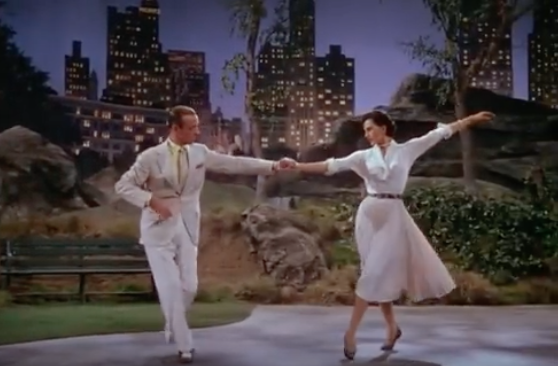
The Band Wagon is a musical about people making a musical, and the leads - Fred Astaire and Cyd Charisse - are amazing dancers. They aren't strong actors, so when they have to convince the audience their characters are falling in love, they can't do it through dialogue. There's one dance - filmed in the park and called 'Dancing in the Dark' - that does it, because of how they flow together, with Charisse's balletic grace and strength mesmerizing.


Another dance number, 'The Girl Hunt,' is a musical parody of film noir and hard-boiled detective stories. Astaire plays the tough detective (which is funny in and of itself), and Charisse plays both a helpless-seeming blonde and a dangerous brunette. There's some amazing dancing in this number, and a room full of mannequins at one point. 'The Girl Hunt' is both ridiculous and riveting. (If you're a fan of Michael Jackson's music, you might like to know that his music video for "Smooth Criminal" took inspiration from Astaire's suit and the scene at the nightclub from 'The Girl Hunt.')

Another notable musical number - 'The Triplets' - features Astaire, Nanette Fabray, and Jack Buchanan as triplet babies. They wear baby gowns and dance on their knees. (I'm not making this up.) The lyrics are also funny. These are violent babies who rhyme cleverly.

Fabray, who has great presence and sings wonderfully, should have been in more musical scenes. At least she's part of the group singing 'That's Entertainment,' the most famous of the songs from the movie. This isn't a movie that takes itself seriously. It's silly and full of music and dance talent (ballet, jazz dance, a tap routine in top hat and tails). A really enjoyable movie.

Tuesday, January 19, 2016

Why Watch Seconds (1966)?

Title: Seconds
Director: John Frankenheimer
Language: English
Rating: R

With the help of a mysterious company, a middle-aged man fakes his own death and restarts his life elsewhere under a new identity. The company has provided him with a new home, a new profession, and even a younger-looking body (a result of plastic surgery and a regimen of exercise). They seem to be offering him everything he's ever wanted. But when he still can't find the happiness he thought he'd enjoy, he wants to start all over again. Poor fool.

Seconds poster.jpg
"Seconds poster". Via Wikipedia.


Why watch it?

Friday, March 13, 2015

13 short stories for Friday the 13th

I don't believe in the Friday the 13th superstition or that 13 is an unlucky number, but I thought I'd have some fun with today's date (especially because this weekend it's the Ides of March too!).

So here are a bunch of stories that are dark, disturbing, or otherwise strange, exploring fears and tragedies. The characters might be unlucky. They might also work to make themselves unlucky.

P1060869

Tuesday, October 28, 2014

Arsenic and Old Lace (1944): What's in the wine and in the window seat?

Title: Arsenic and Old Lace
Director: Frank Capra
Language: English
Rating: Not Rated

"Insanity runs in my family. It practically gallops."

So says Mortimer Brewster (Cary Grant), a drama critic who at the start of the movie gets married to Elaine Harper (Priscilla Lane) after years of confirmed bachelorhood. En route to their honeymoon, they stop by the house of Mortimer's kindly old aunts, Abby (Josephine Hull) and Martha (Jean Adair), who are known in their community as generous women, donating toys to poor children, visiting the sick, and performing other charitable acts.

As Mortimer discovers, after a look under their window seat in the front parlor, their idea of charity also includes killing off lonely old men. It takes some time for Mortimer to wrap his head around the fact that his aunts could be doing this.
Mortimer: What happened to him?!
Martha: He died.
Mortimer: Look, Aunt Martha, men don't just get into window seats and die!
Abby: Look now, dear, he died first.

Up until that point, Mortimer had assumed his family's madness was confined to his older brother, Teddy (John Alexander), who believes he's Teddy Roosevelt - and that his family's darker impulses were confined to his other brother Jonathan (Raymond Massey), a sadist who hasn't been seen in 20 years (but of course will show up, with Peter Lorre in tow to up the creep factor).

Meantime, Elaine - who doesn't know what's going on - is wondering why Mortimer suddenly seems so absent-minded and panicky, so unready to embark on their life of wedded bliss. (When there are too many bats in the family belfry, is wedded bliss possible?)

Arsenic And Old Lace Poster.jpg
"Arsenic And Old Lace Poster". Via Wikipedia.

Priscilla Lane has a thankless role as a woman who spends most of the movie getting shoved aside and bodily carried out of rooms. As for Cary Grant, his performance took some getting used to because it was too hammy (like, huge double-takes and expressions of HUH?). The other actors, especially Hull, Adair, Massey and Alexander, were spot-on in their roles. Also, Jack Carson in the role of a friendly but oblivious policeman.

It's a strange, funny dark comedy, which frays at the end like many comedies. There are hilarious scenes, numerous twists, and jokes that take time to develop and pay off. Fun for any time of year, but especially Halloween, if like me you prefer to avoid gory slasher/monster movies.

Saturday, January 4, 2014

Step into the home of the Femm family, The Old Dark House (1932)

Title: The Old Dark House
Director: James Whale
Language: English
Rating: G

In this freaky and ridiculous horror movie, five people get stranded in the Femm family home, located in a remote corner of Wales. The Femms live in a stew of ruination and resentment. There's the sister, Rebecca (Eva Moore), a bitter and creepy old woman who broods on the sins of the world, especially anything to do with sex and youth. Her scarecrow of a brother, Horace (Ernest Thesiger), sometimes attempts to defy her but is reduced to fits of trembling. Their 102-year-old father is somewhere upstairs. And is there anyone else? Oh yes, the butler, Morgan (Boris Karloff of Frankenstein fame), who's difficult to manage once he starts drinking.

The Old Dark House - 1932 theatrical poster.jpg
From Wikipedia, Fair use


The unfortunate guests are a married couple, Philip (Raymond Massey) and Margaret Waverton (Gloria Stuart), and a bachelor, Penderel (Melvyn Douglas), who was traveling with them in their car. Later, a businessman, Sir William Porterhouse (Charles Laughton) and his high-spirited chorus girl companion, Gladys (Lilian Bond), show up seeking refuge from the violent weather that's driven everyone into the Femm home.

It's a good ensemble pic, the kind of movie I really enjoy when it's done well. The standout performance for me was Charles Laughton, as a cheery but profoundly sad and lonely loudmouth, though the actors playing the Femm family are also great, and Gloria Stuart is luminous, bringing brightness to the Femm home (Stuart, by the way, played the elderly Rose in Titanic).

There's no gore, and no need of supernatural entities, because people's personalities are gruesome enough. The movie is a mix of creepiness and absurdity. There are some surprisingly funny moments - not obvious jokes, but just the way a character says or does something at a given moment. The whole scenario is over-the-top, and I think the director (also of Frankenstein fame) and everyone else involved with the film made it with playfulness.

Thursday, December 26, 2013

Three Stories from Stephen King's Just After Sunset

Collection: Just After Sunset
Author: Stephen King


When King finds the emotional center of a story, shows us the hearts of his characters, it makes all the difference. There are stories in this collection that have an interesting premise but don't develop. Sometimes there's too much straining for effect. But here are three stories I like because they're gripping and for the most part are told with heart. Each has its own unique atmosphere of horror.

Title: The Gingerbread Girl
Emily is running from the horrors in her life. She takes up running after her baby dies from Sudden Infant Death Syndrome. Separating from her husband, she moves to a family property in Florida where she'll need to use her running abilities, along with her ingenuity and will to survive, in order to escape from a psychotic neighbor. (There's a painfully suspenseful scene where the main character tries to break free from a chair she's tied to before the homicidal neighbor returns to torture her and finish her off.) At its heart the story is about someone striving for life. Emily fights to live and outpace the terrors the world holds for her.

Title: N.
Told in a collection of case notes, letters, and newspaper clippings, the story is a horrifying mystery centered on a psychiatrist and a patient, referred to as N. in the case notes, who has Obsessive Compulsive Disorder (OCD). N. has many of the usual compulsions of people with OCD, such as the need to count things a certain number of times, arrange things in certain ways and perform other rituals. But he tells his psychiatrist he's doing this for a very real reason: to prevent the reentry of a demonic entity into the world.

Given that people with OCD believe that their rituals and compulsions stave off disasters, the psychiatrist at first thinks that his patient is merely imagining this Lovecraftian entity. But when he visits the site that his patient tells him about, a remote field in rural Maine with a grouping of rocks where the creature might break through, he begins to have second thoughts. He develops his own compulsions. But is this terrifying creature of darkness real? Or has the psychiatrist merely taken on the symptoms of his patient, which does happen sometimes?

Title: Willa
The story sort of crumbles into bittersweet goo as it goes on, while still remaining sad and chilling. It starts with a group of passengers waiting in a remote Wyoming train station. The train is set to come at any moment, but David can't find his fiancée, Willa. The other passengers tell him not to go looking for her; many of them don't like her. David doesn't even realize how long she's been missing, and he remembers how she's sometimes chided him for not being able to see what's right in front of his eyes; like most people, his capacity for denial is strong. When he finds her, he discovers that some things, like their love for each other, haven't changed and that "perception and expectation together" really are powerful.

Sunday, October 28, 2012

Three disturbing stories for Halloween (or any other time you wish to be disturbed)

Title: The Damned Thing
Author: Ambrose Bierce
Where I read it: Fifty Great American Short Stories (ed. Milton Crane)


A creepy little horror piece about a man living alone in the wilderness being stalked by something he can't see. The story begins with the coroner examining his body, so you know how it ends for him. All he's left behind as a clue is his journal, where he describes day by day, with growing dread, the thing stalking him. I first read this story years ago and still remembered some of the details. It gets lodged in your brain like a splinter.

-------------

Title: Silent Snow, Secret Snow
Author: Conrad Aiken
Where I read it: Fifty Great American Short Stories (ed. Milton Crane)


If I tell you that this is a terrifying story about snow, you might think it's something like a Jack London story with people getting trapped in log cabins in the dead of winter and eating the frozen remains of their friends. But the snow here exists only in the mind of the protagonist, Paul - it's like a static hissing, building up slowly between himself and the rest of the world.

What makes the story so disturbing isn't only that Paul's life is dimming around him, but that he welcomes it; he craves the secret oblivion of the snow and wants the rest of the world to disappear. Is he going insane? Rejecting outer reality for something inward and alien to others? Maybe. That he's the son of typical middle class parents in Anytown, USA heightens the eeriness (there's a Twilight Zone feel to the story). I love how the author takes what could have been an absurd premise and makes it frightening:

The hiss was now becoming a roar - the whole world was a vast moving screen of snow - but even now it said peace, it said remoteness, it said cold, it said sleep.

-------------

Title: The Tell-Tale Heart
Author: Edgar Allan Poe
Where I read it: The Oxford Book of American Short Stories (ed. Joyce Carol Oates)


"And now have I not told you that what you mistake for madness is but over-acuteness of the senses?"

When it comes to deranged narrators, no one beats Edgar Allan Poe. This one isn't the elegant, depraved madman of The Cask of Amontillado, who lures his victim into the catacombs for an elaborate premeditated demise. The narrator in The Tell-Tale Heart is holding onto his sanity by a thread. His actions are clumsy and sad. When the police arrive he tries so hard to seem sane (I love how, even though everything takes place from his POV, we can guess what the officers are thinking as they listen to him try to make polite chit-chat in the room where he's buried the body). As in The Cask of Amontillado, this narrator has us stand alongside him and witness his crime; he wants us to understand him. But he also has a conscience, which surfaces through the madness.

-------------

Other stories in Fifty Great American Short Stories include: The Blue-Winged Teal (by Wallace Stegner) and The National Pastime (by John Cheever); along with The Girls in their Summer Dresses (by Irwin Shaw) and A New England Nun (by Mary E. Wilkins Freeman).

-------------

Other stories in The Oxford Book of American Short Stories include: The Middle Years (by Henry James) and Sweat (by Zora Neale Hurston).

-------------

This post is shared at the The Short Story Initiative at Simple Clockwork.