clop
I don't understand the appeal of a carriage ride in the park. The horses look depressed. The ride won't even show you the best sights.
decades
They've been married for 30 years, and there's a 20-year age gap between them. Their wedding took place when he was in his 20s, and she was in her 40s.
habits
One of the main points of agreement among the dozen or so people around the table is how difficult it is to change a habit. It's great to hear about the different approaches people take to uproot an entrenched pattern of behavior or thought. The strategies include introducing a new habit to supplant the old one, speaking out loud to yourself, and keeping track of progress in a journal. Outcomes vary, with reports of progress, backsliding, futility, triumph, vigilance.
materials
Where to even start with this essay. He's gasped out a couple of sentences. Copy and pasted a bunch of links into the file but hasn't read them yet. Come to think of it, that's a start of sorts. We can work with what's there.
mysterious
We cut through the park about an hour after sunset. I like how alien it feels. The rock formations look like gigantic creatures curled up in sleep. The skyline glitters like a computing device. People emerge into lamplight and lose themselves in shadow soon after.
plans
He shows me the blueprints, the promise of a home remade. He tries not to think too much about the bureaucratic red tape and the noise and messiness of construction.
tracking
At night, we walk past the large, arched window of a museum. A marble statue, turned mostly away from us, still seems to peer at us from the corner of its eye.
Showing posts with label construction. Show all posts
Showing posts with label construction. Show all posts
Tuesday, July 23, 2019
Wednesday, September 26, 2018
Week in Seven Words #426
blueness
Beyond the whirring tools and the dentist's graceful hands, an episode of Blue Planet plays on a small screen. I have no idea what's going on, aside from seeing great quantities of fish, but the general blueness is relaxing.
brightness
Sometimes a brilliant moment is made of sunlight falling on the white planks of a house and on the spruce that has sprung up beside it.
directing
The toddler stumble-walks with his finger out pointing.
inspiring
Art can be an antidote to oversimplification, smooth and quick explanations, cowardice, and brutality.
mawkish
She tries to entice me to watch the movie by showing me a YouTube clip, but all I see is syrup and little substance and actors who talk as if the dialogue is sticking to their teeth.
oof
The dog gets so excited that her owner has come home that she launches herself at my stomach from several feet away.
roofing
A writing assignment of many words that makes me realize just how important it is to have the right roof over one's head.


Thursday, August 30, 2018
Week in Seven Words #421
cheerfully
Most of the rooms are in shadow on a rainy day, but the kitchen remains bright and welcoming.
formation
We try building a tall, convoluted slide for marbles, and we finish about a third of it before I leave. The instructions aren't straightforward, and similar pieces have been painted the same color. But I'm surprised to find myself enjoying the project.
intensely
When conducting Beethoven, he looks like he's listening to heavy metal. Head banging, gritted teeth.
nearly
A catastrophic argument is looming like an iceberg on the horizon of our evening. We avoid it by a hand span, and watch it from the corner of our eyes as it looms up beside us before falling away into the night.
purring
A man sits quietly by the bandshell caressing his guitar.
sequester
On the train during rush hour, people dive into pockets of solitude. They fix their eyes on the kneecaps of the person sitting opposite. They play repetitive games on their phone or hunch behind a newspaper. A young woman with a soft face and thin hair stares out the window and croons to the music from her headphones.
undermining
His bottle is tucked into a brown paper bag. As the bus rolls on past big-box stores and ranch-style homes, he sips from the bottle and talks about his court date tomorrow for a drinking-related offense.
Wednesday, August 16, 2017
Van Cortlandt Park and a Laura Mvula song
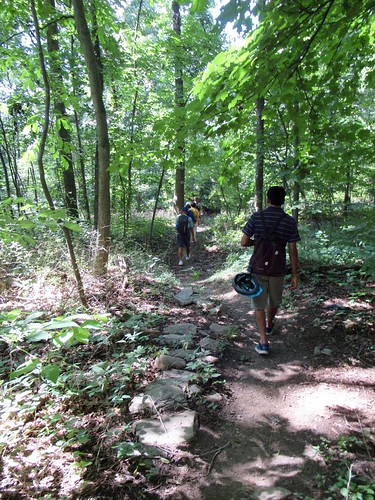
This past Sunday, I went on a hike through Van Cortlandt Park in the Bronx. The hike leader also gave a talk on the role the park plays in the city's water supply, and the challenges of supplying water to a city of millions.
This is a memorial on Katonah Avenue, right outside the northeast corner of the park, for tunnel workers who lost their lives building Tunnel #3, a major piece of city water infrastructure.

Some photos from the hike:


Also, because it's summer - and Laura Mvula's "Green Garden" (and its music video) is full of what I like best about summer - I'm sharing it here.
This is a memorial on Katonah Avenue, right outside the northeast corner of the park, for tunnel workers who lost their lives building Tunnel #3, a major piece of city water infrastructure.
Some photos from the hike:
Also, because it's summer - and Laura Mvula's "Green Garden" (and its music video) is full of what I like best about summer - I'm sharing it here.
Sunday, January 18, 2015
Week in Seven Words #241
fissure
The photo of a canyon, blown up and stretched wide, looks like a marvelous chasm in her wall.
hacked
When people substitute an ideology for self-knowledge, they talk and act as if parts of them have been carved out.
hued
Dresses draped all over the closet like colorful skins she has shed.
inhibitions
Does writing in a journal help? I think it can, as long as you're honest with yourself. I know that over the years, growing up and even a little into adulthood, I forced cheer and optimism into some of what I wrote - writing things as I wished they were or as I thought people would want them to be were they ever to discover the journal. Sometimes I just wrote, uninhibited, but it didn't come easily. It's important to write freely, especially when writing to myself. Though looking back at past entries I've also learned some key things about my younger self from what I omitted or how I spun a certain event.
prioritize
As his grandmother raises questions about the bill, he leans towards the waiter and whispers, "Can I have chocolate milk?"
renovating
Their house is littered with power tools, the cabinets gaping and furniture stacked in the front room. They look forward to the day when order will emerge from the obstacle course.
sinking
His speech is a series of smooth white pebbles that sink slowly to the bottom of a pond.
Friday, January 9, 2015
Week in Seven Words #240
clatter
A sculpture park pockmarked with construction - few differences between the art displayed and the machinery making room for new installations.
distances
Her long-legged stride represents how she's made her way through life.
huddling
Clouds roll in over the river. On the rocks, a sea gull, a soda can, and a bundle of clothes that may have someone in them.
oscillate
The conversation fans out to West Africa, Korean soap opera stars, karaoke, and the way people lock their thoughts into binaries during arguments - two solutions to every problem, two possible opinions in complete opposition.
smudges
Pigeons hold court in the shadows of the bridge.
stock
He barrels out of the convenience store with a shopping cart full of cupcakes and beer. No partying in half-measures.
twinging
Walking a long distance outdoors, especially on uneven ground, gets at muscles that remain dormant during a gym routine.
Wednesday, February 29, 2012
Worth Watching: Lilies of the Field (1963)
Title: Lilies of the Field
Director: Ralph Nelson
Language: English
Rating: Unrated
Synopsis
When we first see Homer Smith (Sidney Poitier) driving along a lonely desert road, we don't know where he's coming from or where he's going. He's a drifter, skilled at construction work and apparently without a steady home or job. When his car overheats, he pulls into the closest place where he can get water: a small farm worked by a group of nuns who've come to the US from East Germany. Mother Maria (Lilia Skala) asks Homer, whom she calls "Schmidt" instead of "Smith," to help with some odd jobs on their farm. Homer does so in expectation of getting paid, only to find that instead of giving him money, Mother Maria invites him to the nuns' meager meals, offers him a place to stay, and insists that he's an instrument of divine will, sent to build a chapel for the nuns and the parishioners in the surrounding area.

Characters
Homer figures out early on that the nuns can't pay him; they don't have the means, a fact confirmed to Homer by one of the locals, Juan (Stanley Adams), a friendly, business-minded man who isn't big on religion. Aside from Mother Maria, who's dignified and reserved, the other nuns - Sisters Agnes, Gertrude, Albertine, and Elizabeth - are like cheerful light-hearted birds, which almost masks the fact that they're living in poverty, barely able to subsist off their plot of land in the southwest US desert. So why does Homer stick around for a while, instead of immediately cutting his losses and driving off? We see at one point that he has the skill and confidence to land himself a job on the spot, so it's not that he can't find work anywhere. In part he stays out of a grudging sympathy for the nuns and a defensiveness on their behalf, which includes defending their choice to appoint him as a "contractor." It becomes a point of pride for him, especially when others scoff at the fact that the nuns have faith in him. Also, maybe he likes the feeling of being a part of the family, where he gets to break bread at their table and teach them English. They're strange and curious to him.
Furthermore, I think he relishes taking charge of the project and not getting ordered around on a construction site by another contractor. To Homer, building the chapel becomes a personal test and an opportunity. Poitier's strong performance conveys the struggle that Homer is locked into not only with Mother Maria but with himself. Building this chapel could tie him down to one spot for years and burden him with people's expectations, so what's the point? He doesn't want the commitment. On the other hand, he savors the challenge and perhaps the trust that comes with it. And Homer strikes me as someone who's rusty, possessing skills he hasn't used for years because he hasn't found work that's made real demands of his gifts. (Now, if only those nuns had money for him…)
Homer is a kind of everyman figure, and while I wanted to know more about his background, the role of timeless, aimless drifter makes sense for this movie. Lilies of the Field asks general questions about what people can leave behind them in this world, and what they can take with them. It's part of life to claim things as your own knowing you'll have to let go of them. But Homer also values personal recognition; he doesn't want to be seen as an instrument of a larger plan, perhaps interchangeable with others; ultimately, he wants to leave his mark on his terms.

Mother Maria isn't terribly concerned about Homer's indecisiveness. She recognizes it, but acts as if it doesn't exist. As far as she's concerned, he'll build that chapel. Not that she's forcing him to stay; she just acts as if it's a foregone conclusion. Mother Maria has her moments of tiredness or relaxed happiness, conveyed with subtle beauty by Lilia Skala, but what comes across most is her force of will. Maybe she needs to think of herself (and those around her) as instruments of a higher plan simply so that she can keep surviving and seeing something of her hopes realized. She brought her small group of nuns across the Iron Curtain and all the way to the US. The community they serve now, made up mostly of poor laborers, doesn't have a chapel so a chapel is what she'll build. Lack of money and building materials won't stop her, and neither will Homer's reluctance. Contradicting her is difficult, not because she threatens people, but because it's pointless, like telling the wind to stop blowing. At the same time she drives the other nuns, and Homer, to persist.
Relationships
As two strong-willed people, Homer and Mother Maria share a kind of kinship even as they clash. What Homer mainly wants from her as the movie goes on is a recognition of himself as an individual. Mother Maria has a strong tendency to see people, including herself, as instruments of a larger divine will. What Homer demands is a more personal recognition. Mother Maria's acknowledgement doesn't mean everything to him. It doesn't make him over-joyed or grateful. But it would still be a kind of victory for him if she sees his hand in the chapel-building, a project he comes to regard as his own. It would be a nod of respect given from one formidable person to another.

Memorable sights and sounds
One striking sight is of the five nuns walking along the road in the desert heat to Father Murphy's outdoor services a considerable distance from their farm; they try their best not to show fatigue, especially Mother Maria, who looks like she could survive in the desert by sheer will alone. Father Murphy (Dan Frazer) is the local priest. Burned out and heat-worn, he performs his religious duties without dereliction but also without passion.
The singing in the movie is memorable. The nuns sing a melodious chant that catches at Homer; he drifts closer to listen to them. In turn he starts up a rousing Baptist song, to which they chorus "amen" in response to each line. When the nuns are singing to themselves they pronounce it 'ah-men'; in Homer's song it's 'ay-men.'
I also like the play of emotions on Mother Maria's face during the closing scene as she sits and listens while the other nuns sing obliviously.
Stand-out scenes
There are many strong scenes, including some humorous ones; along with the drama of faith, of being chosen and challenged, there's also the comedy of a Baptist drifter surrounded by European nuns.
When Homer hears the nuns trying to improve their English using recordings that were meant for wealthier people ("Please send the valet up to my room"), he steps in and starts to teach them some phrases as well, having fun with it; a significant phrase, and one that takes Mother Maria rather a while to say, is "thank you." At other times Mother Maria and Homer point out different biblical verses to one another in order to communicate.

As for the construction of the chapel, it goes through several stages, reflecting changes in Homer's outlook. In this way the chapel-building takes on a kind of personality and spirit of its own.
Further thoughts
When the chapel is finished, what comes next? Mother Maria looks ahead at everything else that needs to be done. Homer considers the completed work and what's changed, and what hasn't changed enough, as a result. Satisfaction at a job well done doesn't last for long before restlessness kicks in again. No one rests on their laurels.
*All images link back to their sources (Wikipedia, Rottentomatoes, and Flixster community). [Post edited 2/2015]
Director: Ralph Nelson
Language: English
Rating: Unrated
Synopsis
When we first see Homer Smith (Sidney Poitier) driving along a lonely desert road, we don't know where he's coming from or where he's going. He's a drifter, skilled at construction work and apparently without a steady home or job. When his car overheats, he pulls into the closest place where he can get water: a small farm worked by a group of nuns who've come to the US from East Germany. Mother Maria (Lilia Skala) asks Homer, whom she calls "Schmidt" instead of "Smith," to help with some odd jobs on their farm. Homer does so in expectation of getting paid, only to find that instead of giving him money, Mother Maria invites him to the nuns' meager meals, offers him a place to stay, and insists that he's an instrument of divine will, sent to build a chapel for the nuns and the parishioners in the surrounding area.

Characters
Homer figures out early on that the nuns can't pay him; they don't have the means, a fact confirmed to Homer by one of the locals, Juan (Stanley Adams), a friendly, business-minded man who isn't big on religion. Aside from Mother Maria, who's dignified and reserved, the other nuns - Sisters Agnes, Gertrude, Albertine, and Elizabeth - are like cheerful light-hearted birds, which almost masks the fact that they're living in poverty, barely able to subsist off their plot of land in the southwest US desert. So why does Homer stick around for a while, instead of immediately cutting his losses and driving off? We see at one point that he has the skill and confidence to land himself a job on the spot, so it's not that he can't find work anywhere. In part he stays out of a grudging sympathy for the nuns and a defensiveness on their behalf, which includes defending their choice to appoint him as a "contractor." It becomes a point of pride for him, especially when others scoff at the fact that the nuns have faith in him. Also, maybe he likes the feeling of being a part of the family, where he gets to break bread at their table and teach them English. They're strange and curious to him.
Furthermore, I think he relishes taking charge of the project and not getting ordered around on a construction site by another contractor. To Homer, building the chapel becomes a personal test and an opportunity. Poitier's strong performance conveys the struggle that Homer is locked into not only with Mother Maria but with himself. Building this chapel could tie him down to one spot for years and burden him with people's expectations, so what's the point? He doesn't want the commitment. On the other hand, he savors the challenge and perhaps the trust that comes with it. And Homer strikes me as someone who's rusty, possessing skills he hasn't used for years because he hasn't found work that's made real demands of his gifts. (Now, if only those nuns had money for him…)
Homer is a kind of everyman figure, and while I wanted to know more about his background, the role of timeless, aimless drifter makes sense for this movie. Lilies of the Field asks general questions about what people can leave behind them in this world, and what they can take with them. It's part of life to claim things as your own knowing you'll have to let go of them. But Homer also values personal recognition; he doesn't want to be seen as an instrument of a larger plan, perhaps interchangeable with others; ultimately, he wants to leave his mark on his terms.
Mother Maria isn't terribly concerned about Homer's indecisiveness. She recognizes it, but acts as if it doesn't exist. As far as she's concerned, he'll build that chapel. Not that she's forcing him to stay; she just acts as if it's a foregone conclusion. Mother Maria has her moments of tiredness or relaxed happiness, conveyed with subtle beauty by Lilia Skala, but what comes across most is her force of will. Maybe she needs to think of herself (and those around her) as instruments of a higher plan simply so that she can keep surviving and seeing something of her hopes realized. She brought her small group of nuns across the Iron Curtain and all the way to the US. The community they serve now, made up mostly of poor laborers, doesn't have a chapel so a chapel is what she'll build. Lack of money and building materials won't stop her, and neither will Homer's reluctance. Contradicting her is difficult, not because she threatens people, but because it's pointless, like telling the wind to stop blowing. At the same time she drives the other nuns, and Homer, to persist.
Relationships
As two strong-willed people, Homer and Mother Maria share a kind of kinship even as they clash. What Homer mainly wants from her as the movie goes on is a recognition of himself as an individual. Mother Maria has a strong tendency to see people, including herself, as instruments of a larger divine will. What Homer demands is a more personal recognition. Mother Maria's acknowledgement doesn't mean everything to him. It doesn't make him over-joyed or grateful. But it would still be a kind of victory for him if she sees his hand in the chapel-building, a project he comes to regard as his own. It would be a nod of respect given from one formidable person to another.
Memorable sights and sounds
One striking sight is of the five nuns walking along the road in the desert heat to Father Murphy's outdoor services a considerable distance from their farm; they try their best not to show fatigue, especially Mother Maria, who looks like she could survive in the desert by sheer will alone. Father Murphy (Dan Frazer) is the local priest. Burned out and heat-worn, he performs his religious duties without dereliction but also without passion.
The singing in the movie is memorable. The nuns sing a melodious chant that catches at Homer; he drifts closer to listen to them. In turn he starts up a rousing Baptist song, to which they chorus "amen" in response to each line. When the nuns are singing to themselves they pronounce it 'ah-men'; in Homer's song it's 'ay-men.'
I also like the play of emotions on Mother Maria's face during the closing scene as she sits and listens while the other nuns sing obliviously.
Stand-out scenes
There are many strong scenes, including some humorous ones; along with the drama of faith, of being chosen and challenged, there's also the comedy of a Baptist drifter surrounded by European nuns.
When Homer hears the nuns trying to improve their English using recordings that were meant for wealthier people ("Please send the valet up to my room"), he steps in and starts to teach them some phrases as well, having fun with it; a significant phrase, and one that takes Mother Maria rather a while to say, is "thank you." At other times Mother Maria and Homer point out different biblical verses to one another in order to communicate.
As for the construction of the chapel, it goes through several stages, reflecting changes in Homer's outlook. In this way the chapel-building takes on a kind of personality and spirit of its own.
Further thoughts
When the chapel is finished, what comes next? Mother Maria looks ahead at everything else that needs to be done. Homer considers the completed work and what's changed, and what hasn't changed enough, as a result. Satisfaction at a job well done doesn't last for long before restlessness kicks in again. No one rests on their laurels.
*All images link back to their sources (Wikipedia, Rottentomatoes, and Flixster community). [Post edited 2/2015]
Subscribe to:
Posts (Atom)