cantankerous
The dark building scowls at the street, its face scarred by scaffolding. The names by each mailbox are peeling off like scabs.
lazing
I'm tired of the expression "politically correct." It's become a knee-jerk criticism, a shortcut in thought.
liberated
Half of the fence has collapsed towards the house, the other half towards the lawn. An evergreen shrub has thrust itself into the gap.
ribbing
A broken umbrella tumbles between the cars, tickling them as it goes.
smirking
Another expression I'm tired of - more than tired of, I'd like to pulverize it with my fists - is "good intentions." It's an excuse, a deflection, a pat on the back. A false innocence, a willful ignorance.
unattainable
Some people show you a love like the horizon. It'll be yours, they say, if you keep struggling towards it, on land, by sea, with everything in you. One day you'll have their love. Just make an effort. A real effort. Break yourself on the dream of it.
unshackled
Behind a restaurant, a waiter puts out his cigarette and break dances. Pigeons rocket away.
Friday, October 30, 2015
Tuesday, October 27, 2015
Awesome Autumn Hike: Sleepy Hollow and Rockfeller State Park Preserve

I went on a fantastic 13-mile hike this past Sunday with Shorewalkers through Sleepy Hollow and Rockefeller State Park Preserve.
The foliage looked like it was at its peak; the weather was mild, with the day starting off a little drizzly, then gray and finally sunny in the afternoon. It was brilliant.
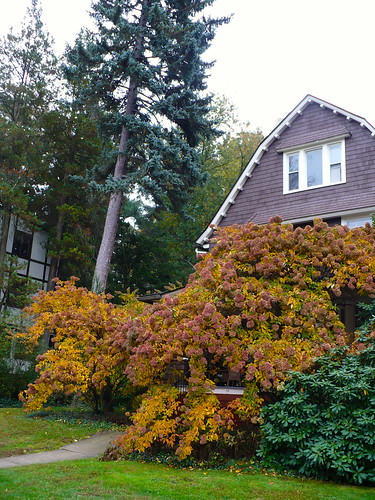
The hike started at the Philipse Manor train station on the Hudson Line of the Metro North Railroad; it's about an hour north of New York City's Grand Central Station by train. First we walked a few blocks through Sleepy Hollow, a quiet suburb with lovely homes half-buried in autumn colors.


Monday, October 26, 2015
Week in Seven Words #267
aging
White linens folded in a pile. Beside it, a vase of brown roses.
defaced
Long scars on a lone tree. It looks like it's been whipped.
ferreting
On all fours, her nose to the floor, she searches for candy among people's feet.
flatness
The kid flops onto the floor. He stares at the ceiling, then rolls over onto his stomach. Thunks his forehead against the carpet a couple of times, rolls onto his back, and kicks his heel against the wall. "Ow," he says, and kicks the wall again. Any sensation is preferable to boredom.
fluorescent
Lime green graffiti lighting up a street soaked in rain.
tippy
An old man pedaling a bike, leaning into it. It's a purple bike, and he wears a Panama hat and black sandals. He shifts a toothpick from one side of his mouth to the other. The front wheel of the bike jerks left and right.
token
A barren nest tucked in a tree hollow.
White linens folded in a pile. Beside it, a vase of brown roses.
defaced
Long scars on a lone tree. It looks like it's been whipped.
ferreting
On all fours, her nose to the floor, she searches for candy among people's feet.
flatness
The kid flops onto the floor. He stares at the ceiling, then rolls over onto his stomach. Thunks his forehead against the carpet a couple of times, rolls onto his back, and kicks his heel against the wall. "Ow," he says, and kicks the wall again. Any sensation is preferable to boredom.
fluorescent
Lime green graffiti lighting up a street soaked in rain.
tippy
An old man pedaling a bike, leaning into it. It's a purple bike, and he wears a Panama hat and black sandals. He shifts a toothpick from one side of his mouth to the other. The front wheel of the bike jerks left and right.
token
A barren nest tucked in a tree hollow.
Thursday, October 22, 2015
Two Ealing comedies with Alec Guinness
It's a shame that most people only know of Alec Guinness as Obi Wan Kenobi. He looked the part and delivered his lines with gravity ("I felt a great disturbance in the Force, as if millions of voices suddenly cried out in terror and were suddenly silenced"). But he could have played Obi Wan in his sleep; it wasn't his most interesting or entertaining role.
Guinness was a fine dramatic actor, and he also did wonderfully well in comedy. The following are two movies showcasing his comedic talents, both movies made by Ealing Studios after WWII.
Guinness was a fine dramatic actor, and he also did wonderfully well in comedy. The following are two movies showcasing his comedic talents, both movies made by Ealing Studios after WWII.
Tuesday, October 20, 2015
Week in Seven Words #266
diligence
She shows me how she's patiently worked her way towards a difficult yoga pose, adjusting her legs in increments over weeks. Now she sits with serenity, as if the arrangement of her lower body doesn't register in her conscious mind.
employed
Her job duties include ignoring the phone and investigating vacation spots on Google Maps.
hushed
The sun turns to ashes behind an aluminum fence.
mildly
A mug of tea warming my hands. A conversation that passes with no bitter words.
pulse
The dog, calming on my lap, is a pounding heartbeat wrapped in hair.
stale
The store smells of sawdust and wheaty things. Breathy acoustic versions of pop songs make background noise.
venipuncture
She sinks the needle into one arm, then the other. Gives me a bewildered look, as if to ask, "Are you human?" and leaves to search for a second phlebotomist: the one I call "The Vein Whisperer," who trails her fingers along my forearms, taps the skin, holds the needle poised above the surfacing vessel.
She shows me how she's patiently worked her way towards a difficult yoga pose, adjusting her legs in increments over weeks. Now she sits with serenity, as if the arrangement of her lower body doesn't register in her conscious mind.
employed
Her job duties include ignoring the phone and investigating vacation spots on Google Maps.
hushed
The sun turns to ashes behind an aluminum fence.
mildly
A mug of tea warming my hands. A conversation that passes with no bitter words.
pulse
The dog, calming on my lap, is a pounding heartbeat wrapped in hair.
stale
The store smells of sawdust and wheaty things. Breathy acoustic versions of pop songs make background noise.
venipuncture
She sinks the needle into one arm, then the other. Gives me a bewildered look, as if to ask, "Are you human?" and leaves to search for a second phlebotomist: the one I call "The Vein Whisperer," who trails her fingers along my forearms, taps the skin, holds the needle poised above the surfacing vessel.
Sunday, October 18, 2015
Two stories on art and ugly politics
Title: Portrait of the Avant-Garde
Author: Peter Høeg
Translator: Barbara Haveland
Where I Read It: The Art of the Story
In the years leading up to WWII, Simon is intoxicated with his power as an artist. He sees his paintings as a way to remake the world. In his mind, he is a mini-god, wielding fire and air. He throws himself behind vicious political movements in Europe, because they promote a new order, a vision that appeals to him. He thinks of the process more than the consequences. The costs don't occur to him, because as a powerful artist he isn't a common person; he imagines he can stand astride the world and comfortably watch it burn.
To balance out the insufferable Simon, there's Nina, his lover. She's earth and water to his fire and air. She takes him to visit a remote island where she grew up. People move slowly there; things change slowly or not at all. Simon hears a myth about a warrior's power expressed in a dream, with the power dissolving when the warrior awakes. And then there are the final scenes, where he finally experiences what it is to be small, to have others impervious to his gestures and to the ideas he constructs. In one sense, the world remains his stage, but the audience doesn't watch him with admiration or terror.
Title: The Twenty-seventh Man
Author: Nathan Englander
Where I Read It: The Art of the Story
Stalin's police have rounded up a bunch of Jewish writers, and the story focuses on four of them who share a cell. One is an author who sold out to the regime and wrote government propaganda. The second is an old revered Yiddish writer. The third is a great bear of a poet, both soulful and crude. And the fourth, the twenty-seventh man, isn't known to anyone and was most likely arrested because of a fluke, a clerical error. He's spent his life quietly writing stories in his parents' inn; while they are interesting stories, he has made no effort to publish them or otherwise make a name for himself.
This is a nonsensical, brutal situation, and Englander understands the absurdity of it. There's no compelling reason for these writers to get arrested. And they know they're facing death. As they share a cell, their conversation raises questions about why people write and who they write for (this is set after WWII, and the old Yiddish writer, for example, knows full well that most of his audience has been slaughtered). What meaning do words have when you're a few hours away from facing a firing squad? People with wisdom, talent, and regrets try to make sense of their impending death.
(Who is listening? At the very least, they're hearing each other out, and what is that worth? Depending on how you look at it, it could be worth very little or could mean everything in the world. Final flickers from creative minds about to be extinguished. Maybe they can still give each other a reason to live even when they're about to die.)
Author: Peter Høeg
Translator: Barbara Haveland
Where I Read It: The Art of the Story
In the years leading up to WWII, Simon is intoxicated with his power as an artist. He sees his paintings as a way to remake the world. In his mind, he is a mini-god, wielding fire and air. He throws himself behind vicious political movements in Europe, because they promote a new order, a vision that appeals to him. He thinks of the process more than the consequences. The costs don't occur to him, because as a powerful artist he isn't a common person; he imagines he can stand astride the world and comfortably watch it burn.
To balance out the insufferable Simon, there's Nina, his lover. She's earth and water to his fire and air. She takes him to visit a remote island where she grew up. People move slowly there; things change slowly or not at all. Simon hears a myth about a warrior's power expressed in a dream, with the power dissolving when the warrior awakes. And then there are the final scenes, where he finally experiences what it is to be small, to have others impervious to his gestures and to the ideas he constructs. In one sense, the world remains his stage, but the audience doesn't watch him with admiration or terror.
Title: The Twenty-seventh Man
Author: Nathan Englander
Where I Read It: The Art of the Story
Stalin's police have rounded up a bunch of Jewish writers, and the story focuses on four of them who share a cell. One is an author who sold out to the regime and wrote government propaganda. The second is an old revered Yiddish writer. The third is a great bear of a poet, both soulful and crude. And the fourth, the twenty-seventh man, isn't known to anyone and was most likely arrested because of a fluke, a clerical error. He's spent his life quietly writing stories in his parents' inn; while they are interesting stories, he has made no effort to publish them or otherwise make a name for himself.
This is a nonsensical, brutal situation, and Englander understands the absurdity of it. There's no compelling reason for these writers to get arrested. And they know they're facing death. As they share a cell, their conversation raises questions about why people write and who they write for (this is set after WWII, and the old Yiddish writer, for example, knows full well that most of his audience has been slaughtered). What meaning do words have when you're a few hours away from facing a firing squad? People with wisdom, talent, and regrets try to make sense of their impending death.
(Who is listening? At the very least, they're hearing each other out, and what is that worth? Depending on how you look at it, it could be worth very little or could mean everything in the world. Final flickers from creative minds about to be extinguished. Maybe they can still give each other a reason to live even when they're about to die.)
Friday, October 16, 2015
Week in Seven Words #265
aloofly
Silver branches with buds that bide their time.
dereliction
The plum-colored house overlooks an abandoned lot. Papers, cigarette stubs, and glass have piled up on the front steps. Among the weeds along the base of the house - the blur of rodents bolting for cover. The French doors are open by a hair.
errantry
I need to be careful, when helping her, to consider my motives and make sure I'm not playing the part of knight errant.
jack-in-the-box
Suddenly the window pops open, and he thrusts half his body out and waves and whistles.
tedium
The statue stares at copper-colored pavement, a bicycle rack, a man and woman arguing about a mutual friend.
utopian
He dreams of living on a farm. He doesn't know anything about farm life, but he wants to live on one. The city makes him feel like less of a person; he imagines that on a farm, he'll feel like he's made of flesh and not frayed wires. He'll be surrounded by earth and growing plants. He'll rise at dawn and commit himself to bed at dusk. This is his dream of farm life.
venous
The dry vines on the building look like veins on the back of a hand.
Silver branches with buds that bide their time.
dereliction
The plum-colored house overlooks an abandoned lot. Papers, cigarette stubs, and glass have piled up on the front steps. Among the weeds along the base of the house - the blur of rodents bolting for cover. The French doors are open by a hair.
errantry
I need to be careful, when helping her, to consider my motives and make sure I'm not playing the part of knight errant.
jack-in-the-box
Suddenly the window pops open, and he thrusts half his body out and waves and whistles.
tedium
The statue stares at copper-colored pavement, a bicycle rack, a man and woman arguing about a mutual friend.
utopian
He dreams of living on a farm. He doesn't know anything about farm life, but he wants to live on one. The city makes him feel like less of a person; he imagines that on a farm, he'll feel like he's made of flesh and not frayed wires. He'll be surrounded by earth and growing plants. He'll rise at dawn and commit himself to bed at dusk. This is his dream of farm life.
venous
The dry vines on the building look like veins on the back of a hand.
Subscribe to:
Posts (Atom)