Saturday, November 29, 2014
Friday, November 28, 2014
Week in Seven Words #234
afloat
A chair floating legs-up in a lake, like a creature from Seuss.
busted
A building grinning through broken teeth.
civilized
A well-to-do woman from San Francisco sits beside me on the bench. She asks several questions about New York - recommendations for museums, etc. - and after each suggestion, she points out that in San Francisco there's something better. "You have fine museums," she says, as if she fears I'm deeply offended. "But…" And here she tells me another thing that's wrong with New York, in tones of gentle regret. I hope she doesn't guess how amused I am by our conversation.
deposits
The lake has a marble quality to it, light and glass as you look to the floor of the shallows and find pink rocks and twisted scrap metal.
guardedness
I'm becoming better aware of what resources I can spare for others and what I should better protect. Another line of defense against those who alight on other people's emotions in a vampiric way.
heartsease
To make train fare, he tries selling artwork, some of it not his own. Out of a book he's torn a detailed sketch of a pansy drawn in three colors. One dollar for it.
pressured
A morning of quiet sidewalks and still trees. The air doesn't move, and the sun pounds on my head.
A chair floating legs-up in a lake, like a creature from Seuss.
busted
A building grinning through broken teeth.
civilized
A well-to-do woman from San Francisco sits beside me on the bench. She asks several questions about New York - recommendations for museums, etc. - and after each suggestion, she points out that in San Francisco there's something better. "You have fine museums," she says, as if she fears I'm deeply offended. "But…" And here she tells me another thing that's wrong with New York, in tones of gentle regret. I hope she doesn't guess how amused I am by our conversation.
deposits
The lake has a marble quality to it, light and glass as you look to the floor of the shallows and find pink rocks and twisted scrap metal.
guardedness
I'm becoming better aware of what resources I can spare for others and what I should better protect. Another line of defense against those who alight on other people's emotions in a vampiric way.
heartsease
To make train fare, he tries selling artwork, some of it not his own. Out of a book he's torn a detailed sketch of a pansy drawn in three colors. One dollar for it.
pressured
A morning of quiet sidewalks and still trees. The air doesn't move, and the sun pounds on my head.


Friday, November 21, 2014
Mr. Sammler's Planet: Mr. Sammler Is the Moon
(I read this novel for the Classics Club challenge.)
For much of Mr. Sammler's Planet, Artur Sammler reminds me of a gasping fish on a garbage heap. In some ways, he is also like the moon.
Why is he gasping for air?
Sammler is living on the Upper West Side of Manhattan in the 1960s. He has a keen eye for all the ways society is crumbling. He makes note of the crudeness and immaturity, the lack of dignity and stuntedness in people's behavior. As an intellectual, he is asked at one point to give a talk at a university and is soundly rejected by the audience for being old and impotent. Society, he thinks, has been given over to children and barbarians.
Had the book stayed on this level, of an elderly intellectual analyzing the defects of the society around him, it would not have been as interesting as what it becomes. Because, even as Mr. Sammler assesses the surrounding degradations, he doesn't think that he has any solutions to offer.
For much of Mr. Sammler's Planet, Artur Sammler reminds me of a gasping fish on a garbage heap. In some ways, he is also like the moon.
Why is he gasping for air?
Sammler is living on the Upper West Side of Manhattan in the 1960s. He has a keen eye for all the ways society is crumbling. He makes note of the crudeness and immaturity, the lack of dignity and stuntedness in people's behavior. As an intellectual, he is asked at one point to give a talk at a university and is soundly rejected by the audience for being old and impotent. Society, he thinks, has been given over to children and barbarians.
Had the book stayed on this level, of an elderly intellectual analyzing the defects of the society around him, it would not have been as interesting as what it becomes. Because, even as Mr. Sammler assesses the surrounding degradations, he doesn't think that he has any solutions to offer.
Sunday, November 16, 2014

Friday, November 14, 2014
Week in Seven Words #232 & 233
232
greenhouse
Inside, it's quiet. There are dead plants and a warm, wet smell. A machine is whistling from another room. Rot and the promise of monsters in the middle of the afternoon.
locked
Among flowers, a firefighter, frozen, clutches a small child.
rippled
From the border of her yard, she watched the ships pass in and out of the harbor. Even after they slid from view, she remained where she stood and observed how the water resettled in their wake.
risking
Dashing across a road with no crosswalks, drivers unwilling to slow down or stop.
roaring
Smoke spreads from the grills, and music blares, and motors hum. Festivity means as much noise and odor as possible.
sheeny
Wind sliding over bright sunny water.
unfledged
They're crowing, they're pushing each other around, they've inked their baby-fine skin with flames and hearts. They're so young and so hellbent on piling experience on themselves, no matter what the cost, because they think that's the way to grow up faster.
greenhouse
Inside, it's quiet. There are dead plants and a warm, wet smell. A machine is whistling from another room. Rot and the promise of monsters in the middle of the afternoon.
locked
Among flowers, a firefighter, frozen, clutches a small child.
rippled
From the border of her yard, she watched the ships pass in and out of the harbor. Even after they slid from view, she remained where she stood and observed how the water resettled in their wake.
risking
Dashing across a road with no crosswalks, drivers unwilling to slow down or stop.
roaring
Smoke spreads from the grills, and music blares, and motors hum. Festivity means as much noise and odor as possible.
sheeny
Wind sliding over bright sunny water.
unfledged
They're crowing, they're pushing each other around, they've inked their baby-fine skin with flames and hearts. They're so young and so hellbent on piling experience on themselves, no matter what the cost, because they think that's the way to grow up faster.
Tuesday, October 28, 2014
Arsenic and Old Lace (1944): What's in the wine and in the window seat?
Title: Arsenic and Old Lace
Director: Frank Capra
Language: English
Rating: Not Rated
So says Mortimer Brewster (Cary Grant), a drama critic who at the start of the movie gets married to Elaine Harper (Priscilla Lane) after years of confirmed bachelorhood. En route to their honeymoon, they stop by the house of Mortimer's kindly old aunts, Abby (Josephine Hull) and Martha (Jean Adair), who are known in their community as generous women, donating toys to poor children, visiting the sick, and performing other charitable acts.
As Mortimer discovers, after a look under their window seat in the front parlor, their idea of charity also includes killing off lonely old men. It takes some time for Mortimer to wrap his head around the fact that his aunts could be doing this.
Up until that point, Mortimer had assumed his family's madness was confined to his older brother, Teddy (John Alexander), who believes he's Teddy Roosevelt - and that his family's darker impulses were confined to his other brother Jonathan (Raymond Massey), a sadist who hasn't been seen in 20 years (but of course will show up, with Peter Lorre in tow to up the creep factor).
Meantime, Elaine - who doesn't know what's going on - is wondering why Mortimer suddenly seems so absent-minded and panicky, so unready to embark on their life of wedded bliss. (When there are too many bats in the family belfry, is wedded bliss possible?)

"Arsenic And Old Lace Poster". Via Wikipedia.
Priscilla Lane has a thankless role as a woman who spends most of the movie getting shoved aside and bodily carried out of rooms. As for Cary Grant, his performance took some getting used to because it was too hammy (like, huge double-takes and expressions of HUH?). The other actors, especially Hull, Adair, Massey and Alexander, were spot-on in their roles. Also, Jack Carson in the role of a friendly but oblivious policeman.
It's a strange, funny dark comedy, which frays at the end like many comedies. There are hilarious scenes, numerous twists, and jokes that take time to develop and pay off. Fun for any time of year, but especially Halloween, if like me you prefer to avoid gory slasher/monster movies.
Director: Frank Capra
Language: English
Rating: Not Rated
"Insanity runs in my family. It practically gallops."
So says Mortimer Brewster (Cary Grant), a drama critic who at the start of the movie gets married to Elaine Harper (Priscilla Lane) after years of confirmed bachelorhood. En route to their honeymoon, they stop by the house of Mortimer's kindly old aunts, Abby (Josephine Hull) and Martha (Jean Adair), who are known in their community as generous women, donating toys to poor children, visiting the sick, and performing other charitable acts.
As Mortimer discovers, after a look under their window seat in the front parlor, their idea of charity also includes killing off lonely old men. It takes some time for Mortimer to wrap his head around the fact that his aunts could be doing this.
Mortimer: What happened to him?!
Martha: He died.
Mortimer: Look, Aunt Martha, men don't just get into window seats and die!
Abby: Look now, dear, he died first.
Up until that point, Mortimer had assumed his family's madness was confined to his older brother, Teddy (John Alexander), who believes he's Teddy Roosevelt - and that his family's darker impulses were confined to his other brother Jonathan (Raymond Massey), a sadist who hasn't been seen in 20 years (but of course will show up, with Peter Lorre in tow to up the creep factor).
Meantime, Elaine - who doesn't know what's going on - is wondering why Mortimer suddenly seems so absent-minded and panicky, so unready to embark on their life of wedded bliss. (When there are too many bats in the family belfry, is wedded bliss possible?)

"Arsenic And Old Lace Poster". Via Wikipedia.
Priscilla Lane has a thankless role as a woman who spends most of the movie getting shoved aside and bodily carried out of rooms. As for Cary Grant, his performance took some getting used to because it was too hammy (like, huge double-takes and expressions of HUH?). The other actors, especially Hull, Adair, Massey and Alexander, were spot-on in their roles. Also, Jack Carson in the role of a friendly but oblivious policeman.
It's a strange, funny dark comedy, which frays at the end like many comedies. There are hilarious scenes, numerous twists, and jokes that take time to develop and pay off. Fun for any time of year, but especially Halloween, if like me you prefer to avoid gory slasher/monster movies.
Friday, October 24, 2014
Autumn Hike: Franny Reese State Park and Walkway Over the Hudson
Here's a blueprint for a brilliant hike in the autumn.
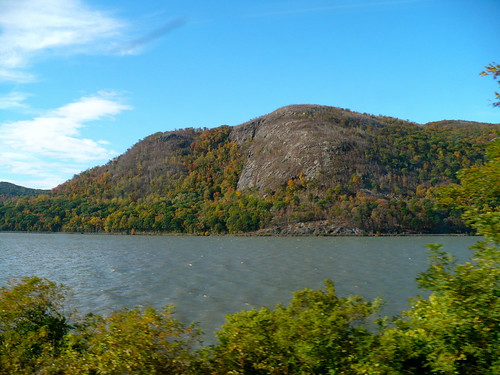
Take the Metro North from Grand Central Station in NYC. The view from the train window, the Hudson River:
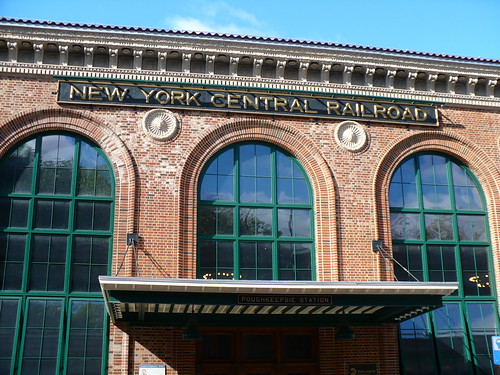
Get off at the train station in Poughkeepsie (last stop on the Hudson line):
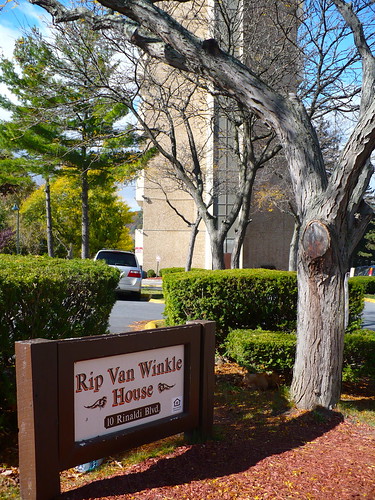
Walk south, paying attention to what some of the buildings are called. (Washington Irving is a major literary figure in these parts.)
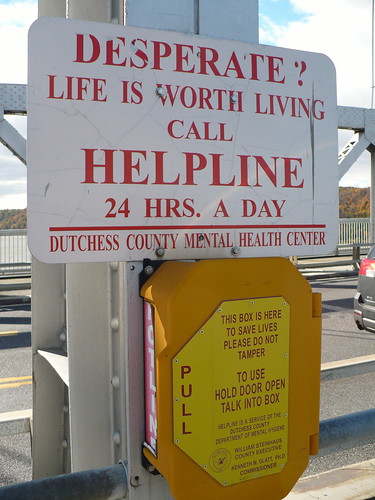
Cross the Mid-Hudson Bridge on foot (this isn't the famous pedestrian bridge in the area, but it has a footpath, so you can share the bridge with motor vehicle traffic).
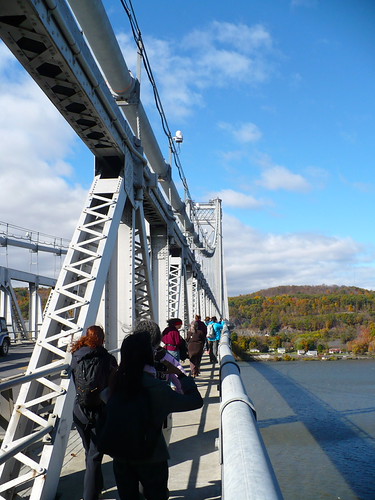
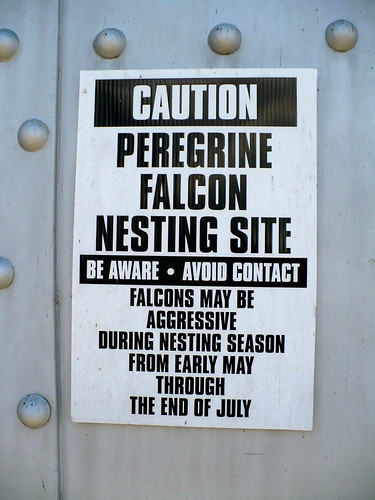
Look at different signs on the bridge.
Then look north along the Hudson.
Because that other bridge you see? That's the Walkway Over the Hudson. It's the longest elevated pedestrian bridge in the world, and it's where you'll be ending your hike.
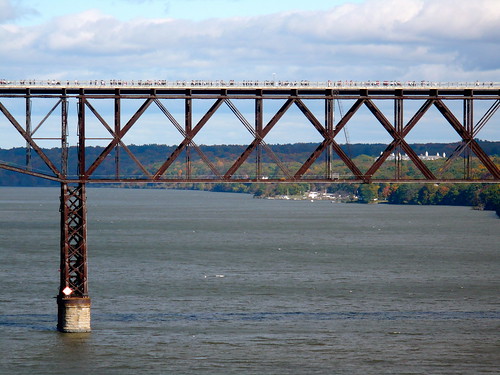
Fall foliage is stunning.

Take the Metro North from Grand Central Station in NYC. The view from the train window, the Hudson River:
Get off at the train station in Poughkeepsie (last stop on the Hudson line):
Walk south, paying attention to what some of the buildings are called. (Washington Irving is a major literary figure in these parts.)
Cross the Mid-Hudson Bridge on foot (this isn't the famous pedestrian bridge in the area, but it has a footpath, so you can share the bridge with motor vehicle traffic).
Look at different signs on the bridge.
Then look north along the Hudson.
Because that other bridge you see? That's the Walkway Over the Hudson. It's the longest elevated pedestrian bridge in the world, and it's where you'll be ending your hike.
Fall foliage is stunning.
Subscribe to:
Posts (Atom)